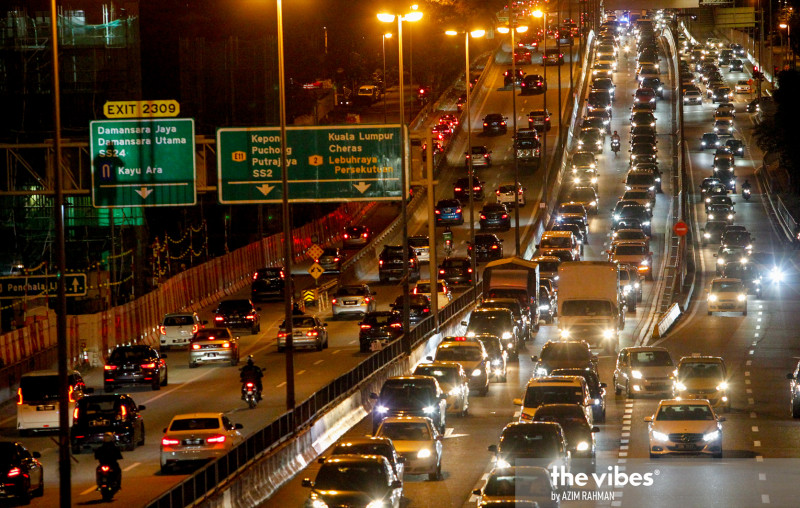
FOR a daily commuter from Seremban to the heart of Kuala Lumpur, traffic congestion has become more than just a daily inconvenience — it is a drain on time, finances, and mental well-being.
“Although the distance isn’t particularly far, the time spent in the vehicle stretches much longer due to unpredictable traffic congestion,” the person shared. “It has become routine for me to leave the house at around 6.30am, only to end up trapped in gridlock, especially when the weather turns rainy or uncertain.”
Covering approximately 65 kilometres via the Sungai Besi toll — a key gateway into the capital — the journey takes around 50 minutes under normal conditions, but can easily stretch to two hours during peak periods.
Driving a sport utility vehicle (SUV) may offer comfort on long journeys, but it comes at a steep cost. Monthly fuel and toll expenses now range from RM700 to RM900 for the Seremban–Kuala Lumpur route.
The writer suspects that erratic weather plays a role in worsening the congestion: “My hypothesis is that uncertain weather leads many road users to opt for cars instead of motorcycles to avoid getting soaked.”
This daily crawl has become a mirror for the broader commuting struggle faced by thousands. “You can see the weary faces of others stuck in traffic, as if silently sharing the same exhaustion,” the commuter told Harian Metro today.
Despite leaving as early as dawn to avoid the infamous ‘gila jam’ that can turn a commute into a two- to three-hour ordeal, the writer admits there is no escaping the tide of vehicles: “No matter how early I set out, I still get caught in that sea of cars.”
Sometimes, moments of stillness at traffic lights offer a chance for fleeting creativity. “I’ve drafted news stories in my phone’s notes app while waiting at long red lights,” the writer recalls. “Creativity often arrives when the car doesn’t move.”
But over time, the cost of traffic is not just measured in minutes or money. “Traffic jams don’t just waste time – they gradually wear down the mind. Imagine spending two to three hours daily, five days a week, sitting in traffic. That’s nearly 20 to 30 hours weekly, inhaling exhaust fumes and dodging impatient drivers.”
It is, the writer argues, equivalent to a part-time job. “It’s no wonder some drivers have short tempers — the pressure of extreme congestion slowly chips away at our mental strength.” - July 19, 2025