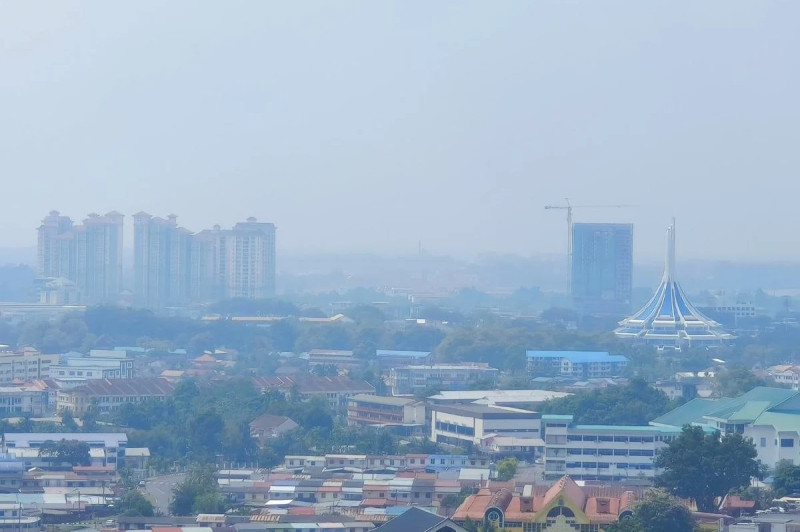
FIVE locations in Sarawak recorded hazardous air pollution levels above 300 yesterday, as smoke from fires in Kalimantan continued to drift into the state and meteorological authorities warned that the haze could persist for at least another week.
Data from the Department of Environment’s Air Pollutant Index Management System (APIMS) showed Serian recording the highest Air Pollutant Index (API) reading at 374 as of 6pm, followed by Kuching at 346, Sarikei at 333, Sibu at 323 and Samarahan at 318.
Four other locations in Sarawak recorded very unhealthy readings, with Sri Aman at 295, Bintulu at 247, Mukah at 241 and Samalaju at 226.
Four locations recorded unhealthy readings, namely ILP Miri at 191, Miri at 186, Kapit at 185 and Limbang at 173.
In Sabah, six locations also recorded unhealthy air quality, with Kota Kinabalu at 177, Labuan at 171, Kimanis and Keningau at 165 each, Politeknik Kota Kinabalu at 161 and Tawau at 154.
In Peninsular Malaysia, Johan Setia in Selangor was the only location recording an unhealthy reading, at 157.
The worsening haze has also raised concerns over the potential health impact of prolonged exposure to fine particulate matter, particularly among vulnerable groups such as pregnant women.
Public health medicine specialist at Universiti Kebangsaan Malaysia’s Faculty of Medicine, Prof Dr Sharifa Ezat Wan Puteh told Utusan Malaysia that prolonged exposure to haze could increase the risk of miscarriage and pregnancy complications, including low birth weight and birth defects.
She said human and animal studies had shown a biologically plausible association between air pollution and an increased incidence of spontaneous miscarriage.
According to Sharifa Ezat, air pollution could reduce blood vessel formation in the placenta, while pregnant women were more vulnerable to its effects and should minimise exposure to haze to protect their health and that of their unborn children.
“Particles measuring less than 2.5 micrometres can reach the alveoli of the lungs before entering the bloodstream and crossing the placental barrier.
“This could potentially disrupt foetal growth through mechanisms involving inflammation, oxidative stress and vascular damage,” she said.
She added the threat posed by haze extended beyond pregnant women and unborn babies, with prolonged exposure to PM2.5 linked to an increased risk of stroke of up to 30 per cent.
Exposure to fine particles could also increase the likelihood of developing high blood pressure by between five and 10 per cent, while hospital admissions for heart failure could rise by between 10 and 20 per cent.
Long-term exposure to PM2.5 and PM10, nitrogen dioxide and ozone can cause progressive inflammation of the respiratory tract, reduced lung function and chronic bronchitis.
The risks could increase by between five and 30 per cent depending on pollutant concentrations and the duration of exposure, while prolonged exposure could also trigger asthma attacks, contribute to the development of chronic obstructive pulmonary disease and increase respiratory infections.
Meanwhile, residents in Sarawak are expected to face hazy conditions for at least another week as long as fires in Kalimantan remain uncontrolled and south-westerly winds continue carrying smoke towards the state.
The Malaysian Meteorological Department (METMalaysia) said rainfall could temporarily improve conditions in Malaysia but would not resolve the haze unless widespread rain reached the areas affected by fires in Kalimantan.
METMalaysia Deputy Director-General of Operations Ambun Dindang said the persistence of the haze was largely dependent on two factors — the fires and prevailing wind direction.
“The source of the fires is known to be linked to the Southwest Monsoon, which is characterised by dry, hot conditions and limited rainfall.
“These conditions are expected to continue throughout September,” he said on Monday.
Ambun said the possibility of a Super El Niño developing in October was another factor requiring close monitoring.
He said El Niño had already begun in June and was expected to strengthen between October and December, potentially reaching a very strong level.
The weather conditions have also coincided with a significant number of hotspots detected across Borneo.
Ambun said 1,738 hotspots were recorded across southern and western Borneo on Aug 28, although the figure subsequently fell to 261 in West Kalimantan.
Despite the decline, he said smoke from the remaining fires continued to be carried by south-westerly winds towards western and southern Sarawak.
He said widespread rainfall was needed in the affected areas to tackle the source of the haze.
“Throughout September, winds are expected to continue blowing consistently from the southwest, from the direction of the affected fire areas.
“What we hope for is widespread rainfall, particularly in western and southern Kalimantan, so that the haze originating from those areas can be reduced,” he said.
Meanwhile, Ambun said cloud-seeding operations scheduled from Sept 3 to 5 would focus on Sarawak and northern Peninsular Malaysia.
“We will try to increase water levels by conducting cloud-seeding operations using the wet seeding method during that period,” he said.
METMalaysia’s assessment suggests Sarawak’s haze could persist throughout September, particularly if dry conditions and south-westerly winds continue while fires in Kalimantan remain active. - September 2, 2026