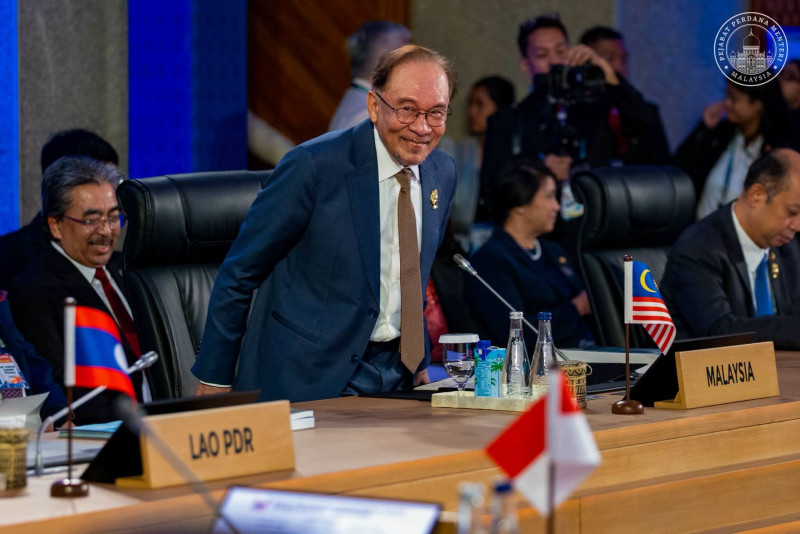
ASEAN must reduce its dependence on fragmented national energy systems and vulnerable global supply chains by accelerating regional integration and strengthening collective self-reliance, says Prime Minister Datuk Seri Anwar Ibrahim.
He said the region faced growing geopolitical and economic uncertainties that required stronger cooperation in energy, food and medicine security to protect its strategic interests and economic resilience.
Addressing the 49th ASEAN Summit plenary session in Manila today, Anwar said regional energy demand was projected to increase more than fourfold by 2060, making the acceleration of the ASEAN Power Grid (APG) increasingly urgent.
"With regional energy demand expected to increase up to fourfold by 2060, national energy grids can no longer operate in isolation," he said.
He said expediting the APG would turn individual countries' vulnerabilities into collective strengths while enabling cross-border sharing of renewable electricity and ensuring affordable, reliable and sustainable energy supplies.
Anwar also called for greater commitment to the Treaty of Amity and Cooperation in Southeast Asia (TAC), saying ASEAN must remain a platform for cooperation rather than competition among major powers.
On economic resilience, he said recent global disruptions had exposed structural weaknesses caused by excessive dependence on limited sources of essential supplies.
He urged member states to diversify critical supply sources, expand intra-ASEAN trade and deepen regional production networks, particularly in food and medicines.
"This need is most urgent in the food and medicine sectors, which are basic necessities that people cannot do without. Efforts to strengthen regional food security must begin with supplies of fertilisers, seeds and animal feed, much of which is sourced from outside the region," he said.
He said ASEAN should strengthen supply chain resilience by ensuring essential food supplies and agricultural inputs continued to flow through trusted green lanes during crises.
The bloc should also optimise collective regional reserves, including the ASEAN Plus Three Emergency Rice Reserve, to improve its ability to respond to supply disruptions.
Drawing lessons from the Covid-19 pandemic, Anwar warned that climate change and environmental degradation could increase the risk of future pandemics.
He said ASEAN should improve access to medicines through mutual recognition of regulatory approvals, pooled procurement and stockpiling, alongside stronger regional manufacturing capabilities for essential medicines and vaccines.
Anwar also called for expanded cooperation in the digital economy, artificial intelligence governance, science diplomacy and biodiversity conservation, as well as stronger efforts to address transboundary haze.
He said ASEAN's approach to major powers should remain balanced and constructive, guided by unity, centrality and strategic autonomy.
He also cited the ASEAN Community Vision 2045 as a framework for deepening economic integration and ensuring that the benefits of regional development reached all people. - November 15, 2026