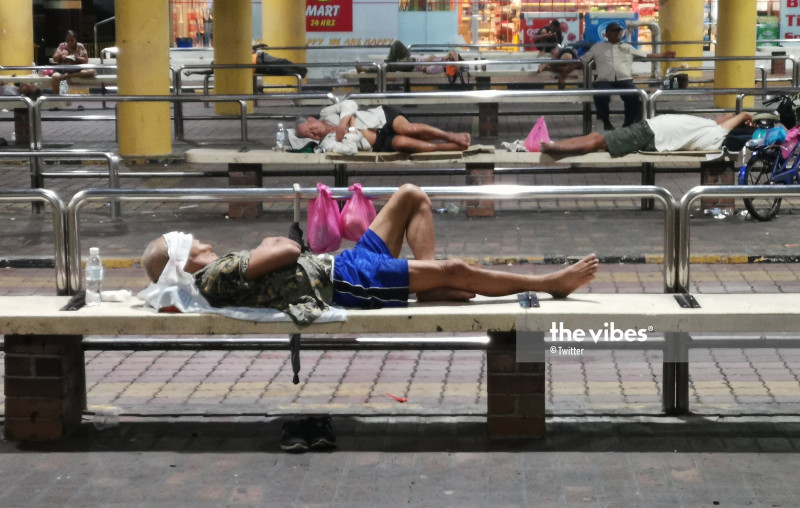
GEORGE TOWN – Life is definitely full of ups and downs – and no one knows this more than those who are down and out. Once teachers and lawyers, they now roam the streets of Penang, hungry and without a roof over their heads.
As the plight of the homeless takes centre stage during the Covid-19 crisis, so do the pleas for better shelters and facilities to help this disadvantaged group.
Penang Hindu Association president P. Murugiah said that it was astounding to find out that those whom they were providing food and shelter to were former professionals including teachers and lawyers.
“One of them who was homeless was an ex-teacher of the Penang Free School,” he said. “When we found him a home, we received calls from his ex-students, who were horrified to discover that their master was roaming the streets alone.”
Murugiah told The Vibes that at times, the homeless were people who wanted freedom instead of being cooped up in their homes or confined to an old folks’ home where their movement and access to recreation such as watching television was limited.
This was corroborated by Kechara Soup Kitchen programme director Patsy Gooi. “The homeless are aged between 45 and 65. There are many who prefer to be homeless because of family disputes and abandonment by their families,” said the non-governmental organisation representative.
Earlier today, the Penang Island City Council (MBPP) announced that construction on the first RM4.4 million transit centre for the homeless in Jalan Magazine is set to be completed by October.
MBPP Mayor Datuk Yew Tung Seang told the Malay Mail online that the building was also the first of its kind in the state to achieve the “triple net-zero energy, water and waste” status.
A triple net-zero building means that all energy sources are fully renewable, that the water comes from a rainwater-harvesting system, and that zero waste is generated.
Yew said the building will be 100% solar powered, and that the aim was for the building to achieve the Green Building Index (GBI) platinum status, making it a truly environmentally friendly structure with a low carbon footprint.
He added that the centre will have two dormitories segregated by gender on the second floor. There will be 18 single beds for women and 50 single beds for men for a total of 88 bunks, where both categories will have six dedicated beds each for the physically challenged.
In response to this, Murugiah said: “We are appreciative of the MBPP building the transit centre for the homeless – but their focus should be on senior citizens as there is an acute shortage of affordable facilities for the aged.”
He called upon the MBPP to build more affordable old folks’ homes, with emphasis on proper living conditions and open spaces so that the residents will be happy and do not end up running away.
“The beds must be evenly spread out. There should be a garden for recreational activities, as well as sufficient internet access. Last but not least, there must be trained staff and classes to keep them occupied – otherwise, they might make a run for it,” Murugiah said.
In 2012, the Penang Institute think tank estimated that the number homeless in the whole state to be 288. That number has since dwindled to 160, with at least about 80 of them loitering around the state’s capital and Komtar.
State Welfare Committee chairperson Phee Boon Poh said that the state planned to have at least 100 senior citizen homes soon, out of the estimated 80 available now.
“But to build more requires capital expenditure. The private sector should help,” he said, adding that it was regretful that some of the young have forsaken their responsibility to care for the old. – The Vibes, February 17, 2021