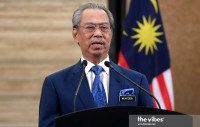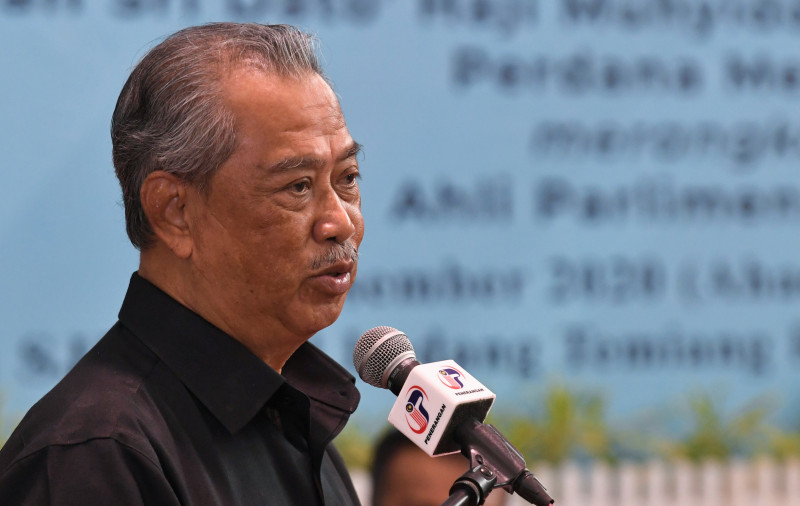
KUALA LUMPUR – Prime Minister Tan Sri Muhyiddin Yassin today called on vaccine-producing countries to avoid stockpiling and share their supply with nations in need, as negotiations are taking up precious time.
Vaccine nationalism and stockpiling are counterproductive to efforts to increase the global Covid-19 immunisation rate and clear the path for recovery across economies, he said.
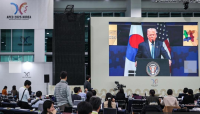
He urged Asia-Pacific Economic Cooperation (Apec) members to strengthen collaboration towards equitable, affordable and accessible Covid-19 vaccines for all.
“We have seen that there is a correlation between the success of vaccination programmes or an increased inoculation rate and the ability to speed up economic recovery.
“With the spread of highly transmissible new variants, Covid-19 vaccines are a lifeline for our peoples,” he said in his intervention during the Apec Informal Leaders’ Retreat held virtually today.
Intergovernmental economies must ensure that the stark global vaccination gap is not a hurdle to attaining herd immunity, and must act sensibly to ensure that no economy is left at the end of the vaccine line, he said.
“In this spirit, while underscoring the importance of preserving incentives for innovation, Malaysia supports global initiatives to boost global vaccine capacities, including through negotiations at the World Trade Organisation on the temporary waiver of certain provisions of the Trade-Related Aspects of Intellectual Property Rights Agreement.
“This is a step in the right direction, because extraordinary circumstances call for extraordinary measures.”
While it is comforting to witness the return to a certain level of normalcy in some economies, he said, many economies are still grappling to regain stability.
“This divergent fate is a cause for concern. The reality is, in a globalised world, we are all interdependent and interconnected, and this necessitates us to take immediate and steadfast actions collectively.”
Muhyiddin said the pandemic has greatly impacted people-to-people connectivity, including cross-border travel, which is now regarded as a high-risk activity.
“Some might say this is the crux of the problem. Reopening our borders in this pandemic era is precarious, requiring extremely careful planning and a high level of confidence from all parties.”
Nevertheless, he applauded his Japanese counterpart Yoshihide Suga and the Tokyo administration for organising the Olympic Games, which will start next week.
This is a testament to how cross-border travel can be undertaken, under stringent measures and in a controlled environment, he said.
Here lies the opportunity for Apec to find a middle ground to revive the tourism industry and people-to-people connectivity in the region, in a safe and trusted environment, he added.
“I call on Apec economies to discuss potential regulatory coherence on the establishment of travel bubbles and quarantine arrangements, or the mutual recognition of vaccination certification documents, without undermining the global requirements set out by the International Civil Aviation Organisation and World Health Organisation.
“When the time is right, all these practical solutions will be the answer to facilitating seamless people-to-people connectivity in the region.” – Bernama, July 16, 2021