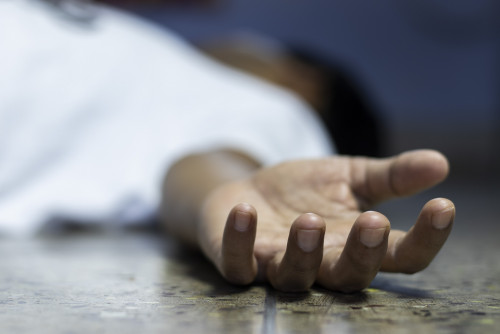
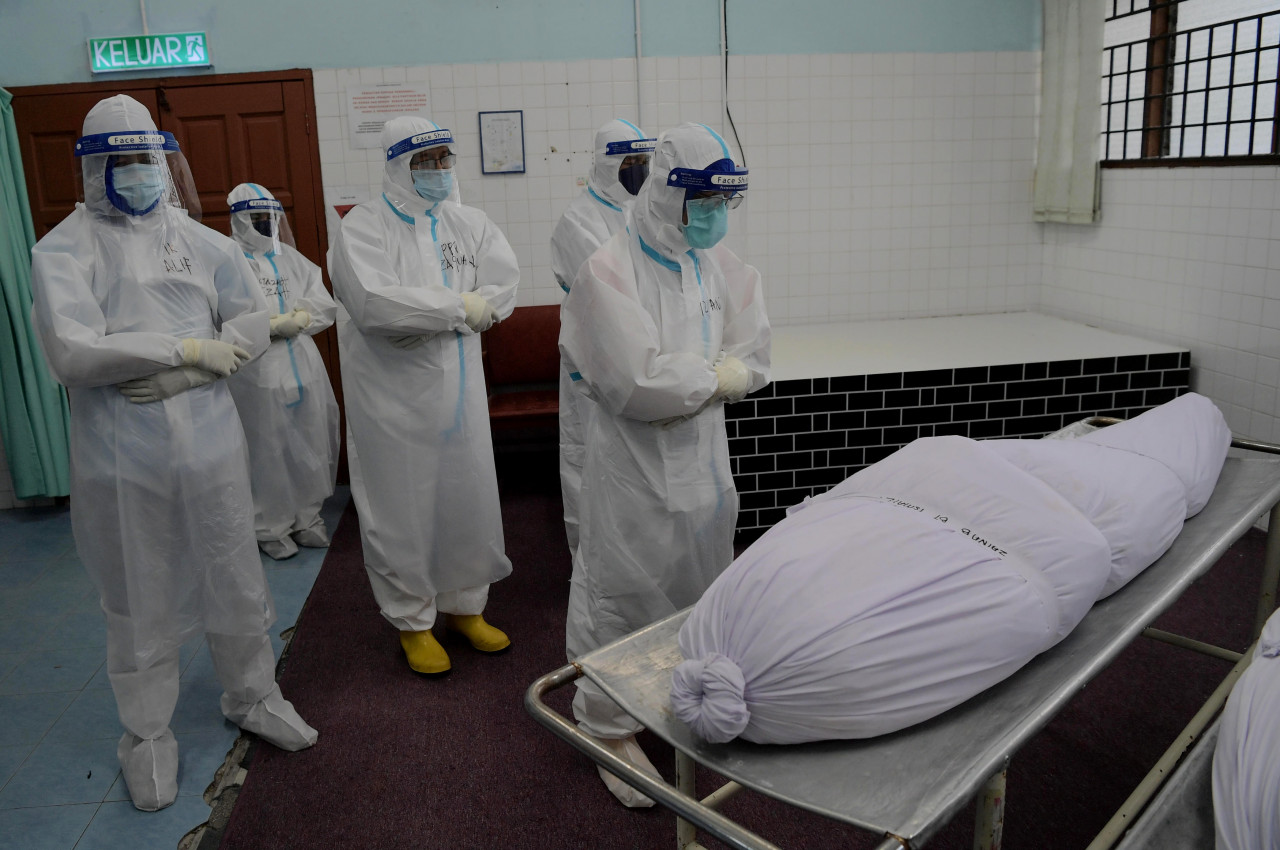
JOHOR BARU – A melancholic atmosphere pervades the premises of the Forensic Medicine Department at Sultanah Aminah Hospital (HSA) for it is the final transit point for the remains of patients who die of Covid-19.
Dressed in full protective gear, staff assigned to the management of the corpses concerned carry out their tasks solemnly and meticulously before the remains are transported for burial or cremation purposes.
Said Mohd Afiq Ngah, an assistant medical officer at HSA’s Forensic Medicine Department, said: “It’s an absolutely heartbreaking and sad sight… the deceased’s family members are not allowed to pay their last respects or see them (up-close) for the last time.”
According to the Health Ministry’s (MoH) guidelines for the handling of dead bodies of suspected/probable/confirmed Covid-19 cases, family members and relatives are strictly forbidden from touching or kissing the body. Only one family member or relative is allowed to view the body for identification and the person must stand at a distance of at least 1m from the body.
Said said since deaths due to Covid-19 are occurring every day, the bodies have to be managed swiftly to reduce the risk of transmission of the deadly coronavirus.
Reducing exposure vital to avoiding infection
Said, 31, who is also chief supervisor at the department, said the staff involved in the management of the bodies of Covid-19 victims have to be well-prepared, both physically and mentally, as they are exposed to the risk of infection.
“In theory, the longer one is exposed to the source of infection, the higher one’s risk of getting infected. Therefore, we can reduce our exposure by speeding up the management (of the corpses). Another thing is that our department has limited space to keep the bodies, so we have to work fast to create space for other fatality cases,” he told Bernama in an interview recently.
Although there is no concrete evidence of how long the Covid-19 virus can persist in human corpses, healthcare staff must comply with MoH’s guidelines on the management of bodies of Covid-19 victims.
“There is still no final word on the infectivity and survival of the Covid-19 virus in a dead body. But we do know that the virus can survive on certain surfaces. Hence, we should just assume the virus is there and can infect others. We’ve to prioritise our lives and the safety of frontliners,” he added.
Said is thankful that his department has not recorded any case of infection among the staff handling the bodies of Covid-19 fatalities. This can be attributed to their practice of self-hygiene as all of them take a bath and change their clothes before returning home after work, as well as complying with the necessary standard operating procedures (SOPs).
“We are all fully vaccinated but still (we are worried) we may touch a (contaminated) surface somewhere. We worry about this always because some of us have family members who are not inoculated yet,” he said.
Risk of infection persists after death
Said said that although they are all required to wear personal protective equipment (PPE) when managing the corpses, it cannot entirely eliminate the risk of infection, more so if precautionary measures are not taken when wearing and removing the PPE, as well as proper disposal.
“Used PPE has to be disposed of as clinical waste,” he said, adding that all equipment such as the trolleys to transport bodies are disinfected regularly to reduce the risk of infection.
As Said and his colleagues go about discharging their duties to the best of their abilities, deep in their hearts they weep for the families of the victims whose lives were snatched by the dreaded Covid-19 virus.
“When it comes to the process of identifying the body, the family members concerned are not allowed to touch their loved ones or come near the body, as per the SOPs set by MoH.
“We don’t have any fixed rule on how long a family member can view the body but we want the process to be done as fast as possible,” he said.
He said if the family members are undergoing quarantine, the identification is done via a video call.
“For the video call, we would open the body bag for the family to identify… it is so heartbreaking as we can hear the family members sobbing,” he said.
Urging the public to continue adhering to SOPs by wearing a mask, washing their hands frequently, observing physical distancing and avoiding crowded places, Said warned that the effects of Covid-19 are real and deadly.
“In this hospital (HSA), an average of seven deaths due to Covid-19 are recorded daily. The government is encouraging us all to get the Covid-19 vaccine. So get vaccinated so that our nation can attain herd immunity,” he added. – Bernama, July 22, 2021