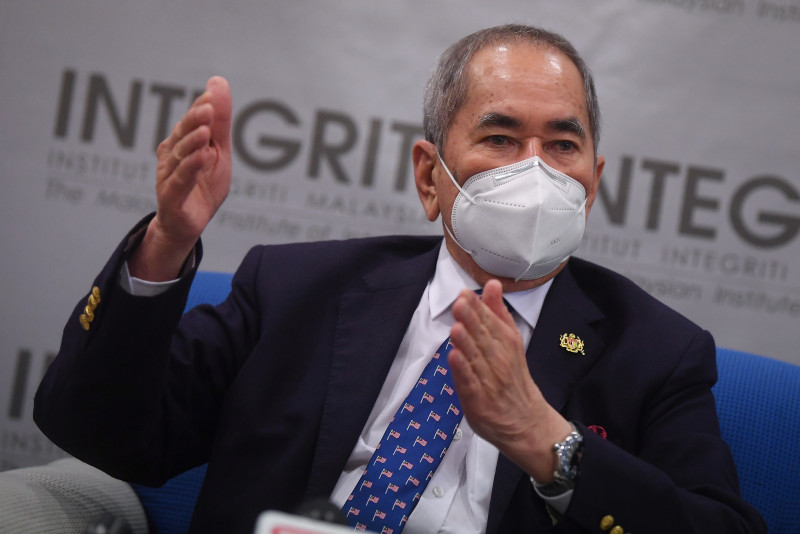
KUALA LUMPUR – Laws relating to whistleblowers under the Whistleblower Protection Act 2010 (Act 711) have to be thoroughly reviewed in an effort to increase national integrity, said Minister in the Prime Minister’s Department (Parliament and Law) Datuk Seri Wan Junaidi Tuanku Jaafar.
Wan Junaidi said existing whistleblower laws were inadequate and needed to be reviewed.
“I’m still reviewing the matter of whistleblowers. Since 2017, I’ve said that whistleblower laws are still lacking and need to be studied carefully. If we’re talking about ourselves, there’s no boss. Whistleblowers are not overseen by anyone.
“It’s placed under my ministry, in the legal affairs division of this ministry, but there’s no one handling it. Consider other countries. In the United States, it’s under a director, and in Australia, an ombudsman. We need to consider the matter and I have asked the division to look into it,” he said in a media conference after witnessing the presentation of the 2021 National Integrity Convention’s resolutions at Menara Integriti yesterday.
He added that a detailed study is needed to ensure that the confidentiality of informants is safeguarded if the complaint involves an agency.
“We could place it under the Enforcement Agency Integrity Commission so that the commission could keep information about any agency confidential. Only then would many people (be whistleblowers).
“So far, there aren’t many whistleblowers because people are not brave enough to lodge reports. If they reported to police, police would investigate and the complainant’s information would be known to police.
“This is why people don’t use this whistleblower act, unless there is an agency to oversee and maintain the confidentiality of the person who lodges a report. So currently it is under review. Insya-Allah we will find a way to improve it,” he added.
Meanwhile, Malaysian Institute of Integrity chief executive officer Nor’afiza Saim said the institute would continue to focus on preventing corruption in organisations as well as increasing integrity in both the public and private sectors through the development of a new system.
“With the mandate given, we will focus on assisting organisations to prevent corruption and misuse of power, with an emphasis on the private sector as the Malaysian Anti-Corruption Commission focuses more on the public sector.
“We currently use the international standard, the Anti-Bribery Management System, but we will develop our own standard, the Integrity Management System. So, Insya-Allah, with this system we can increase integrity within organisations in both the public and private sectors,” she said. – Bernama, November 10, 2021