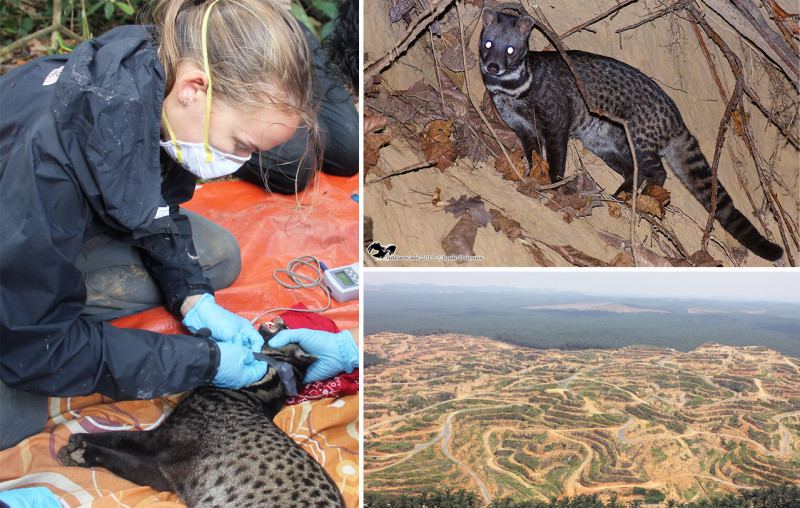
KINABATANGAN – Conservationists conducting research at the floodplains here have discovered traces of metal pollution threatening the survival of local wildlife and related ecosystems.
A scientific study conducted by Danau Girang Field Centre, Sabah Wildlife Department, and Cardiff University at the Kinabatangan floodplains since 2013 on small carnivores in the region found traces of metal in local Malayan civets.
“We went to our lab and quantified the levels of 13 different metals contained in each hair sample, which included contaminants of notable biological concern such as lead, mercury, chromium, and cadmium.”
“Metals, and particularly those commonly referred to as heavy metals, can be dangerous to not just animal, but also human health; biological effects following exposure to different metals range from relatively small issues such as skin irritation to markedly more serious repercussions such as infertility and even death,” said Meaghan Evans, project leader and author of the study.
Evans said Malayan civets as an indicator species would allow the team to identify the extent of metal contamination within the Kinabatangan floodplains.

“This region has been largely converted to oil palm plantations, and there have been no formal evaluations in determining the ecotoxicological repercussions of such large-scale anthropogenic disturbance.
“We found certain metal levels in civet hair were associated with civet age, weight, proximity to tributaries, and access to oxbow lakes,” she said.
Further research, she said, revealed that civets that spent time in oil palm plantations had significant concentrations of aluminium, lead, and cadmium in their hair samples compared with animals that stayed in protected forests.
However, she said, the data does not definitely identify plantations as the explicit source of metals.
“The publication of this groundbreaking research coincides with a press release issued last month by our department.
“In that report, elevated concentrations of cadmium were detected in samples from three dead Bornean elephants (Elephas maximus borneensis).
“Although neither of these studies directly identified the original sources of these metals, both provide irrefutable evidence of animal exposure to inorganic pollutants,” said Sabah Wildlife Department assistant director Mohd Soffian Abu Bakar. – The Vibes, December 8, 2021