KUALA LUMPUR – Personal data will not be uploaded or exposed each time users turn on MySejahtera Trace as it requires explicit consent, said Health Ministry’s (MoH) Dr Mahesh Appannan amid concerns over privacy and “interaction” data.
Mahesh, who is the head of data for the ministry’s Crisis Preparedness and Response Centre, took to Twitter to allay questions on the app’s latest feature.
Biar saya jelaskan 3 perkara yang mungkin anda persoalkan:
— Dr Mahesh Appannan (@maheshappannan) January 2, 2022
1) Mengapa ada "interaction" walaupun saya duduk di rumah sahaja?
2) Adakah MySJ Trace mendedahkan data saya bila ada "interaction"? (langsung tidak)
3) Mengapa masih perlu check-in dengan scan QR?
? https://t.co/P0jyjK65zG
He said MySJ Trace does not upload or expose personal data, as it remains stored on individual mobile phones.
“If you are Covid-19 positive, you will be asked to upload a 14-day history to enable notifications to people categorised as contacts. This needs explicit consent.
“If you’re negative for Covid-19, your data will not be uploaded, instead it will be erased after 14 days.
Without explicit consent, the interaction data kept in your phone will not be shared. This method is similarly used in the UK and Singapore.”
He also refuted a comment saying that when a Bluetooth signal is detected, there has to be a handshake.
“There is no such handshake or exchange of information when an interaction is recorded (on the phone). For example, it is like a radio. You can hear the radio broadcast, but the broadcaster cannot access your data,” said Mahesh.

Earlier, it was reported that netizens have been bashing the MySJ Trace feature, mostly citing concerns about intrusion of privacy.
Twitter searches found the majority of netizens expressing concerns that their personal data would be hacked if the application’s new function was used, Getaran reported.
Some individuals also expressed dissatisfaction with the MySJ Trace function, as the Bluetooth function must be turned on at all times, which they say is impractical as it drains the phone’s battery life.
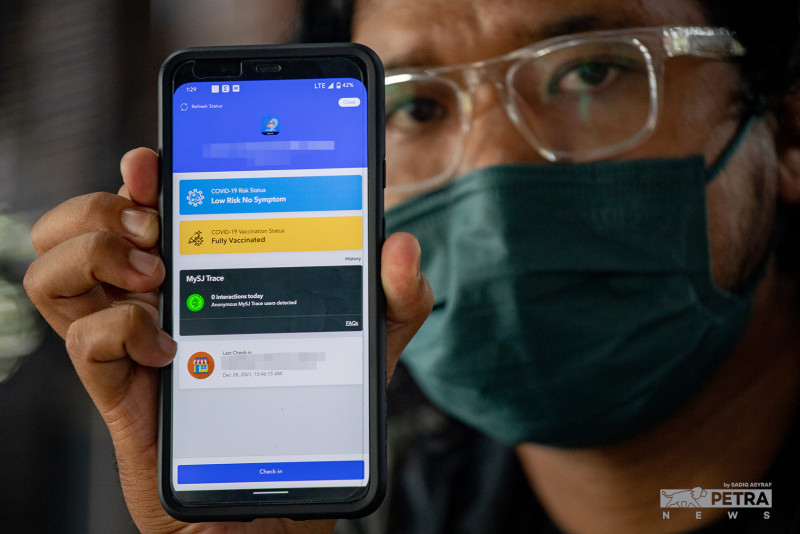
Meanwhile, some users are confused that their MySJ records interactions even though they are alone at home.
Mahesh said this is because the Bluetooth signal can reach a radius of 10m.
“Maybe your phone could detect your neighbour, but this does not mean you are immediately categorised as a close contact.
The algorithm takes into account signal strength. It also explains why your interactions might differ even if husband and wife are out together.
There are many factors that could interfere with the Bluetooth signal, for example, your body, other tools, electronic keys, etc.
“Where your phone is placed is another factor – if you are holding it in your hand or leaving it in your pocket. Those residing in Singapore had asked about this when the app TraceTogether was first introduced there.”
During the rollout of MySJ Trace on December 25, the government said it requires users to activate their Bluetooth function on their mobile devices all the time.
“When an individual has been confirmed as positive, a notification can be obtained through the MySejahtera app to get approval for sharing any close contact information that was detected,” said the statement.
If the individual grants approval, MySejahtera will grant MoH access to conduct risk assessment on any close contact data detected from the Bluetooth.
The MySJ Trace function uses an anonymised Unique User ID and will not collect user data or geo-location. The data can only be accessed by MoH and will be kept in the smart device for 14 days.
“The privacy and secrecy of the database and the entire process of contact tracing is guaranteed by the government.”
Although the government aims to phase out the check-in/check-out function, users are still able to use it, as there are those who do not turn on the MySJ Trace function.
“The combination of MySJ Trace and check-in feature allow automatic contact tracing while generating data for the ministry’s public health teams. During the endemic phase, self-regulation is vital,” he said.
As of 11.59pm January 1, there are 41,034 active Covid-19 cases, with 3,386 logged yesterday. – The Vibes, January 2, 2022