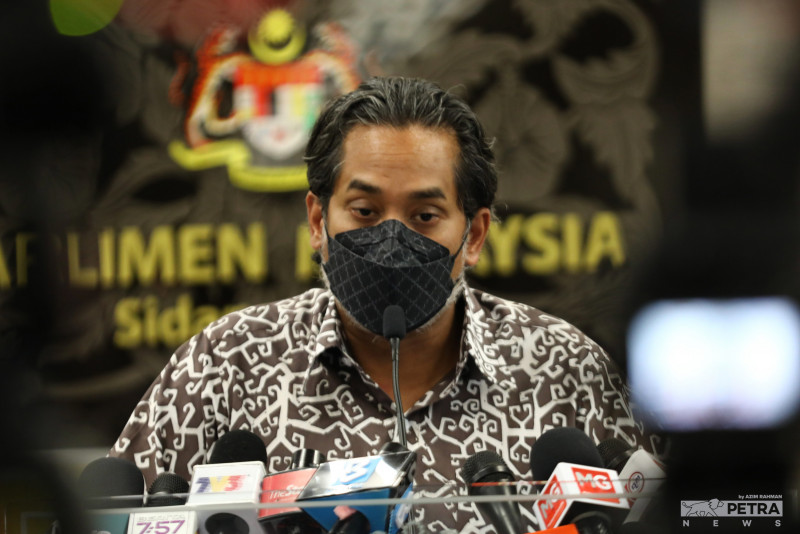
PUTRAJAYA – The Health Ministry can focus on managing the epidemic of non-communicable diseases (NCDs) now that the Covid-19 pandemic has been brought under control, said Health Minister Khairy Jamaluddin.
He said although the Covid-19 pandemic was an emergency in terms of public health, the infection only runs for a while compared with NCDs, which are more long-term in nature.
“If we are infected with Covid-19, we will see the symptoms in three or four days, but if we have NCDs, the symptoms or ill effects may only be seen in the next few years," he said at the launch of the B40 Healthcare Scheme Report (PeKa B40) 2021 here today.
“Covid-19 is a clear and present danger to us but NCDs are like a ticking bomb; they are there, and will explode one day, and when they do (explode), it will be too late as we need to care for or treat it. We cannot take action to prevent NCDs from becoming worse for the people,” he said.
According to Khairy, the National Health and Morbidity Survey (NHMS) 2019 reported that NCDs accounted for 67% of premature deaths.
The NHMS report said one out of five adults or 3.9 million people, aged 18 and above, in Malaysia suffer from diabetes; three out of 10 or 6.4 million people have high blood pressure; and four out of 10 people or eight million people suffer from high cholesterol, he said.
Therefore, Khairy said regular health screenings can detect NCDs earlier, and intervention and treatment can then be given before they become more serious or severe.
He said the PeKa B40 scheme, a government initiative under the ministry and run by ProtectHealth Corporation Sdn Bhd, was aimed at addressing the growing burden of NCDs, especially among the B40 group.
From its introduction in 2019 until March 31 this year, PeKa B40 has screened 582,746 people.
The main focus of the initiative is early prevention strategies through four health benefits offered, namely free health screening, medical device assistance, incentives to complete cancer treatments, and transportation incentives, he said.
“Most of them (who were screened) did not know that they were suffering from a disease or chronic illness that could be treated through the ministry. Of those screened, 186,610 people were detected to have at least one NCD.
“This (matter) is very worrying because many who are eligible for the PeKa B40 do not come forward for health screenings and do not know their health status,” he added.
Meanwhile, ProtectHealth Corporation Sdn Bhd chief executive officer Datuk Dr Anas Alam Faizli said the three highest NCDs in the B40 group are high blood pressure, cholesterol, and diabetes.
He noted that from 2019 to December 31, 2021, a total of 30,864 applications for medical device assistance were approved for surgical and non-surgical equipment.
“Intraocular lenses saw the highest applications at 41.7% of the total applications, followed by hearing aids at 22.5% and cardiac stents at 6.7%,” he said.
Dr Anas said that cancer treatment incentives saw 4,721 applications approved in 2021.
He said the top three types of cancer detected throughout 2021 were breast cancer, followed by digestive system cancer, and ear, nose, and throat cancer. – Bernama, April 28, 2022c
















.jpeg)