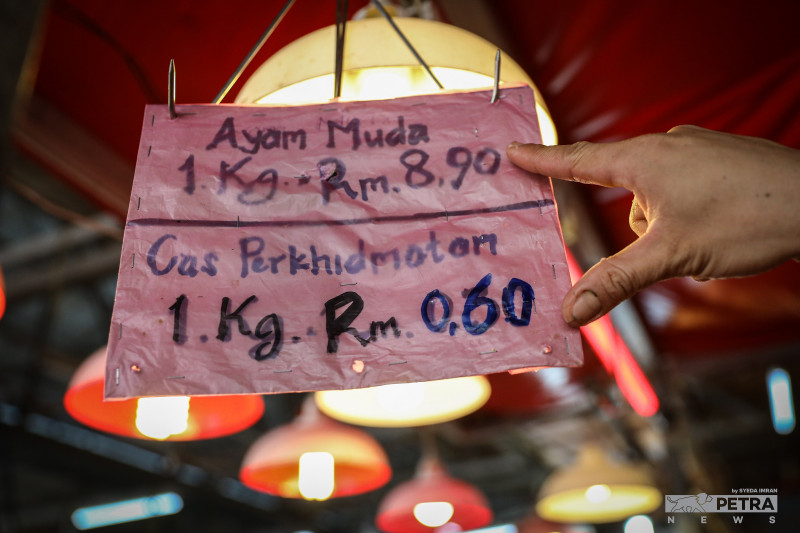
KUALA LUMPUR – Prices of food and other essential items, which reportedly have shot up by 60%, are raising concern as the effects are not only being felt by B40 householders but also people in the middle-income category – especially those living in the bigger cities.
Paying more for food and basic necessities has translated to higher household spending and dwindling savings.
In fact, observers expect consumers’ purchasing power to continue to decline in the coming months based on last month’s consumer price index (CPI) or inflation rate.
They are also urging the government to create an effective mechanism to address the rising prices as well as shortages in the supply of certain food items.
According to the Statistics Department, the CPI for April 2022 rose by 2.3% to 125.9%, compared to 123.1% in the same month a year earlier.
The department’s chief statistician Datuk Seri Mohd Uzir Mahidin was quoted as saying that food inflation rose by 4.1% in April 2022 with 89.1% of items in the food and beverage group recording increases.
May become critical
Putra Business School economic analyst Ahmed Razman Abdul Latiff said the price hike became evident after the nation’s economic sectors and international borders reopened fully and caused an imbalance in demand and supply.
“Prices started to go up at that time due to disruptions in the food supply chain. Besides that, many people and business owners had also received cash aid via the government’s fiscal stimulus packages, which left them with excess cash to spend.
“This created a situation where demand exceeded supply, thus causing prices of goods to escalate. The situation was worsened by the Russia-Ukraine conflict as well as the global weather factor which led to declining agricultural yields, forcing some exporting nations to limit their food exports to ensure sufficient supplies for domestic consumption,” he said.
If no effective short-term and long-term measures are drawn up by the government to address the rising prices and supply hiccups, the current food crisis may grow critical, Razman warned.
He also urged the government to reconsider the implementation of targeted subsidies because, according to him, there is no guarantee that they would keep the prices of goods low.
This is because the higher-income group will still have to pay the market prices for the goods concerned – as a result of which, there will continue to be a hike in overall prices.
“The government may not be able to cover the cost of providing the subsidies because this year’s total subsidies are expected to increase to RM28 billion, which is higher than the total annual collection from the sales and service tax (SST),” he said.
Razman said the government has to devise an effective mechanism for the medium and long term to ensure food prices remain affordable, in addition to the initiatives it has already introduced such as abolishing approved permits (APs) to import food, stopping chicken exports and reducing the nation’s dependence on food imports.
Huge impact
While agreeing that abolishing the APs and putting a halt to chicken exports will help to check the price and supply crises, Razman, however, opined that such initiatives are not suitable for implementation over the long term.
“Those are merely short-term measures. The government should quickly work on implementing medium-term and long-term measures… it can, for example, implement all the action plans outlined in the National Agrofood Policy 2.0 as soon as possible.
“It should also, at the same time, ensure that the food supply chain is fully monitored to prevent certain parties from taking advantage (of the situation). And all problems raised by those in the food industry should also be looked into,” he added.
Universiti Putra Malaysia Faculty of Human Ecology dean Prof Mohamad Fazli Sabri, meanwhile, said any increase in the price of goods, even in small amounts, will have a substantial impact on household spending because incomes have not changed.
He said previously one could buy an average of three to four chickens for RM50 but these days, only two chickens can be bought for the same amount.
From M40 to B40
Describing the rising prices as a never-ending story, Fazli also said the government should draw up a comprehensive mechanism to alleviate the burden of the people who are increasingly pressured by the rising cost of living.
“Before this, many people were affected by the Covid-19 pandemic as the economic sector couldn’t operate fully for over two years. Now that it has reopened fully, various issues have emerged, including the hike in food prices.
“We don’t want such issues to prolong because it may result in more people from the M40 group slipping into the B40 category as was the case during the (height of the) pandemic,” he said.
According to the government’s Household Income Estimates and Incidence of Poverty Report Malaysia, 2020, 12.8% of T20 households and 20% of M40 households have shifted to the low-income category.
Its data showed that 600,000 to one million M40 households have shifted to the B40 group as a result of retrenchment exercises and pay cuts.
Food rationing
Universiti Malaysia Terengganu Faculty of Business, Economics and Social Development lecturer Associate Prof Roshaiza Taha said it would not surprise her if some B40 families have taken to practising food rationing – a situation that should not be happening in Malaysia.
In fact, she added, the current situation may also compel some households to sacrifice some of the food items they have been enjoying all these years.
“The food issue is critical because not only have prices gone up sharply but supplies too have been insufficient to meet the demand,” she said.
She also said the time has come for relevant bodies such as the Federal Agricultural Marketing Authority, Malaysian Agricultural Research and Development Institute, Agriculture Department, and Fisheries Department to devise strategies to reduce the nation’s dependence on food imports.
“I believe these agencies have been given huge allocations to do research on sustainable food resources. It’s time for the government to evaluate the findings of their studies, especially research related to food resources.
“The government should also review the implementation of unnecessary development projects and, instead, focus on the food industry as done by developed countries to ensure adequate food supplies,” she said.
The Agriculture and Food Industries Ministry recently said it is committed to stepping up local agricultural output to reduce the nation’s dependence on imports as well as to ensure adequate food supplies. – Bernama, May 31, 2022