By Murray Hunter
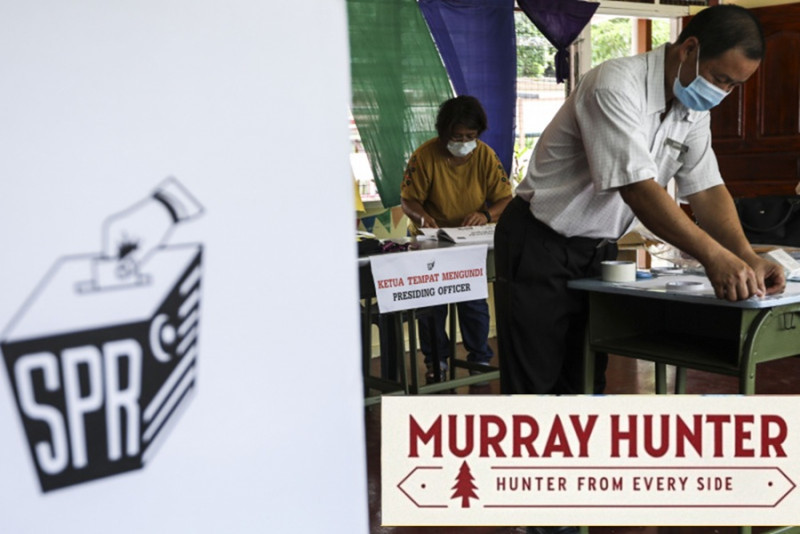
VOTER turnout is a crucial issue in all Malaysian elections. It is a rough measure of the Rakyat’s support of the political process and level of passion for political parties, policies and the politicians themselves.
Voter turnout is even more crucial in Malaysia because citizen voting in elections is not compulsory.
It is completely up to people as to whether they decide to come out and vote or not.
This means political parties must work extra hard to get their supporters out to enable them win enough seats to form or participate in the government of the day.
For example, the aggregate voter turnout of 84.8% in GE13 back in 2013 indicated intense political competition.
The 82.3% aggregate turnout in GE14 back in 2018 was driven by a strong public interest for change.
The lower turnout of 74.1% in GE15 in 2022 led to a hung parliament due to a lack of passion by voters to turnout to vote.
Lower voter turnouts indicate possible voter fatigue of politics which is often seen in state and byelections.
However, voter turnout figures don’t follow objective trends.
Back in 2008, there was only a 75.92% aggregate voter turnout, but commentators at the time described the result as a ‘tsunami’ against the then federal Barisan Nasional government.
Likewise, the low 73.9% voter turnout of 73.9% in 2004 was described as an overwhelming vote in support of then prime minister Tun Abdullah Ahmad Badawi.
What is crucial for the winner of individual seats is that they can muster their supporters out to push them across the line and win more votes than the other candidates to win.
In GE16, the election will be won that way on a seat-by-seat basis. Whichever candidates can inspire the Rakyat to come out and support them will win.
Thus, in the coming election voter turnout in each seat will be crucial. This will be influenced by a number of factors including overall party support, candidate support, and beliefs in what the standing candidates can do for their respective communities.
These factors will influence tight races across the nation.
Traditionally, the long-established parties and their grassroot infrastructures at seat level will be very important in GE16 and play a role in how parties group together to stand as coalitions.
PAS, UMNO, and the DAP have a great advantage in their traditional regions of support.
So, what about GE16?
Because the current government is a mixture of different parties making up the Madani coalition, aggregate voter turnout will not indicate very much.
The days when the civil service and military were vote banks for one particular party are gone. These so-called ‘vote banks’ are now very fragmented.
Gen Z is another group that wont fall behind any grouping. There appears to be a high level of political apathy within this grouping.
High vote turnouts in rural areas will be expected to favour PAS, while high voter turnout in urban areas will be expected to favour Pakatan Harapan.
However, there could be a high level of voter apathy in GE16.
Consequently, standard electoral campaigning will not be expected to change voters’ attitudes very much.
Therefore, a key strategy in winning seats will be within the grassroots seat committees at seat level.
The winners will be the parties who can pick up transport voters to the election booths to vote. Local campaign groups will be much more gainfully employed in mustering voters to come out and vote, and in many cases, this will mean providing transport.
This is where campaign committees must place their resources. This is where parties will pick up seats.
Ceramahs will be much less important in GE16, the money will be best spent in hiring buses and cars to get voters to the voting booths.
This will also require skillful convincing hence team training will be the key.
Driving voters to booths to vote on the general election day, and pre-election voting will be the key.
Such a strategy will favour the parties that put a major effort into ferrying voters to vote.
This could change expected outcomes in the coming GE16. – April 20, 2026
The observations reflect the writer's personal insights and do not necessarily represent the official stance of The Vibes.com