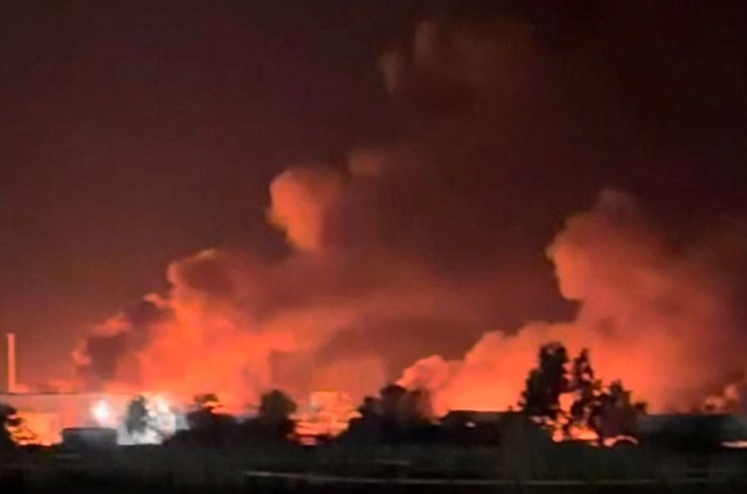
THE United States launched a fresh series of airstrikes against Iran early on Thursday, prompting Tehran to retaliate with missile and drone attacks targeting US-aligned countries across the Gulf, further jeopardising a fragile ceasefire intended to pave the way for a permanent end to the Middle East conflict.
The latest exchange marked one of the most significant escalations since the interim truce was announced, with air raid sirens sounding repeatedly in Bahrain, where the US Navy's Fifth Fleet is headquartered, while missiles and drones were launched towards Kuwait, Qatar and Jordan, all of which host American military personnel or facilities.
Kuwait's military said it intercepted three ballistic missiles, one cruise missile and 10 drones, adding that one person was injured by falling debris. Bahrain also confirmed it intercepted incoming projectiles, while Jordan said its air defences successfully destroyed all missiles entering its airspace. Iranian state television claimed the Islamic Revolutionary Guard Corps had targeted a US military base in Jordan.
There were no immediate reports of damage in Qatar.
AP cited the US Central Command saying American forces struck approximately 90 military targets across Iran, including missile launchers and airfield infrastructure, in an operation aimed at further reducing Tehran's capability to threaten maritime security in the Strait of Hormuz.
The strategic waterway carries around one-fifth of the world's traded oil and natural gas and remains one of the most critical global energy corridors.
Iranian officials later accused the United States of conducting an airstrike near the country's only nuclear power plant in Bushehr. However, US Central Command made no reference to the facility, stating only that its strikes targeted military objectives.
According to Iran's Health Ministry, two days of US airstrikes have killed at least 14 people and injured another 78, with most casualties reported to be members of the Iranian armed forces.
The renewed military confrontation came hours after US President Donald Trump warned that Iran's recent attacks on commercial vessels in the Strait of Hormuz had effectively ended the interim ceasefire.
"This is in retribution for yesterday's bombing of ships by Iran. If it happens again, it will get much worse!" Trump wrote on social media.
Trump also renewed previous warnings that the United States could target Iran's civilian infrastructure, including electricity and desalination facilities, and seize Kharg Island, the country's principal crude oil export terminal.
Meanwhile, Iran concluded days of national mourning as Supreme Leader Ayatollah Ali Khamenei was laid to rest in his hometown of Mashhad after being killed during the opening phase of the conflict.
Tens of thousands of mourners attended the funeral procession, with crowds carrying Iranian flags and portraits of Khamenei while chanting slogans against the United States and Israel.
For the first time since April, US strikes also reportedly hit transport infrastructure, including railway bridges leading towards Mashhad, according to Iranian state media and the Revolutionary Guard.
Despite the continued hostilities, diplomatic contacts remained active.
Iranian Foreign Minister Abbas Araghchi held telephone discussions with his counterparts from Saudi Arabia, Türkiye and Oman, as well as Pakistan's Army Chief, Field Marshal Asim Munir, reflecting continued regional efforts to prevent a wider conflict and revive negotiations.
Iranian Parliament Speaker Mohammad Bagher Qalibaf warned Washington against further military action.
"America still hasn't learned that bullying and breaking promises are no longer cost-free. Let me put it plainly: If you strike, you'll get hit," he said.
Although President Trump declared the interim ceasefire "over", he said negotiations would still be allowed to proceed, despite expressing scepticism over their prospects.
Formal talks aimed at securing a comprehensive peace agreement are expected to begin following Khamenei's funeral, focusing on the reopening of the Strait of Hormuz and the future of Iran's disputed nuclear programme, the two issues considered central to any lasting settlement. - July 10, 2026