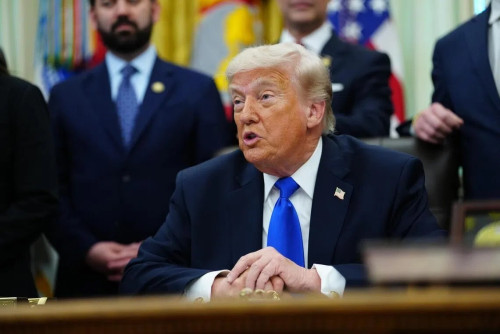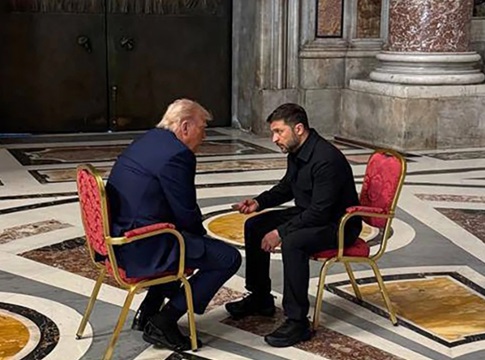
US President Donald Trump has urged Ukraine to settle its war with Russia as his envoy Steve Witkoff prepares to meet Russian President Vladimir Putin on Wednesday, following what Washington described as constructive talks with Ukrainian President Volodymyr Zelenskiy in Norway.
A US official said the Oslo discussions on Tuesday had made “meaningful progress” towards a coordinated approach to engaging Moscow, with Ukraine presenting new ideas and proposals.
Reuters cited that the talks, attended by Norwegian Prime Minister Jonas Gahr Stoere, Finnish President Alexander Stubb and European and NATO representatives, covered key elements of a potential peace framework, including security guarantees for Ukraine, post-war economic recovery and broader European security arrangements.
Witkoff’s meeting with Putin is intended to establish a path towards direct negotiations involving Ukraine, Russia and the United States, as well as wider multilateral discussions, the official said.
However, the diplomatic efforts are unfolding amid strained relations between Washington and Kyiv, uncertainty over US military assistance and intensified Russian attacks on Ukrainian infrastructure.
Trump said on Tuesday that Ukraine needed to want a settlement, arguing that Russia had gained ground in the conflict.
“Ukraine has to want to settle this war,” he told reporters, adding that Moscow wanted to reach an agreement.
Trump also said Russia had been “fine on Ukraine”, remarks that contrast with Kyiv’s repeated warnings about Russian attacks on its cities and energy infrastructure.
Zelenskiy said Ukraine was again receiving advance warnings of Russian missile attacks after discussions with US Secretary of State Marco Rubio, describing the system as working well.
He said the discussions also covered supplies of Patriot missile interceptors and access to the Starlink satellite communications system, which Kyiv has said experienced restrictions when used on fast-moving platforms such as drones.
Zelenskiy added that Ukraine had discussed security guarantees modelled on Article 5 of the NATO treaty, under which an attack on one member is treated as an attack on all.
“I am thankful to the American side that they underlined again that it will be strong,” he said.
Stoere described the Oslo meeting as constructive, while Stubb said he believed the peace process was “back on track”.
Despite the diplomatic engagement, Russian forces continued to target Ukrainian energy facilities. Overnight attacks struck electricity infrastructure across seven regions, causing power outages, while further strikes were reported in the western Lviv region and the capital, Kyiv.
Russia’s Defence Ministry also said its forces had struck three cargo vessels in Ukraine’s port of Reni and two others heading towards Odesa.
Ukraine, meanwhile, resumed attacks on Russian oil refineries after holding back for several days in response to Trump’s request for both sides to spare each other’s energy infrastructure.
The prospect of a settlement remains complicated by disagreements over military assistance. Although the Trump administration has largely stopped supplying weapons directly to Ukraine, European countries continue to purchase US arms for Kyiv under the Prioritised Ukraine Requirements List programme.
US Secretary of State Marco Rubio acknowledged that a shipment of Patriot interceptors purchased by European countries might not yet have been delivered, but denied that Washington had deliberately changed its policy to undermine Ukraine.
Defence Secretary Pete Hegseth said the administration’s position remained unchanged, stressing the need to maintain US weapons stockpiles.
Relations between Washington and Kyiv have also been strained by the Trump administration’s moves to ease certain restrictions on Russia, including a waiver of tougher sanctions and a deal involving Russian diesel. Trump has said the measures would help reduce high fuel prices in the United States ahead of the Nov 3 midterm elections. - October 21, 2026