ISLAMIC finance must break free from merely mimicking conventional financial products and instead deliver original, principles-based solutions that reflect the values of fairness, transparency and stewardship, according to Datuk Mohammad Faiz Azmi, Chairman of the Securities Commission Malaysia (SC).
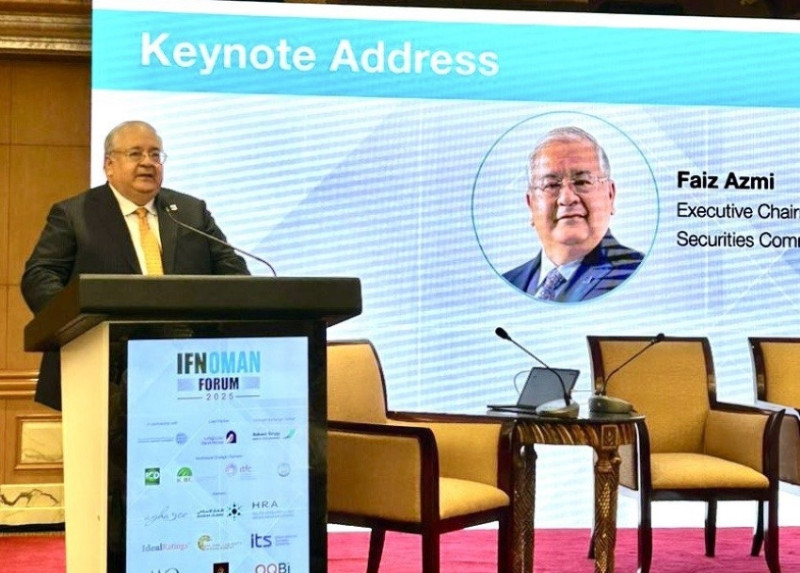
Delivering the keynote address at the IFN Oman Forum 2025 at the Grand Hyatt Muscat, Faiz said the sector must evolve to focus on authenticity and outcomes, particularly as it becomes more visible on the global financial stage.
“This is not just about making a profit, but how you made that profit,” he said. “And in my part of the world, my investors want to know which investments would meet our common Shariah principles from those that do not.”
He emphasised that Islamic finance should not remain in a comfort zone of replicating bonds or insurance through sukuk and takaful, but must now push into areas where it can lead, particularly in sustainability, digital finance and intergenerational wealth transfer.
The occasion marked a milestone for Malaysia, with the first SC–IFN Business Forum being held alongside the main event to highlight Malaysia’s Islamic capital market achievements and explore bilateral cooperation with Oman.
“This format signals that Islamic finance is not only about national growth stories, but creating shared value across borders,” he said.
Faiz set out Malaysia’s position as a global leader in Islamic capital markets. Sixty percent of the country’s USD1 trillion capital market is Shariah-compliant, while Malaysia accounts for nearly one-third of all outstanding sukuk worldwide.
“About 80% of companies listed on Bursa Malaysia are Shariah-compliant, spanning energy, healthcare, technology and manufacturing,” he said. “Our Islamic fund management industry now manages USD60 billion, offering diverse products from Islamic ETFs to REITs and wholesale funds.”
But he cautioned that size alone is insufficient.
“In recent years, sukuk from Malaysia have funded projects for renewable energy, sustainable transport, healthcare, and education. They represent a pipeline of investable projects aligned with real economic outcomes.”
With the upcoming Capital Market Masterplan 4 (CMP4) expected to be released by the end of 2025, Dato’ Faiz said internationalisation would be central to Malaysia’s future capital market strategy.
“We intend to articulate to the market why we need to seek out new investors around the world and not just from the traditional markets we have now,” he said. “We need to find new friends and rekindle old relationships. And that is why we are here in Oman.”
He invited participants to the afternoon session of the SC–IFN Business Forum, which he described as a practical platform to explore synergies between Malaysia and Oman in Islamic finance and private sector development.
Faiz identified three key drivers that will define the next phase of growth for Islamic finance: climate action, digital inclusion, and a new wave of Islamic innovation.
He lauded Oman’s efforts in environmental resilience, citing the Blue Carbon initiative and Wadi Dayqah Dam as examples of sustainable infrastructure.
Malaysia, he said, had likewise intensified efforts, securing a €2.8 million grant from the Green Climate Fund to develop its National Adaptation Plan and launching mARs – a blended finance initiative for non-bankable climate adaptation projects across ASEAN.
“We introduced the SRI Sukuk Framework in 2014 and have since built on this with the SRI-linked Sukuk Framework, Maqasid Al-Shariah Guidance, and the adoption of IFRS’s sustainability standards, S1 and S2 — the first in ASEAN.”
On the digital front, Malaysia’s Islamic fintech sector was valued at USD13 billion in 2024 and is projected to nearly double by 2028.
“The underlying objective is for these digital tools to deliver inclusion, not exclusion — through fractional access for retail investors and underserved MSMEs,” he said, adding that tokenisation could unlock some USD2 trillion in liquidity by 2030.
“Islamic finance must ensure this liquidity is channelled with purpose, not speculation.”
Faiz argued that Islamic finance must move beyond duplication to innovation.
“For much of its history, Islamic finance thrived by offering alternatives: sukuk instead of bonds, Islamic funds instead of conventional funds, and Takaful instead of insurance,” he said. “But the next phase must go further.”
He cited the potential of impact-linked sukuk, tokenised Islamic social funds, and Maqasid-based disclosures that align investment with principles such as justice and stewardship.
“I insure all my cars with Takaful because there is a small upside or refund on my premiums if the operator runs the business well. There is no such equivalence in insurance,” he said.
“Competitive advantage in Islamic finance is not found in products or platforms, but in people,” he said, adding that CMP4 will place strong emphasis on developing pathways for Shariah advisers, fintech specialists and sustainability professionals.
Recent initiatives include the Young Regulators Development Programme and the Islamic Capital Market Summer School in collaboration with Durham University, which saw participation from Oman’s Financial Services Authority.
“Looking ahead, we can explore similar initiatives with the GCC, nurturing the next generation of leaders who will carry our industry forward.”
Faiz reiterated that Islamic finance is ultimately a moral trust that must be exercised with integrity, responsibility and foresight.
“Islamic finance is ultimately an Amanah — a responsibility entrusted to us. The real question is whether its growth will be meaningful: that it is strongly associated with trust, inclusivity, and resilience.”
“This Forum, and the SC–IFN Business Forum soon after, provides a window into Malaysia’s journey – but more importantly, a platform for Oman and Malaysia to explore how we can co-invest and co-innovate.”
“Together, Oman and Malaysia, as well as the wider community, have the opportunity to build an Islamic market ecosystem that not only progresses, but simultaneously uplifts societies, protects the planet, and generations to come.” - Sept 8, 2025