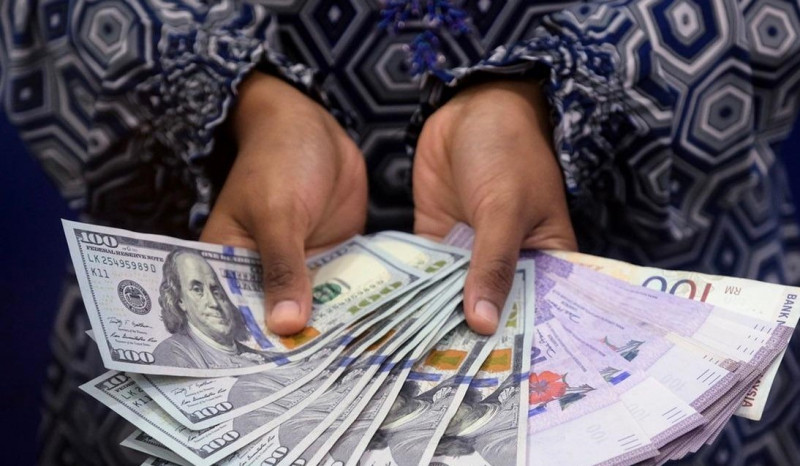
THE Malaysian ringgit has emerged as the best-performing currency in Asia for 2026, according to a report by CNBC Indonesia, which highlighted its resilience amid global market uncertainty while cautioning against negative sentiment surrounding its gains.
The report said the currency’s strong performance has come at a time when global financial markets remain volatile, with geopolitical tensions involving Iran heightening concerns over potential disruptions to global energy supplies and upward pressure on oil prices.
Between the start of the year and the close of trading on 28 April 2026, the ringgit appreciated by 2.64 per cent against the US dollar, placing it at the top of regional currency rankings.
The Chinese yuan followed in second place with a 2.23 per cent gain.
According to the report, the ringgit’s strength has been driven by Malaysia’s resilient external trade position, stable macroeconomic fundamentals and continued inflows of foreign capital into domestic financial markets.
Figures from the Department of Statistics Malaysia (DOSM) showed that total trade in March 2026 increased by 9.3 per cent year-on-year to RM273.0 billion, compared with RM249.8 billion a year earlier.
Exports rose by 8.3 per cent to RM148.8 billion, while imports climbed 10.4 per cent to RM124.2 billion. The trade surplus, however, narrowed slightly by 0.9 per cent to RM24.6 billion.
Bank Muamalat Malaysia Berhad Chief Economist Dr Mohd Afzanizam Abdul Rashid said Malaysia’s economy remains on a solid footing, with gross domestic product growth projected to exceed 5 per cent in the first quarter of 2026.
“This shows the Malaysian economy is in a strong position to face current challenges, including rising oil prices following the conflict in Iran,” he was quoted as saying.
The report also noted that sustained foreign portfolio inflows into Malaysia’s capital markets have strengthened demand for the ringgit, further supporting its upward trajectory.
Against this backdrop, the ringgit is seen as well-positioned to maintain its positive performance, even as global uncertainty persists.
Across Asia, the currency has strengthened against most major regional peers year-to-date, posting its strongest gains against the Indian rupee at 8.07 per cent, followed by the Philippine peso (7.31 per cent), Indonesian rupiah (6.76 per cent) and Thai baht (6.46 per cent).
It also gained against the South Korean won (5.24 per cent), Japanese yen (4.63 per cent), Taiwan dollar (3.57 per cent), Vietnamese dong (2.82 per cent) and Singapore dollar (1.97 per cent), while its appreciation against the Chinese yuan was more modest at around 0.41 per cent. - May 1, 2026








.jpg)