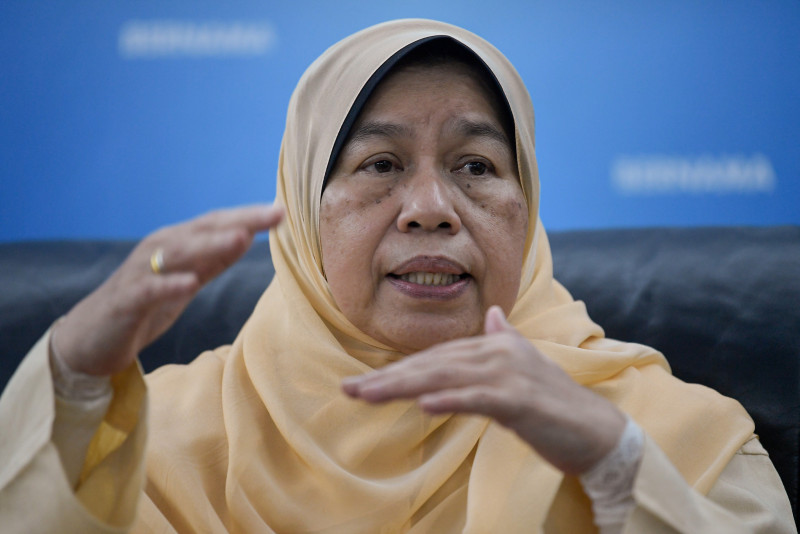
KUALA LUMPUR – Malaysia is currently having government-to-government talks with India, Bangladesh and Thailand on bringing more migrant workers into the local plantation industry besides Indonesia, said Plantation Industries and Commodities Minister Datuk Zuraida Kamaruddin.
She said Indonesia has already approved the entry of 32,000 Indonesians by the middle of February this year after Malaysia settled some technical issues with its government.
“They want to sign a memorandum of understanding which covers employment in the industry and once we ratify that, then they will allow their people to come to Malaysia,” she said at a press conference held in conjunction with the Palm Oil Economic Review and Outlook Seminar 2022 organised by MPOB today.
Zuraida explained that there are other factors being discussed with Indonesia, namely on the living quarters of the workers and their social welfare here.
“On salary, we are not worried, because the minimum wage is RM1,200, and on average the palm oil workers are earning RM2,200 per month,” she said.
Asked if Indonesia requested a higher minimum wage, Zuraida said the ministry will engage with the plantation companies and will negotiate back with the government to find a more amicable solution.
Meanwhile, the minister wants to ensure that the plantation industry continues to have a supply of labour to avoid the loss of fresh fruit bunches and have consistent palm oil production.
However, she stressed that this is only a short-term strategy, as in the next five years’ time, the country would be reducing its dependence on foreign labour and replacing it with robust automation and mechanisation.
In her speech earlier, Zuraida said that from January till December 2021, the average CPO price surged by 64.1% to the highest record in palm oil history at RM4,407.00 per tonne compared to RM2,685.50 per tonne during the same period in 2020.
Likewise, the average CPO price reached its historical peak for a monthly average at RM5,341.00 per tonne in November 2021 and a record daily average of RM5,429.00 per tonne on November 19, 2021.
This resulted in a significant increase of total palm oil products export revenue by 47.7% to RM95.76 billion in 2021 (January-November) compared to RM64.85 billion in 2020 (January-November).
“Despite these impressive numbers, we cannot afford to remain complacent. The palm oil industry is still facing many challenges globally.
“To maintain our competitiveness in the global market, issues such as environmental governance and sustainable production are stark reminders of the challenges that need to be addressed,” she said.
She added that the government remains committed to implementing strategies and initiatives towards strengthening the palm oil industry.
The allocations made under Malaysia’s Budget 2022 aims for post Covid-19 economic recovery and to boost the growth of the agri-commodity industry.
To recap, the government has allocated RM35 million to implement the Smallholder Palm Oil Replanting Stimulus Scheme and RM20 million to address the ongoing anti-palm oil campaign at the international level.
It also allocated a total of RM30 million for agricultural mechanisation technology research and commercialisation to the Mechanisation and Automation Research Consortium of Oil Palm (MARCOP).
The main focus of MARCOP is to address the problem of fresh fruit bunches (FFB) harvesting operations, which currently involve 80% of migrant labour.
MARCOP will focus on the latest technologies within the framework of the Industrial Revolution 4.0. – Bernama, January 13, 2022