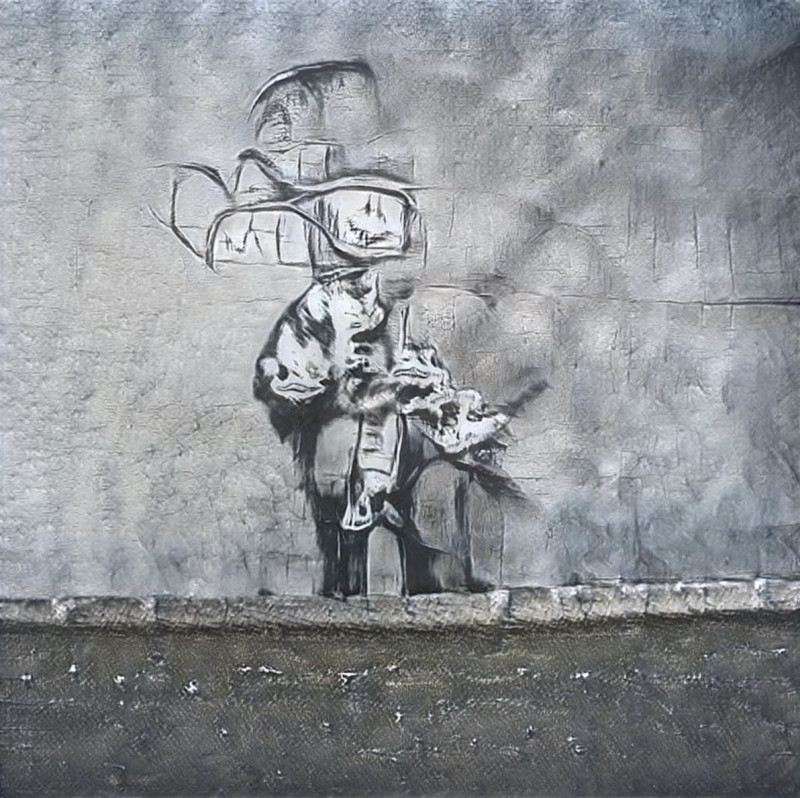
HAS the machine surpassed its master? While prices for Banksy originals climb ever higher, a new AI has been programmed to create artworks that resemble those by the famous British street artist himself. So much so that some art collectors are already snapping up the GANksy creations.
While the works leave no doubt as to the identity of the artist they take inspiration from, the creator of the software, Matt Round, refrains from explicitly mentioning Banksy's name, to avoid any legal complications. The AI software was trained using a bank of hundreds of images of street art, some of which were probably Banksy's works, and was launched in September 2020.
"All of GANksy's works are original creations derived from its understanding of shape, form and texture. GANksy wants to be put into a robot body so it can spraypaint the entire planet," said Round in a statement on his website.
Over 250 works by GANksy are for sale in the form of the exclusive ownership of a GANksy-signed digital file, with prices starting at £1 and rising by £1 with every purchase. According to Round's website, 83 pieces have already found a buyer.
These prices are a far cry from those that Banksy's works routinely fetch; many sell for several million euros. Last week, Show me the Monet, Banksy's reimagining of a Claude Monet painting, saw the hammer fall at £7.6 million (approx. RM 41.2 million) at Sotheby's London. The piece did not, however, beat the record set by the artist's Devolved Parliament, which sailed past its initial estimation of £2 million to sell for £9.9 million at a previous Sotheby's auction in 2019.
Works generated by AI have been well received at auction in the last few years. Among them is Paris-based arts collective Obvious's Portrait of Edmond Belamy, which took the art market by surprise when it sold for $432,500 in October 2018 at Christie's - sixty times its low base estimation of $7000.
Earlier this year, the Bucharest International Biennial for Contemporary Art announced that the chief curator for its 10th edition, set to take place in 2022, will be an AI programme named Jarvis. Jarvis will be trained over two years to use deep learning to gather information on curatorial practices, as well as explore the databases of museums, universities and galleries to select artists and creators who will participate in the Bucharest Biennale. The chosen artists will exhibit their work in a virtual-reality gallery, according to the AI system's creators, Vienna-based studio Spinnwerk. – ETX Studio, October 28, 2020