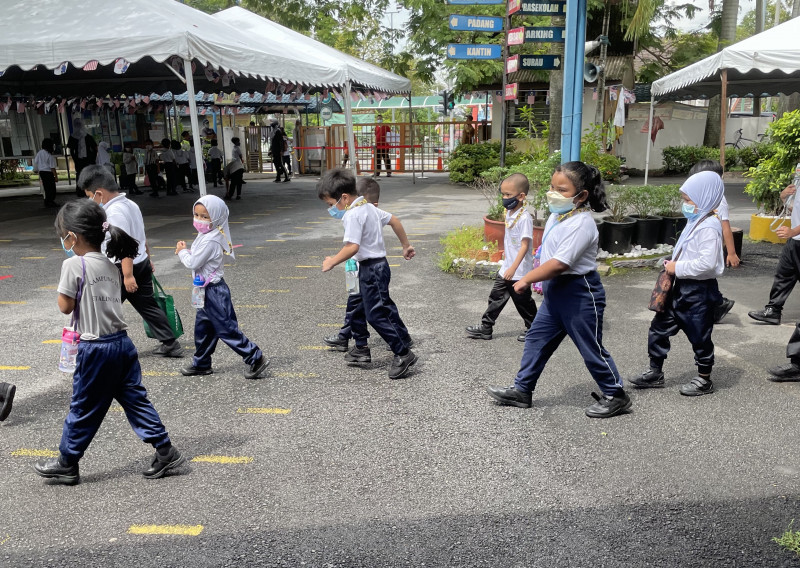
STANDARDISING school uniforms across Malaysian schools should not be prioritised over more fundamental educational challenges, according to leading education expert Dr Anuar Ahmad from Universiti Kebangsaan Malaysia (UKM).
Speaking to the New Straits Times, Dr Anuar highlighted that parents have not raised uniforms as a major concern, and that the Ministry of Education should focus on critical matters such as student dropouts, teacher shortages, and inadequate infrastructure.
“There are many issues that the Education Ministry’s administration should pay attention to, such as dropouts, lack of teachers and infrastructure. It’s not the time to think about minor things like this. It does not have an impact on education,” he said.
Dr Anuar further noted that schools should retain discretion over uniform matters. He stressed that students wear uniforms only about twice a week, with sports attire or other clothing worn on other days.
“The uniform material is okay. The fabric is thin. It’s not an issue. However, vests and blazers should not be mandatory in our education system, given the hot climate—that is something to consider,” he said.
He added that uniforms were originally intended to instil discipline and familiarise students with formal attire. “This should be under the jurisdiction of schools,” he said.
Meanwhile, ministry director-general Datuk Dr Mohd Azam Ahmad confirmed that any decision regarding uniform standardisation will not affect the 2026 school session. He explained that Putrajaya is still evaluating the matter, with potential implementation, if approved, targeted for the 2027 academic year.
Meanwhile, Parent and community representatives have also welcomed the initiative, provided it is implemented thoughtfully. Zainol Abidin Mohamad, Deputy Chairman of the National Parent-Teacher-Community-Private Sector Engagement (PIBKS) and Chairman of PIBKS Kedah, highlighted that standardisation could reduce financial burdens on families, particularly among B40 and M40 households.
“Education should focus on equality, moderation, and learning, not differences in appearance.
The measure is also important to restore schools as spaces for character, knowledge, and values, not as showcases for style or social status,” he said.
Zainol Abidin emphasised that the policy must be phased, inclusive, and involve meaningful consultation with parents, taking into account climate, student comfort, health, and local socio-economic realities.
“Parents should not merely be recipients of decisions; they are strategic partners in the education ecosystem.
“We welcome the Ministry of Education’s intent to harmonise school uniforms nationwide, but any new policy must be implemented through genuine engagement so as not to add pressure on families,” he added.
At present, the standardisation proposal remains under study, with no changes to school uniforms for the 2026 session. The Ministry of Education will only finalise its decision after a thorough review of all relevant factors for potential rollout in 2027. - January 3, 2025