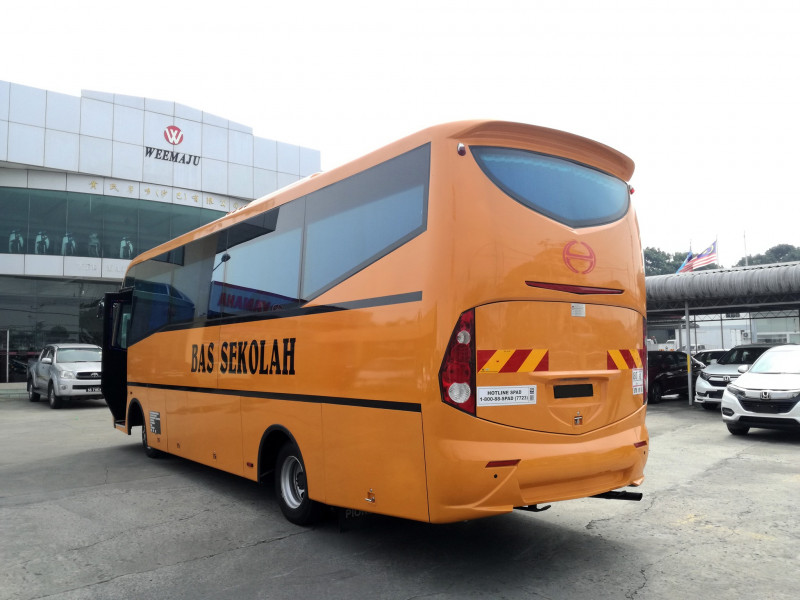
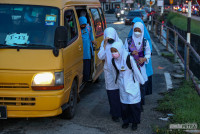
KUALA LUMPUR – The government has been urged to pay attention to the problems faced by bus operators across the country during the schooling session amid the Covid-19 pandemic.
Federation of Malaysian School Bus Associations president Amali Munif Rahmat said the main problem faced by bus operators at the moment was related to fees that were either refused to be paid in full by parents, or not paid at all.
He said more than 50% of parents did not want to pay school bus service fees because of the rotation system used by the Education Ministry (MoE) for the attendance of pupils in schools.
According to Amali Munif, this was quite burdensome for school bus operators, as the fee collection did not even reach half of the previous amount to cover the cost of providing the service.
“We have to pay the driver’s salary in full for a month, not to mention the installments. Financial institutions have already started asking when we are going to pay them. Schools have only begun opening today, and they have started asking us to pay,” he said.
Amali Munif said before the movement control order was implemented by the government in March 2020, there were about 16,000 school buses operating nationwide, but now only about 8,000 were still in operation.
According to him, there are also bus operators who currently operate illegally to avoid incurring the high costs of operating with a license.
“This is because (as) a legal operator, you have to (pay) for the Computerised Vehicle Inspection Centre (Puspakom), insurance and others which make the overheads much higher. The number of illegal operators is increasing because many have been laid off.
“So that’s why some operators have raised fares, because they need to cover their overhead. When we cannot cover our overhead, we will incur a loss. How many times should we incur losses, as we have already made a loss during the MCO previously,” he said.
He suggested for the government to include the operation of school buses as a necessary service to enable the group to be given priority when it came to providing assistance.
“In the 2022 Budget, there is no mention of assistance for school buses. That’s our main regret. It means the government does not consider us a necessary service, when in reality, if we do not operate, many government agencies will be in disarray because there will not be enough staff when parents themselves send and pick up their children from school,” said Amali Munif.
The MoE on December 31 informed that the operation of secondary schools for the third term of the 2021/2022 schooling session involving students of transition classes, Forms 4 to 6, pre-university, International Baccalaureate Diploma Programme and equivalent international examinations, must attend class face to face without any rotation if the vaccination rate among them had reached 90% or more.
However, according to the MoE, educational institutions under the ministry for the term that had not reached the 90% threshold of vaccination would remain operating on a rotation basis.
On December 24, the MoE announced that the third term of the schooling session would begin on January 9 for Group A, namely Johor, Kedah, Kelantan and Terengganu, and January 10 for Group B, namely Melaka, Negeri Sembilan, Pahang, Perak, Perlis, Penang, Sabah, Sarawak, Selangor, Kuala Lumpur, Labuan and Putrajaya.
Meanwhile, Coalition of Malaysian School Bus Associations (GPBSM) president Mohd Rofik Mohd Yusof said the demand for school bus service is not very encouraging at present, while operators also face difficulty in paying maintenance costs as well as renewing their insurance.
According to Mohd Rofik, the action of parents who were hesitant to pay fees due to the rotation system implemented by the MoE also did not help.
“We pay insurance, road tax, Puspakom for a year. They (parents) should at least pay a full months’ fees, because, for the school bus operators, it’s their only source of income.
“We request the government to provide school bus operators nationwide with subsidised diesel at RM1 per litre. In the current situation, the demand is also not there, as many seem to be scared (of Covid-19),” he said.
Mohd Rofik said it is understood that on average, there were less than 10 pupils and students per bus using the service, making it more difficult for them to continue operating. – Bernama, January 10, 2022

.JPG)