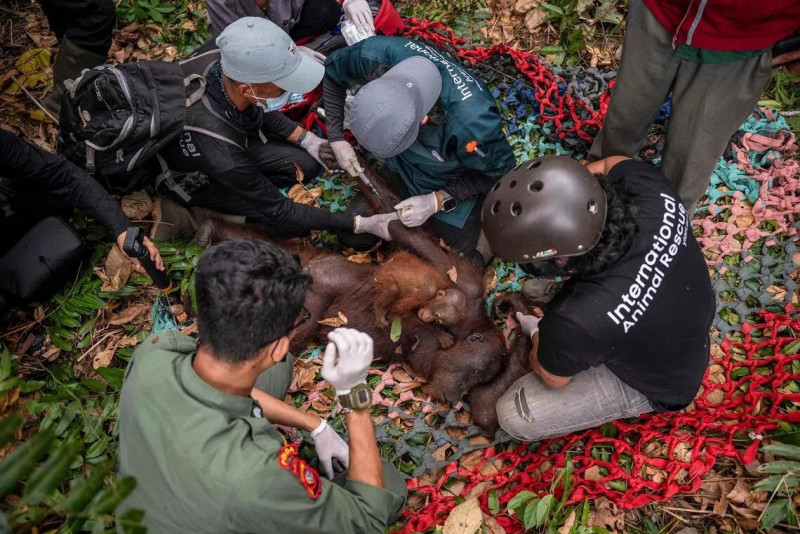
A MOTHER orangutan and her baby have been rescued after wildfires spread towards their habitat in Indonesia’s West Kalimantan province, with conservationists warning that the fires are depriving wildlife of food and shelter.
The pair were evacuated on Sept 3 to a rescue and rehabilitation centre managed by wildlife foundation Yayasan Inisiasi Alam Rehabilitasi Indonesia (YIARI), after having been monitored since July when they were spotted in a plantation area near a forest.
The West Kalimantan Natural Resources Conservation Agency said preliminary health checks found no burn injuries on the two orangutans, although veterinarians are closely monitoring their condition.
YIARI veterinarian Komara said prolonged exposure to smoke could damage the animals’ respiratory systems, particularly when concentrations in their habitat were high.
“Exposure to smoke over a period of time... can affect the orangutan’s respiratory system, especially when smoke concentrations in the habitat are very high,” AFP cited him saying in a statement.
“Both individuals will continue to be monitored while they are at the rescue and rehabilitation centre.”
The latest rescue brings to nine the number of orangutans evacuated because of wildfire threats in Ketapang district in less than a month, YIARI operational director Argitoe Ranting said.
“This shows that fires not only destroy forests but also deprive animals of shelter and food,” he said.
Most animals “do not have many options” to relocate as their habitat burns, he added.
The rescue comes as Indonesia battles wildfires that have blanketed parts of Borneo and Sumatra in smoke, with the resulting haze also contributing to air pollution in Malaysia, Singapore and the Philippines.
The conservation agency said an orangutan died after being rescued last week, with a necropsy indicating that smoke exposure was the cause of death.
The latest incidents underscore the growing threat posed by wildfires to Indonesia’s endangered orangutan population, as fires destroy or render increasingly unsafe parts of their natural habitat. - September 5, 2026