

“Slovakia, which has used rapid tests to screen two-thirds of its 5.4m population on serial weekends may provide proof of concept that mass testing can work. Whether or not a vaccine soon becomes available, it is easy to imagine how testing could be a game-changer. With Covid-19 controlled, millions of jobs would return and millions of students could return to school. Stadiums and theatres, churches and mosques, could reopen. Restaurants and pubs would be safe again…and extended lockdowns a thing of the past. We could reopen our societies — and keep them open.”
– Annie Sparrow, Ichan School of Medicine at Mount Sinai
IN March 2020, the World Health Organization declared the outbreak of Covid-19 a pandemic – the biggest of our lifetimes. A year on, we are still in the midst of it. “Pandemic fatigue” is setting the world over. People are questioning how and when we may be able to return to normal.
The bluntest tool at our disposal – the dreaded “lockdown” – has not worked. Lockdowns assume that every one of us is “positive” and keeps us at home. Worse still, we do not develop “herd immunity” – the only way we can beat a pandemic.
Waiting for the vaccine
Malaysia, like every government in the world, has put practically all its strategy eggs in the vaccine basket. Nothing wrong with that except that we are not in control of that basket:
- When will all the needed vaccines come?
- When will we all get vaccinated?
- How long will the vaccines last giving us the needed immunity?
- If the immunity was for a year, will be in the same quandary next year?
The other way. Look at the chart below:
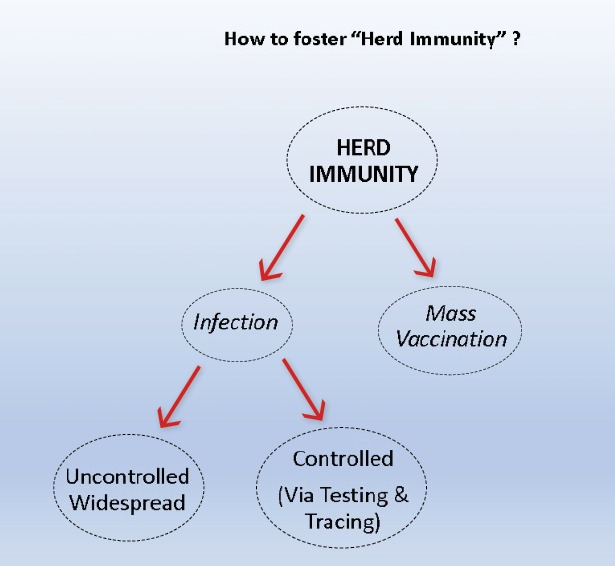
'Herd immunity'
Herd Immunity is a situation when enough of the population has the antibodies in them to prevent the virus from attacking them and spreading in the community. There are two ways to get “herd immunity”. You can vaccinate a large part of the population.
But the other way is by actually having the infection. While we do not want an uncontrolled outbreak that would overwhelm our healthcare system, we can have a very controlled outbreak by way of testing and isolating only those who are positive.
Those who are positive (who are infectious) are removed from the rest of the population and thus the disease will not spread. The rest of us can go back to work and make Malaysia a wonderful nation. This is a very focused version of the “lockdown” – only those who are positive need to be quarantined.
There is a growing number of public health professionals proposing mass testing of large populations. The twist is to test large healthy populations who do not have any symptoms (asymptomatic) may become one of the most important tools to reduce transmission, help to open the economy and bring the pandemic under control.
In 2020, independent research teams in the United Kingdom and the US came up with the proposal to implement population testing of asymptomatic individuals as an exit strategy for the pandemic.
Modelling studies have since demonstrated the feasibility of population testing. Testing programmes are currently being implemented in schools across the world. The British Broadcasting Corporation reported on March 1 that UK schools will reopen on March 8.
Mass testing
In the UK rapid test kits will be provided twice a week to pupils and anyone in their household or support bubble regardless of whether they have symptoms. They will also be available to adults who work with schools, such as bus drivers and after-school club leaders.
Public Health England said testing would help "uncover hidden cases" and break chains of transmission. This would provide yet another layer of reassurance to parents and education staff that schools are as safe as possible.
While there are still many challenges in rolling-out large-scale test programmes, mass testing could be a game-changer in countering the pandemic. – The Vibes, March 8, 2021
“The key to solving the economic crisis is to reduce the fear that someone will get sick. It’s really about building confidence. The thing about testing is that it’s easy to explain. It’s a very simple, easy-to-explain idea—that to control the pandemic, we need to get a reasonable majority of the people who are infectious into quarantine, and then we’re good. That’s really what it is about.”
– Paul Romer, Nobel Prize in Economics in 2018
Next week: High-frequency mass rapid testing
Dato’ Dr Rajen Manicka is a pharmacist with a doctorate in Holistic Medicine. He has been a columnist for various publications on and offline since the mid-1990s.