


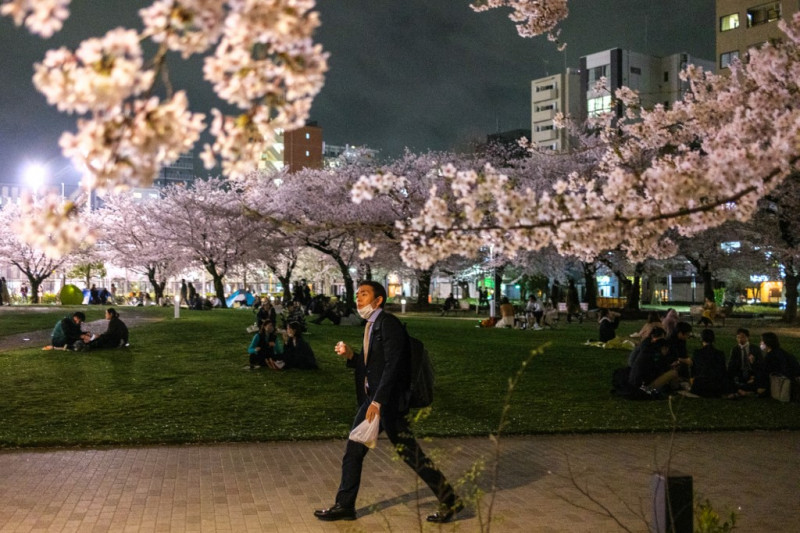
YUKI – Japan's famed cherry blossom season blankets the country in the delicate white flowers of the prized and popular "somei-yoshino" tree, delighting residents and visitors alike. But some want change.
The season produces a nationwide frenzy, as forecasters compete to declare when full bloom will arrive, and Japanese unfurl picnic blankets for sometimes raucous flower-viewing parties – at least in pre-pandemic times.
The blooms of the ubiquitous somei-yoshino strain, which accounts for more than 90% of the cherry trees planted in Japan, last only around a week and tend to emerge simultaneously in a given region because the trees are clones of a single specimen.
And while the tree has become synonymous with blossom season, it is a growing headache for city planners because the strain is prone to disease and tends to grow too large to be well managed in urban settings.
"It's all about planting the right flora in the right place," says Hideaki Tanaka, an expert on sakura – Japanese for cherry blossoms – who is trying to popularise other strains.
"There are all kinds of sakura, not just somei-yoshino. I want to help recreate the old times when people enjoyed a wide variety," added Tanaka, 63.
He runs a farm in Yuki, in eastern Japan's Ibaraki prefecture, with around 1,000 sample trees of 400 cherry varieties.
His goal is to convince local officials across Japan to consider alternatives with petals in all shades of pink, or even rare green.
As Tanaka sits on the grass among his trees, nail-sized petals of pale pink flutter down in the gentle breeze, while elsewhere other flowers are still coming into bloom.
It's a scene more like the cherry blossom seasons Japanese enjoyed several centuries ago, with a range of blooms arriving at different times.
Promoting diversity
His farm is operated by the Flower Association of Japan, which gives cherry saplings to communities that want to create scenic spots to draw tourists and please residents.
The farm has distributed about three million saplings, including somei-yoshino, but it is now promoting the "jindai-akebono" variety which is more resistant to infection and grows smaller, making it easier to prune.
Its flowers bloom around four days earlier than somei-yoshino's and are a stronger pink colour.
But convincing Japan to turn its back on the somei-yoshino strain may not be easy.
As urban development swept the country from the 1950s to 1980s, cities competed to plant countless millions of fast-growing somei-yoshino trees.
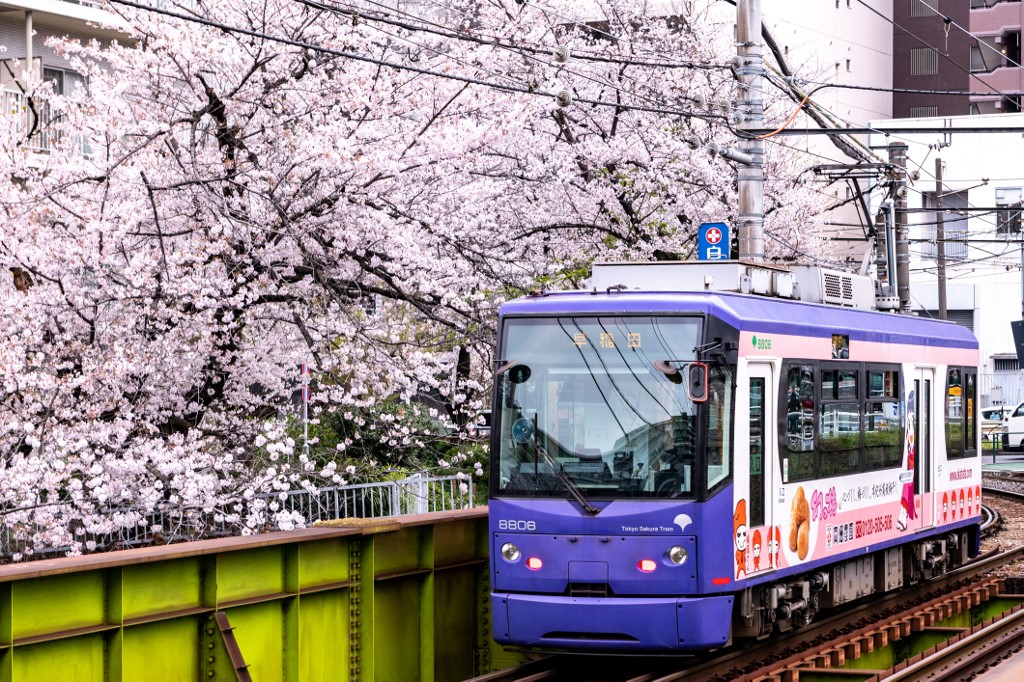
Decades on, many of those trees have not been properly pruned, leaving them vulnerable to an infection called "witch's broom" that deforms twigs, discourages flowering and can kill the trees.
Somei-yoshino also grows large – as high as five-storey buildings in some cases – with sprawling branches stretching from enormous trunks that can develop hollows, and bulky roots that can crack pavements.
Older trees are at risk during the country's typhoon season, giving city planners plenty of reasons to consider replacing them.
But residents are less convinced.
'Green shoots of feeling'
In western Tokyo's Kunitachi, it has taken officials three decades to remove around 80 of the approximately 210 trees that have been designated as needing to be felled or replaced.
The trees formed an elegant floral tunnel every spring and residents wanted to keep them, said Ryusuke Endo, an official at the city's roads and traffic division.
"Some people moved here to enjoy them and bought apartments along the street," he said, describing locals as emotionally attached to the trees.
Elsewhere, efforts in Yokohama to axe around 300 cherry trees along a busy street caused public outcry and made television news.
In Kunitachi, officials have started planting the jindai-akebono variety promoted by Tanaka's farm, and residents are starting to embrace the new arrivals.
"I believe green shoots of feeling are emerging among residents who are starting to see that they too are very beautiful," Endo said.
But Tanaka said even diversity evangelists like him are convinced the somei-yoshino will never be dethroned as Japan's sakura king.
Instead, he hopes to encourage people to "learn about the profound diversity of cherry trees".
"The somei-yoshino will always be the main draw for cherry viewing. I want to help communities create other places where people can enjoy all kinds of cherry varieties." – AFP, April 23, 2022















.jpeg)
