SEVENTY years after the worst natural disaster to strike the Netherlands, Chiem de Vos, seven at the time, still hears his neighbour's desperate cries of "My children are drowning!" ringing in his ears.
And as the Dutch this week commemorate the great flood of 1953, thoughts are inevitably turning to current-day climate change and how the low-lying country remains vulnerable to rising ocean levels.
Horrific images of men, women, children and cattle trying to stay afloat in icy waters that swamped villages and thousands of acres of farmland remain etched in the collective memory of those living in a country of which one-third lies below sea level.
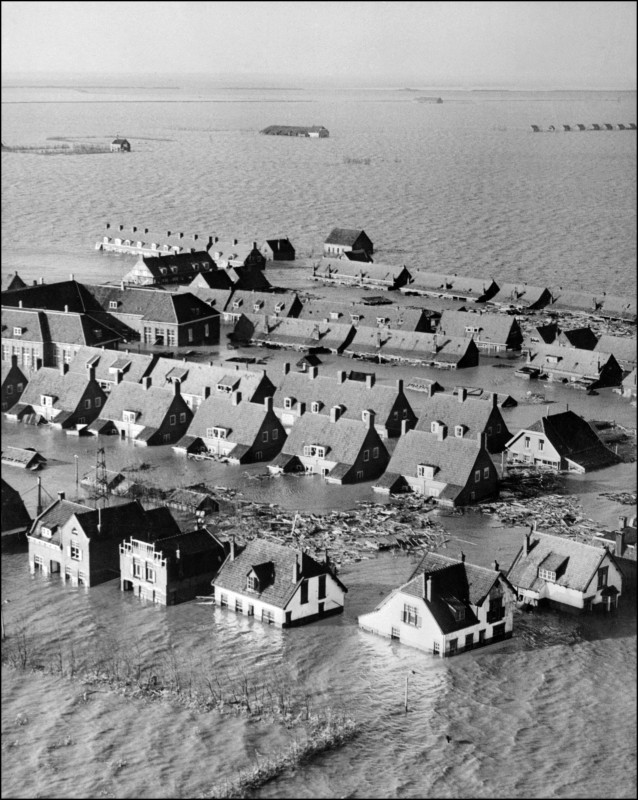
A violent storm blowing up from the North Sea coupled with a tide sent surging waters smashing through dikes in southwestern Netherlands on the night of January 31 to February 1, 1953.
More than 2,500 people were killed in the Netherlands, Belgium and Britain, with 1,836 Dutch among the victims.
Still in shock, the Dutch the following year launched the ambitious Delta Works plan, the world's largest project to stave off flood waters through a series of concrete storm surge barriers, locks and heightened dikes, completed in the mid-1980s.
But seven decades later, rising temperatures and sea levels globally have once again stirred an ancient fear and the topic of climate change is at the centre of the commemorations.
‘Nothing you can do’
"Even if the dikes are now so high and so wide, when the water wants to come in there's nothing you can do to stop it," De Vos, now 77, told AFP.
"And that's what I'm afraid of."
On the fateful night in 1953, the dike supposed to protect De Vos and his family broke at the scenic small village of Heijningen, about 40 kilometres south of Rotterdam.
From his bed he could hear "the roar of the storm and the trees creaking", the desperate cries of his neighbour, pounding on the kitchen window, De Vos recalled.
Total devastation followed.
"We had a vegetable garden, chickens, pigs, cows and an orchard. This big, four-metre tidal wave came and washed it all away," said an emotional De Vos, who was evacuated in time with his family.
More than 10% of the village's inhabitants died in the tragedy. Today a monument in the middle of Heijningen remembers their loss of life.
"Due to climate change the flood survivors in recent years have become increasingly worried, asking 'will the water return?'," said Johan van Doorn, 59, a historian living in Heijningen.
When the Delta Works were completed in the 1980s, the message to the maritime province of Zeeland was that it "was safe", Van Doorn said.
"But we see the climate changing at full speed over the last 10 to 15 years," he said.
‘Never sleep peacefully’
Rising sea levels in the Netherlands is one of the most important consequences of global warming, the Royal Dutch Meteorological Institute (KNMI) said.
It said water levels rose by as much 25cm off the Dutch coast between 1900 and 2020, and by the year 2100 they will rise between 34cm and 1.25 metres, depending on emissions cuts.
The Netherlands has increasingly sought to adapt to the problem, leaving areas that can be flooded instead of simply trying to keep out the sea as they did with the Delta Works seven decades ago.
A Dutch government study on reorganising land use is set to produce its first results at the end of 2023.
But Van Doorn wondered whether measures would be enough, pointing at massive flood damage in 2021, when rivers burst their banks in southern Netherlands and elsewhere in western Europe.
Any survivor of the 1953 flood "will never again sleep peacefully" in the event of a storm or a flood, Van Doorn said.
De Vos had a strategy to avoid a similar nightmare.
He told his 14-year-old grandson to make a future home in the Veluwe, an elevated region in central Netherlands – far away from the coast and the raging waters of the North Sea. – AFP, January 30, 2023