BACK in November, the American company Neuralink announced that it would be looking to implant its first chips in human brains in the spring of 2023.
But Elon Musk's agenda appears to have been thwarted by the US authorities, which have not authorised these first human trials.
This represents a further obstacle for this brain implant project, which is already subject to two investigations by the American authorities.
Neuralink, which specialises in intelligent brain implants, is one of the many startups created by Elon Musk and certainly not the least ambitious.
Its ultimate goal is to achieve a kind of man-machine interface by implanting chips and electrodes into the brain. The idea is to be able to control an electronic terminal, like a smartphone for example, without having to touch it, simply by thinking.
In the longer term, these electrodes could have other uses, notably in the treatment of neurological diseases, thus one day potentially helping patients to overcome Parkinson's disease or epilepsy, or even to allow paralysed people to regain their mobility.
But the bad news for Neuralink is that the Food and Drug Administration (FDA), in charge of authorising or prohibiting the marketing of drugs in the United States, recently rejected the firm's application to conduct an initial trial on humans, citing "major safety concerns" for the prospective guinea pigs.
The FDA is reportedly concerned about the lithium battery in the device or the possibility that the tiny wires in the implant could migrate to other parts of the brain.
The agency is also reportedly concerned about potential damage to brain tissue when the implant is removed. These issues come in addition to two investigations already underway by the US authorities.
One, by the US Department of Agriculture, concerns possible animal welfare violations, and the second, helmed by the Department of Transportation, is investigating allegations that Neurolink transported potentially hazardous pathogens found on contaminated implants taken from monkey brains.
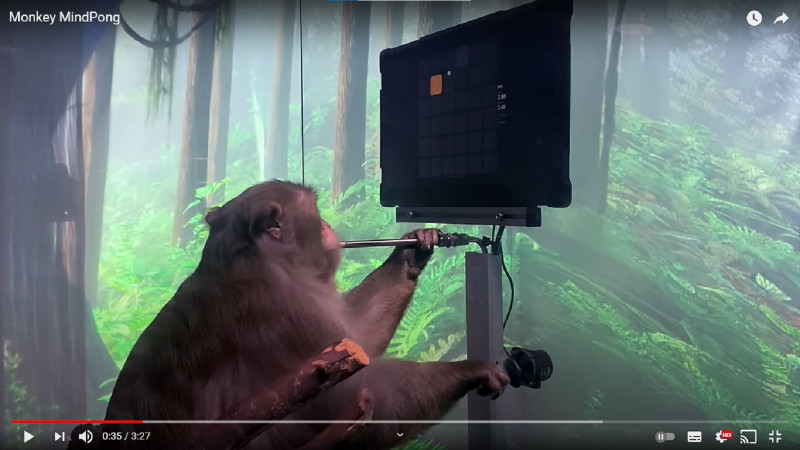
In fact, before testing its technology on humans, Neuralink has already done so on animals. A video posted online by the startup in 2021 showed, for example, a successful experiment on a monkey.
Pager, a nine-year-old macaque, received two chips, combining more than 2,000 electrodes, in the parts of the brain that control arm and hand movements.
His every move was thus analysed by computers, until it eventually became possible to anticipate his actions based on brain activity.
This experiment used a basic video game where, with the help of a joystick (which was later unplugged), the monkey had to move a small circle onto a colored square. In return for playing, the macaque was rewarded with a banana or strawberry smoothie.
After sharing this first video, Elon Musk said that the "first Neuralink product will enable someone with paralysis to use a smartphone with their mind faster than someone using thumbs.
"Later versions will be able to shunt signals from Neuralinks in brain to Neuralinks in body motor/sensory neuron clusters, thus enabling, for example, paraplegics to walk again." – ETX Daily Up, March 14, 2023