SHAH ALAM – Kuala Langat residents who have been struggling with pollution issues caused by errant factory operators are not taking it lying down.
Up to December 18 this year, the Selangor Environment Department received a total of 114 complaints from them. Last year, it received 196 complaints, and 206 in 2018.
The culprits behind Kuala Langat’s environmental woes are illegal factories that have been sprouting up in the district over the past five years.
These plants are built mainly on agricultural land that have yet to be converted to industrial status.
Selangor reportedly has about 5,600 unlicensed factories. Currently, only 1,200 have applied to legalise their operations under a programme initiated by the state government in October last year to license factories and regulate their operations. The deadline under the programme is December 31 this year.
Selangor Environment Department director Nor Aziah Jaafar admitted that Kuala Langat was among the districts in Selangor “sought after” by illegal factory operators. According to a survey carried out by the Kuala Langat District and Land Office, 186 unlicensed factories were operating in the district.
However, only 15 in the district have applied to legalise their operations so far.
Nor Aziah said four applications have been approved so far, while the remaining 11 are still being processed.
“Another 171 illegal factories have yet to initiate any action to ensure that their operations are being carried out in accordance with the established regulations,” she said in an interview at her officer here recently.
Nor Aziah said that the authorities would not hesitate to tear down the buildings of plants that continue to operate without a licence, particularly those that have an impact on the environment.
She said that apart from the economic factor, as they do not pay any taxes to the government, illegal factories are more prone to causing pollution as their activities are unmonitored.
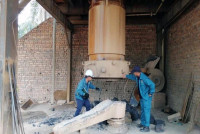
Many of the factories operating in Kuala Langat recycle used tyres and plastic waste.
“The department will focus not only on illegal factories, but also licensed factories that flout the rules under the Environmental Quality Act 1974,” she said.
As of now, 884 premises in Kuala Langat are registered with the department, 596 out of which are industrial and 275 are non-industrial, such as warehouses, workshops and clinics.
Another six premises comprise palm oil factories, while seven premises are designated as scheduled waste disposal sites.
According to Nor Aziah, the state department launched an aggressive operation against illegal factories in Kuala Langat last year and raided 42 premises involved in processing plastic waste imported from other countries.
“They were found processing the plastic by liquefying it without using a filtration device which led to odour and air pollution,” she said.
So far, the operators of 16 of those factories have been charged in court and fined a total of RM1 million.
Nor Aziah also said that Kuala Langat was a magnet for unlicensed industries due to its proximity to Port Klang.
“Other than that, the district also has extensive areas that are still green and developing, thus making it easier for illegal factories to operate without being noticed,” she said.
In view of the increasing number of complaints from Selangor residents on factory-caused pollution, the department has set up district-level offices in Sepang, Sabak Bernam, Kajang, and Gombak to facilitate monitoring efforts.
“Our officers patrol high-risk areas at night up to 11pm to monitor factory operations. If they notice any suspicious activity, they will enter the premises to conduct a surprise check and action will be taken if the operator is found to be flouting the law,” she said.
Nor Aziah said while Selangor monitors a total of 12,604 premises statewide, it only has 80 people to carry out enforcement work. Its enforcement team has to be mobilised four times a week or 16 times a month, she added.
Due to staff constraints, the department has to give priority to monitoring factories against which many complaints have been lodged.
“We also focus on factories located close to rivers that have drinking water intake points,” she said, adding that their officers are also often harassed by gangsters.
She also urged community members who wish to register a complaint against any errant factory to provide accurate information that can be used as evidence.
“We tend to get many complaints which turn out to be baseless… it is such a waste of our resources and time to investigate such cases,” she added. – Bernama, December 24, 2020

_-_PSI_EIA_receives_approval_from_DoE_-_PIC_FB.jpg)