PUTRAJAYA has approved official standard operating procedures (SOPs) for the mining of rare earth elements (REE), as part of a broader strategy to regulate the sector, limit environmental impact and encourage local downstream processing.
The SOPs, developed by the federal government and endorsed by both the Cabinet and the National Minerals Council, were distributed to all state governments in December 2023. They set regulatory standards across pre-mining, active mining and post-mining phases, including mandatory environmental impact assessments and site rehabilitation protocols.
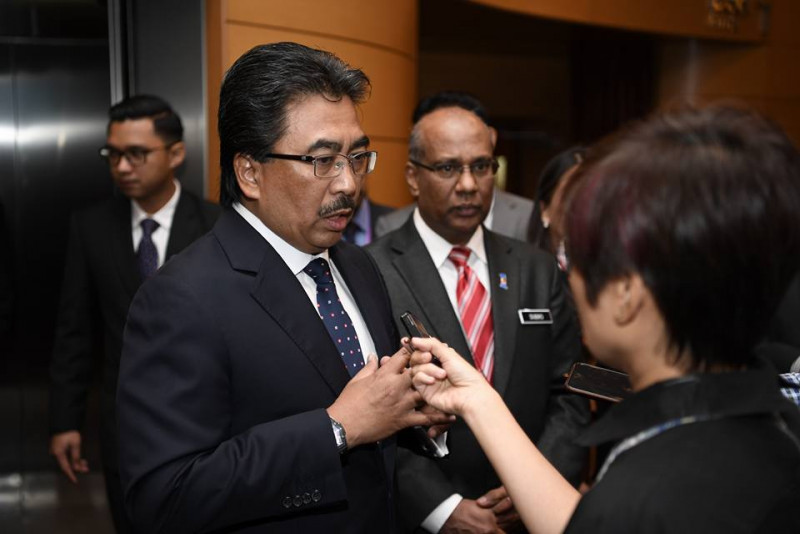
“The SOPs cover all regulatory aspects from pre-mining to post-mining activities, including the requirement for Environmental Impact Assessment (EIA) approval and rehabilitation controls,” said Datuk Seri Johari Abdul Ghani, who is currently fulfilling the duties of the Minister of Natural Resources and Environmental Sustainability, in a written reply to the Dewan Negara.
A pilot project in Mukim Kenering, Perak, has demonstrated that adherence to the SOPs can significantly minimise the environmental risks associated with REE mining.
Johari reiterated that Malaysia continues to enforce a moratorium on the export of raw REE in order to ensure national resources are not exploited without adding value domestically.
“The moratorium compels us to intensify efforts to either import foreign processing technology or develop our own,” he said, responding to a query from Senator Datuk Dr Mohd Hatta Md Ramli regarding the nation's REE extraction and processing strategies.
He noted that Malaysia still lacks a local separation facility capable of refining REE into higher-value products. However, recent high-level diplomatic developments may help change that.
“President Xi Jinping’s visit in April opened the door for potential technology collaboration with China, specifically with the condition that any cooperation involves government-linked companies (GLCs),” Johari said. While still at an early stage, he added, such collaboration could reduce Malaysia’s reliance on raw exports and position it as a regional REE processing hub.
Johari also confirmed that the Lynas processing plant in Kuantan, Pahang, will continue to be a strategic asset in developing Malaysia’s midstream and downstream REE industry.
He added existing initiatives by the Ministry of Science, Technology and Innovation (MOSTI), which include the National Advanced Materials Technology Roadmap (NAMTR) 2021–2030 and the establishment of the National Advanced Materials Consortium (NAMC).
“These initiatives are intended to support knowledge sharing, technology development, and local industry participation across the REE value chain,” he said. - September 10, 2025