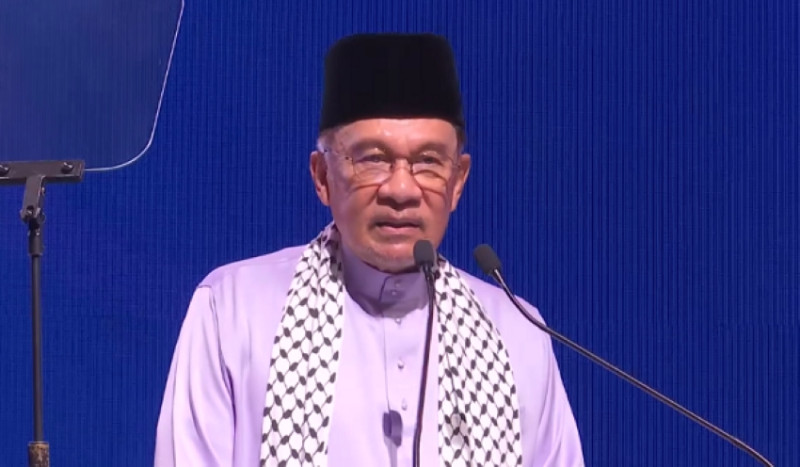
MALAYSIA will continue to champion the halal economy as a central pillar of its global economic and diplomatic strategy, Prime Minister Datuk Seri Anwar Ibrahim said on Thursday, reinforcing the country's position as a global halal leader.
Delivering his keynote address at the 21st Malaysia International Halal Showcase (MIHAS 2025) at the Malaysia International Trade and Exhibition Centre (MITEC), Anwar described halal as “a symbol of international trust” rooted in principles of cleanliness, integrity and accountability.
“Halal is more than a matter of fiqh (deep understanding), It represents a comprehensive worldview – an ethical framework for trade, investment and life itself,” he said, calling for a deeper embrace of the ‘halalan tayyiban’ (lawful or permissible under Islamic law, and wholesome, pure, safe, and of good quality).
To date, nearly 10,000 companies – more than 80 per cent of them micro, small and medium-sized enterprises (MSMEs) – have received halal certification from the Department of Islamic Development Malaysia (Jakim), widely recognised as one of the world’s most stringent certifying authorities.
“Thus far, almost 10,000 companies – over 80 per cent of which are SMEs – have obtained Jakim certification for their full compliance with our rigorous halal standards,” said the Prime Minister.
He noted that the halal industry now extends far beyond food and beverage into sectors such as healthcare, pharmaceuticals, cosmetics, tourism, and Islamic finance, all of which are expected to contribute significantly to Malaysia’s broader economic aspirations.
Malaysia has led the Global Islamic Economy Indicator (GIEI) for 11 consecutive years, consistently ranking highest in Islamic finance, halal food, and Muslim-friendly media and recreation.
“Malaysia has retained its top position not only through the support of local industries and ministries but also thanks to international partners. We remain a global reference point in halal-related sectors,” he said.
Anwar also addressed delegates earlier at the Global Halal Summit (GHaS) 2025, held concurrently with MIHAS, where he reaffirmed the Madani government’s commitment to embedding halal considerations into international trade and policy dialogues.
“Malaysia will ensure halal remains part of our bilateral discussions and economic strategy. We are determined to present it as a global economic model,” he said.
The Prime Minister reiterated national targets under the Halal Industry Master Plan 2030 and the New Industrial Master Plan 2030, which envisage the halal sector contributing RM231 billion – or 10.8 per cent – to Malaysia’s GDP by 2030, including RM80 billion in exports of halal goods and services.
Also present at the event were Deputy Prime Minister Datuk Seri Dr Ahmad Zahid Hamidi; Investment, Trade and Industry Minister Tengku Datuk Seri Zafrul Tengku Abdul Aziz; Minister in the Prime Minister’s Department for Religious Affairs Datuk Dr Mohd Na’im Mokhtar; and Chief Secretary to the Government Tan Sri Shamsul Azri Abu Bakar.
Anwar closed by reiterating that Malaysia’s leadership in the halal space must be driven by substance, not symbolism – a reflection of the nation’s values, capacity and vision.
MALAYSIA will continue to champion the halal economy as a central pillar of its global economic and diplomatic strategy, Prime Minister Datuk Seri Anwar Ibrahim said on Thursday, reinforcing the country's position as a global halal leader.
Delivering his keynote address at the 21st Malaysia International Halal Showcase (MIHAS 2025) at the Malaysia International Trade and Exhibition Centre (MITEC), Anwar described halal as “a symbol of international trust” rooted in principles of cleanliness, integrity and accountability.
“Halal is more than a matter of fiqh (deep understanding), It represents a comprehensive worldview – an ethical framework for trade, investment and life itself,” he said, calling for a deeper embrace of the ‘halalan tayyiban’ (lawful or permissible under Islamic law, and wholesome, pure, safe, and of good quality).
To date, nearly 10,000 companies – more than 80 per cent of them micro, small and medium-sized enterprises (MSMEs) – have received halal certification from the Department of Islamic Development Malaysia (Jakim), widely recognised as one of the world’s most stringent certifying authorities.
“Thus far, almost 10,000 companies – over 80 per cent of which are SMEs – have obtained Jakim certification for their full compliance with our rigorous halal standards,” said the Prime Minister.
He noted that the halal industry now extends far beyond food and beverage into sectors such as healthcare, pharmaceuticals, cosmetics, tourism, and Islamic finance, all of which are expected to contribute significantly to Malaysia’s broader economic aspirations.
Malaysia has led the Global Islamic Economy Indicator (GIEI) for 11 consecutive years, consistently ranking highest in Islamic finance, halal food, and Muslim-friendly media and recreation.
“Malaysia has retained its top position not only through the support of local industries and ministries but also thanks to international partners. We remain a global reference point in halal-related sectors,” he said.
Anwar also addressed delegates earlier at the Global Halal Summit (GHaS) 2025, held concurrently with MIHAS, where he reaffirmed the Madani government’s commitment to embedding halal considerations into international trade and policy dialogues.
“Malaysia will ensure halal remains part of our bilateral discussions and economic strategy. We are determined to present it as a global economic model,” he said.
The Prime Minister reiterated national targets under the Halal Industry Master Plan 2030 and the New Industrial Master Plan 2030, which envisage the halal sector contributing RM231 billion – or 10.8 per cent – to Malaysia’s GDP by 2030, including RM80 billion in exports of halal goods and services.
Also present at the event were Deputy Prime Minister Datuk Seri Dr Ahmad Zahid Hamidi; Investment, Trade and Industry Minister Tengku Datuk Seri Zafrul Tengku Abdul Aziz; Minister in the Prime Minister’s Department for Religious Affairs Datuk Dr Mohd Na’im Mokhtar; and Chief Secretary to the Government Tan Sri Shamsul Azri Abu Bakar.
Anwar closed by reiterating that Malaysia’s leadership in the halal space must be driven by substance, not symbolism – a reflection of the nation’s values, capacity and vision.
Malaysia Holds Firm on Halal Standards in Complex US Trade Negotiations
Meanwhile, Investment, Trade and Industry Minister Tengku Zafrul Abdul Aziz said Malaysia has reiterated its uncompromising stance on maintaining national halal standards during ongoing tariff negotiations with the United States, with describing the process as “challenging and complex”.
Speaking at the opening of the Global Halal Summit (GHAS) 2025, held in conjunction with the Malaysia International Halal Showcase (MIHAS), Zafrul said the issue of Malaysia’s halal certification was raised by the US as a potential non-tariff barrier.
"However, the Cabinet has decided that our halal standards are a red line that must be defended – and that is precisely what we’ve done, with MITI leading Malaysia’s negotiating team," he said.
While Malaysia has agreed to ease market access for select halal products, Zafrul emphasised that the government remains firm in safeguarding the integrity of its globally recognised halal certification system.
He added that halal is no longer a matter of domestic or bilateral concern alone, given its relevance to Muslim communities worldwide.
“With two billion Muslims globally and a halal market currently worth US\$3.5 trillion – expected to rise to US\$5 trillion by 2030 – multilateral cooperation in the halal sector must be a priority,” he said.
Malaysia’s halal certification, governed by the Department of Islamic Development Malaysia (JAKIM), is widely regarded as one of the most stringent and reputable globally. The country’s consistent defence of its standards reflects broader efforts to uphold its leadership in the international halal economy. - September 19, 2025