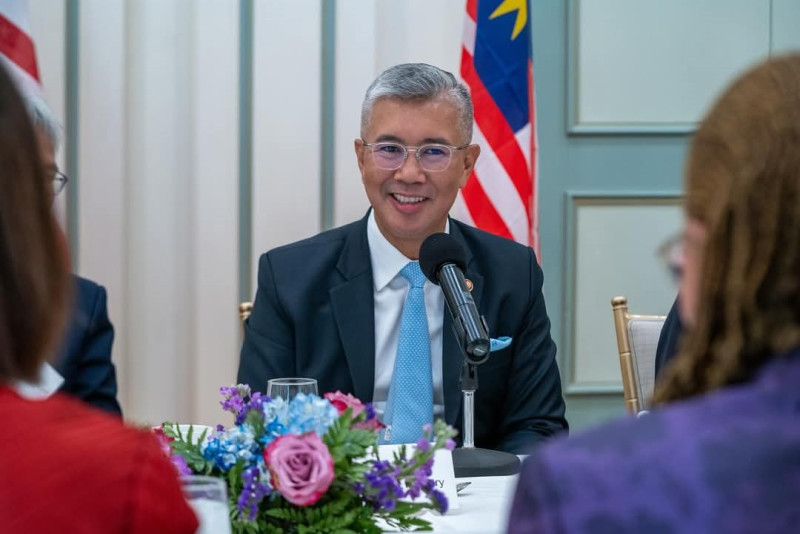
MALAYSIA’S Reciprocal Trade Agreement (ART) with the United States is not a voluntary option but a crucial step to protect millions of Malaysian jobs, according to Investment, Trade and Industry Minister Tengku Datuk Seri Zafrul Abdul Aziz.
He said the agreement allows Malaysia to retain its import tariff rate at 19 per cent—the lowest in ASEAN among countries with a trade surplus with the US.
“Without the ART, tariffs could potentially rise to 25 or even 40 per cent, as imposed on Myanmar and Laos. If tariffs increase, Malaysian exports will become less competitive compared to nations with lower rates.
“When exports decline, factories are forced to scale down production, and this eventually affects employment. In the long run, factories may close, and investors could relocate to countries offering better tariff advantages.
“But with the ART, we are grateful that we can maintain the 19 per cent tariff, the lowest in ASEAN among trade-surplus nations with the US,” Tengku Zafrul said in a video message on Facebook on Monday.
The minister was responding to comments by Pandan MP Datuk Seri Rafizi Ramli, who argued that Cambodia’s trade agreement with the US offers more favourable terms than Malaysia’s, particularly concerning the reciprocity clause. Rafizi noted that the Malaysia–US agreement requires reciprocal actions to be justified by mutual economic interests or national security considerations.
Tengku Zafrul expressed appreciation for Rafizi’s input, saying that most issues raised had been considered during negotiations. He also stressed that comparisons between Malaysia’s and Cambodia’s agreements should be contextualised according to their respective levels of development.
“Cambodia receives more favourable treatment due to its status as a least-developed country. It’s similar to how students from lower-income families receive certain privileges in the education system. Hence, the conditions imposed on Malaysia and Cambodia differ according to each country’s capacity,” he said.
Addressing concerns that the ART might undermine Malaysia’s sovereignty because the term ‘sovereignty’ is not explicitly stated in Article 5.1, Tengku Zafrul said such interpretations were inaccurate.
“Although the word ‘sovereignty’ is not literally mentioned, the contents of the article clearly show that Malaysia’s sovereignty remains intact.
“Among the clauses that safeguard Malaysia’s authority are those allowing Malaysia to choose its own approach, stipulating that implementation timelines must be mutually agreed upon, and ensuring that any actions are limited to shared economic or security threats. The agreement only takes effect if such threats involve mutual interests,” he explained.
He also referred to Article 5.2.3, highlighting that the mechanism for evaluating incoming investments is crucial for national security.
“Malaysia must not assess investments solely based on their monetary value but also the source of funds and background of the investors. We cannot allow illicit capital or individuals linked to terrorism to penetrate our economic system,” he said.
Tengku Zafrul clarified that the United States does not dictate which investments Malaysia should approve. Instead, Malaysia is encouraged to develop its own screening mechanisms aligned with international best practices and national security considerations.
Regarding the clause restricting purchases of nuclear reactors, fuel rods, and uranium, he explained that it applies only when alternative suppliers offering equivalent terms are available.
“If another country offers a better price, Malaysia is free to buy from them. It is not an outright prohibition,” he added.
The minister further emphasised that procurement commitments under the agreement do not involve government funds.
“The procurement list refers to existing plans by local and multinational companies. For instance, Malaysia Aviation Group’s purchase of Boeing aircraft had been announced earlier, even before the US administration introduced tariff measures,” he said.
Tengku Zafrul reiterated his commitment to continuing public engagement to improve understanding of the ART.
“We appreciate all views, including those from Rafizi, and will continue to explain each aspect so that Malaysians understand that this agreement is designed to protect our economy and safeguard jobs,” he said. - November 4, 2025