THE Home Ministry (KDN) has clarified that Malaysians will not be required to replace their existing MyKad cards when the new generation version is introduced beginning 1 June.
Home Minister Datuk Seri Saifuddin Nasution Ismail said the law only requires citizens to obtain a MyKad upon reaching the age of 12, and does not mandate simultaneous replacement of existing identity cards once a new version is introduced.
He said the rollout of the upgraded MyKad is intended to strengthen national identity document security through enhanced and modernised protection features.
“Currently, there are more than 20 million Malaysians who possess MyKad. So, I would like to ask the public not to rush on 1 June to the National Registration Department (JPN) to replace it. Take your time,” he said.
Separately, Saifuddin also said the new MyKad will feature significantly enhanced security measures, with 53 security features compared to 23 in the current card.
Among the new security elements are laser engraving, ultraviolet features, holograms, guilloche patterns, microtext, QR code integration for enforcement purposes, and an upgraded encrypted chip.
The minister said this upgrade reflects the government’s efforts to stay ahead of identity fraud risks and to strengthen the integrity of identity documents.
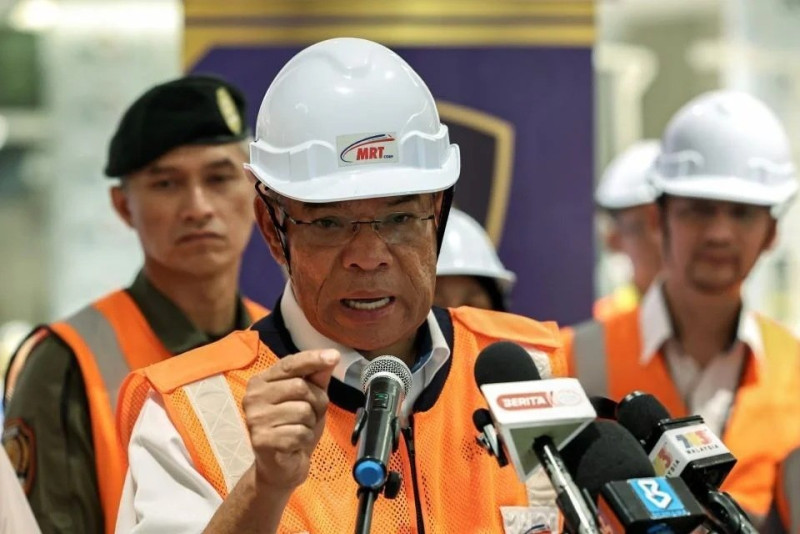
Saifuddin made the remarks after inspecting progress on the Johor Bahru–Singapore Rapid Transit System (RTS) Link project at the Customs, Immigration, Quarantine and Security (CIQS) Complex at Bukit Chagar.
In the same briefing, he said the RTS Link would operate under the highest security standards when it fully opens on 31 December next year, describing it as Malaysia’s busiest future land entry point.
He said the government is not only focusing on physical construction progress, which is now about 90 per cent complete, but also on overall operational readiness, including security systems, communications, technology and human resources.
“We know that border checkpoints are exposed to various security threats such as human smuggling, undocumented migrants, and other forms of illicit activity,” he said.
“So, when we want to ensure movement is seamless and fast, at the same time we use technology to ensure every movement is recorded, analysed and monitored so that there is absolutely no room for irresponsible parties to carry out illegal activities,” he added.
To strengthen border control, Saifuddin said the RTS Link will be equipped with 18 baggage scanners, 22 body scanners and 10 millimetre-wave imaging machines, all integrated with automated threat detection systems to ensure fast yet accurate screening.
He added that the entire border management system will be digitised, including the installation of 220 e-gates which are already in place.
The National Integrated Immigration System (MyNIISe) is also scheduled to be implemented in mid-June, replacing the existing MyIMMs platform.
“The use of this technology will allow every passenger movement to be recorded, analysed and monitored in real time to curb threats such as smuggling, human trafficking and illegal entry,” he said.
On manpower readiness, Saifuddin said 794 posts have been approved involving the Malaysian Border Control and Protection Agency (AKPS), the Royal Malaysian Customs Department and the Royal Malaysia Police.
A total of 478 newly recruited officers will undergo operational training at the Segamat Police Training Centre from 22 June to 27 September before being deployed to the Sultan Iskandar Building and Sultan Abu Bakar Complex from 1 October.
He also said Malaysia and Singapore are refining standard operating procedures for a co-located CIQ model, allowing enforcement agencies from both countries to operate within shared facilities.
“We are now at the highest level of coordination and trust with Singapore to ensure the RTS Link operates smoothly, in an orderly manner and safely,” he said.
The RTS Link is a four-kilometre shuttle rail system connecting Bukit Chagar in Johor Bahru with Woodlands in Singapore, and is expected to fully commence operations on 1 January 2027.
The system is projected to carry up to 10,000 passengers per hour in each direction during peak periods, offering a major solution to congestion at the Johor Causeway. - May 8, 2026