


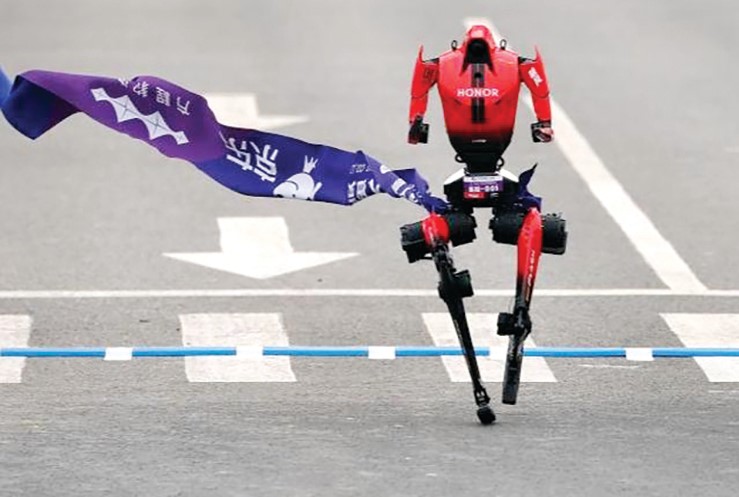
HUMANOID robots will take centre stage at Malaysia’s National Day celebrations this year, offering the public a glimpse of how advances in robotics and artificial intelligence are moving beyond laboratories and industrial settings into everyday public spaces.
Two humanoid robots, A1 and D1, are scheduled to appear at the Malaysia Marathon 2026 on August 30 before taking part in the National Day parade in Putrajaya the following day.
Their appearance is expected to highlight the rapid development of humanoid robotics, particularly in areas such as movement, balance, endurance and the ability to operate in environments designed for humans.
According to Honor, the technology represents a shift in robotics from machines primarily designed for repetitive industrial tasks towards systems capable of navigating and interacting within human environments.
“Such technology shows that robot development is no longer focused solely on repetitive tasks in the industrial sector, but is also moving towards systems capable of operating in spaces designed for humans,” it said.
The participation of D1 in a running event is particularly significant, with Honor noting that the robot previously competed in the Beijing E-Town Humanoid Robot Half-Marathon in April and emerged as the winner in its category.
Unlike wheeled robots, which can operate on relatively stable surfaces, bipedal humanoid robots must continuously maintain their balance while walking or running, control the movement of their limbs and adapt their steps to changing surfaces.
These capabilities depend on a combination of sensors, motion-control systems, mechanical actuators and artificial intelligence.
Sensors allow the robots to interpret their surroundings, while control systems process the information and determine appropriate movements.
Maintaining balance remains one of the most complex challenges for bipedal robots, as even small changes in the position of their centre of gravity can cause them to lose stability.
Honor said the development of humanoid robots could nevertheless offer significant advantages because much of the infrastructure used by humans is already designed around the dimensions and physical capabilities of the human body.
For Malaysia, the appearance of A1 and D1 at major national events represents more than a technological showcase. It reflects the growing visibility of robotics and AI in public life and the country's engagement with emerging technologies.
From research laboratories to running tracks and national celebrations, humanoid robots are increasingly being tested in environments that mirror real-world conditions.
The bigger question now is how such technology can ultimately be deployed responsibly to improve safety, productivity and quality of life while ensuring that humans remain firmly in control. - August 25, 2026














.jpg)
