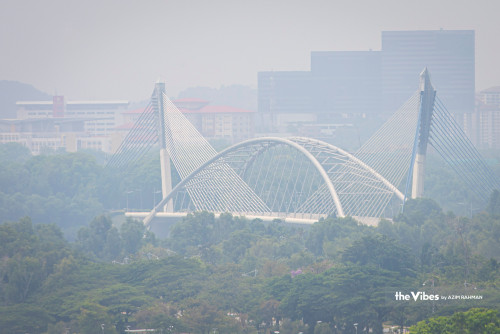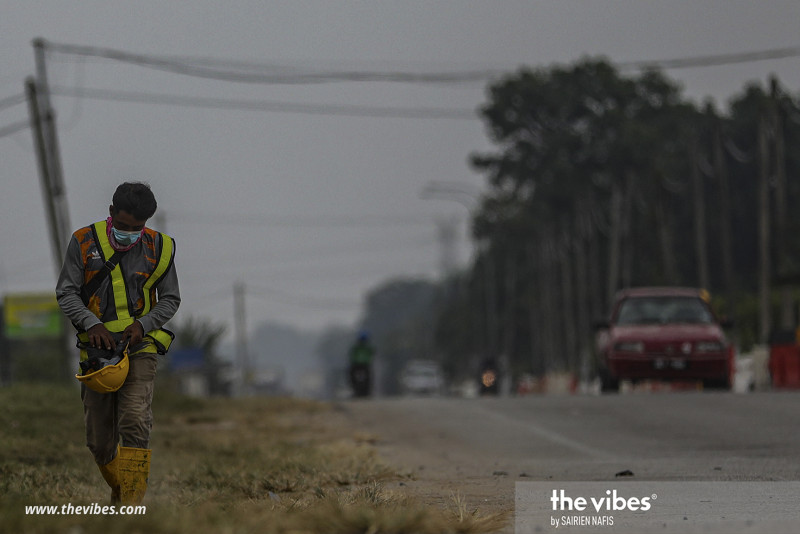
AIR quality deteriorated across parts of Malaysia this morning, with 34 monitoring stations recording unhealthy Air Pollutant Index (API) readings as haze continues to affect several states.
Data from the Malaysian Air Pollutant Index Management System (APIMS) showed Klang and Johan Setia in Selangor recording the highest readings at 192 as at 7am.
Other areas recording unhealthy air quality included Larkin in Johor (187), Bukit Rambai in Melaka (186), Nilai (185) and Seremban (182) in Negeri Sembilan.
In Selangor, Shah Alam recorded an API reading of 181, followed by Banting (171), Petaling Jaya (170) and Kuala Selangor (161).
Several areas in Johor were also affected, including Pasir Gudang (181), Batu Pahat (180), Tangkak (175), Pengerang (173), Kluang (164), Kota Tinggi (163) and Segamat (161).
In Melaka, Alor Gajah and Melaka City recorded readings of 178 each, while Putrajaya registered 176.
In Kuala Lumpur, Cheras recorded an API reading of 174 and Batu Muda 163, while Port Dickson in Negeri Sembilan recorded 175.
Unhealthy readings were also reported in Tanjung Malim and Seri Manjung in Perak; Temerloh, Jerantut, Indera Mahkota in Kuantan and Rompin in Pahang; Samarahan and Serian in Sarawak; Kemaman in Terengganu; and Minden and Seberang Perai in Penang.
Another 34 monitoring stations recorded moderate air quality, with Paka in Terengganu registering the highest reading in that category at 99.
Under APIMS classifications, API readings of 101 to 200 are considered unhealthy, while readings of 51 to 100 indicate moderate air quality.
Children, older people and those with respiratory conditions have been advised to reduce outdoor activities if the haze persists.
The deteriorating air quality comes amid continuing peatland fires in Indonesia, where underground smouldering can persist for weeks or months, producing toxic haze that affects neighbouring countries, including Malaysia and Singapore.
Known as “zombie fires”, the phenomenon occurs when peat continues to burn beneath the surface even after visible flames have been extinguished, making the fires difficult to detect and put out completely.
In parts of Indonesian Borneo, residents have faced thick, foul-smelling haze as fires spread through peatland near residential areas and plantations.
Unlike conventional forest fires, peat fires can spread underground without visible flames. Carbon-rich peat layers can retain heat for prolonged periods, allowing fires to reignite after surface flames have been extinguished.
The risk is particularly difficult to manage when water supplies are limited.
Smoke from peat fires contains hazardous pollutants, including formaldehyde, hydrogen cyanide and ammonia, as well as fine particulate matter known as PM2.5, which can penetrate deep into the lungs and enter the bloodstream.
Greenpeace research has found that peatland fires account for less than a third of Indonesia’s total forest fires but are a major source of the toxic haze affecting the country.
Amid mounting regional pressure, Indonesian Environment Minister Jumhur Hidayat has expressed confidence that the forest fires can be brought fully under control within a month.
He said the estimate was based on discussions with the National Disaster Mitigation Agency (BNPB) following an assessment of the current situation.
However, Jumhur acknowledged several operational challenges, including poor visibility that has hampered the use of helicopters for water-bombing operations.
On offers of assistance from other countries, he said the government was assessing the proposals before deciding whether to accept them.
“We need to first examine the type of assistance being offered and whether it would genuinely be beneficial and appropriate,” he said.
Jumhur’s remarks echoed those of Coordinating Minister for Political and Security Affairs Dudung Abdurachman, who met President Prabowo Subianto and confirmed that foreign assistance offers had yet to be discussed.
Indonesia previously received three CH-47 Chinook helicopters, personnel and supporting equipment from Japan, as well as firefighting powder from Brazil.
Japan’s assistance mission ended on Sept 29 after Jakarta expressed its appreciation for the support and said it was confident of managing the forest and peatland fires without further foreign assistance. - October 15, 2026