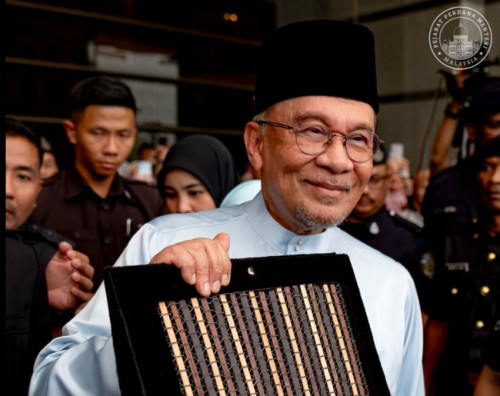

KUALA LUMPUR – Prime Minister Tan Sri Muhyiddin Yassin’s government is set to table the largest Budget in the country’s history, in a move to preserve the livelihood of Malaysian households and provide a much-needed boost to the economy amid the coronavirus crisis.
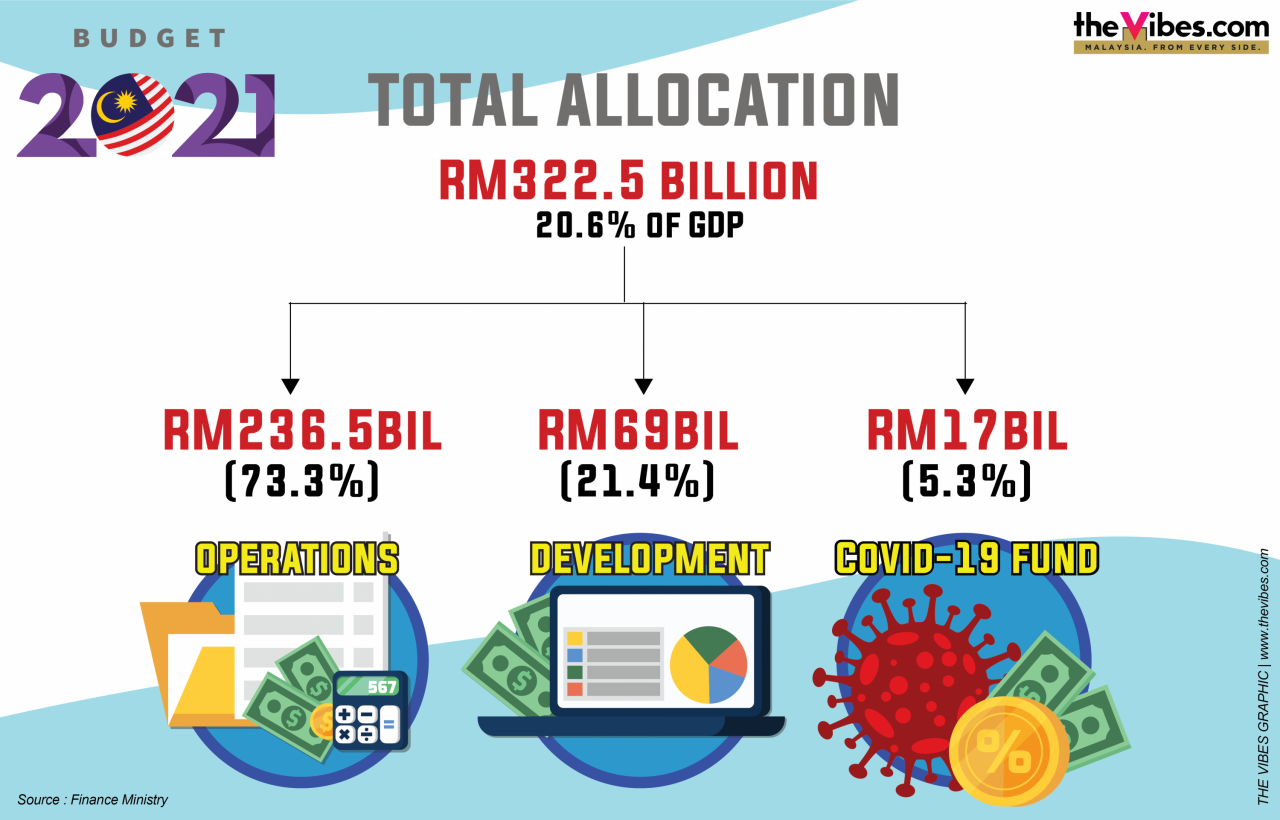
A total of RM322.5 billion, or 20.6% of gross domestic product, will be allocated for Budget 2021. Of this amount, RM236.5 billion will be channelled to operations (73.3%), RM69 billion to development (21.4%) and RM17 billion to the Covid-19 fund (5.3%), according to the Fiscal Outlook and Federal Government Revenue Estimates 2021 released today.
Federal government expenditure for 2020 had been revised upwards to RM314.7 billion from an initial estimate of RM297 billion. The net increase of RM17.7 billion was derived from a fiscsal stimulus injection estimated at RM38 billion and savings from expenditure amounting to RM20.3 billion.
The top three recipients of this year’s Budget, getting 38.5% of the total expenditure, or RM117.5 billion, are the Education Ministry, Finance Ministry and Health Ministry, in that order.
Below is a cost breakdown of Budget 2021:
Operating expenditure
Allocation is estimated to be higher at RM236.5 billion from this year’s revised Budget of RM226.7 billion, with the bulk channelled to emoluments, which constitute 5.4% of GDP, followed by supplies and services (2.1%), debt service charges (2.5%), retirement charges (1.8%), and subsidies and social assistance (1.2%).
Emoluments remain the largest component, constituting 35.7% of the operating expenditure (OE), or RM84.5 billion, contributed mainly by provisions for annual salary increments for civil servants. Retirement charges are estimated to increase by 2% to RM27.6 billion, representing 11.7% of total OE.
The amount includes pension payments, gratuity payments and cash awards in lieu of accumulated leave. Around 74% of the retirement charges comprise monthly pension payments for pensioners and beneficiaries.
RM39 billion is allocated for debt service charges next year. Of the amount, 97.7% is for the payment of coupons on domestic debts, while the balance is for offshore loans. The ratio of debt service charges to OE is estimated at 16.5%.
Supplies and services, which represent 13.9% of OE, is expected to rise by 8.9% to RM32.8 billion, mainly due to higher estimated outlays for repairs and maintenance, rentals, as well as an allocation for professional services.
The Health Ministry will receive the highest allocation at 29.2% of the supplies and services budget, mainly for the procurement of medical supplies, as well as repairs and maintenance of medical facilities, followed by the Education Ministry at 16%, with a substantial allocation for repairs and maintenance of school facilities.
Subsidies and social assistance, which comprise subsidies for goods and services, incentives and social aid, are projected to fall by 6.4% to RM18.9 billion, with the decline attributed to the consolidation of cash assistance programmes under Bantuan Sara Hidup and Bantuan Prihatin Nasional (BPN).
Grants to statutory bodies are allocated at RM15.4 billion, with most of the money going to operational expenses, such as emoluments, as well as supplies and services for public universities and teaching hospitals.
Grants and transfers to state governments are estimated at RM7.7 billion, of which RM5.7 billion is for constitutional transfers as stipulated under the federal constitution.
Development expenditure
RM69 billion will be allocated for development expenditure (DE), an increase of 38% from 2020. Of that amount, RM67.3 billion is in the form of direct allocation, while RM1.7 billion is for loans to state governments and government-linked entities.
Sector-wise, the largest recipient is the economic sector at RM39 billion, with a focus on transportation, trade and industry, as well as energy- and public utilities-related projects.
The transport sub-sector accounts for the largest share at 21.8% of total DE, or RM15 billion. Projects under the sub-sector include the upgrading, expansion and maintenance of highways, roads, railways, bridges, ports and airports, such as the construction of the Electrified Double Track Gemas-Johor Baru Rail Project, Pan Borneo Highway, KVDT1 and Rapid Transit System, as well as the expansion of Kuantan Port and the airport in Sandakan.
The energy and public utility sub-sector will be allocated RM3.3 billion, or 4.8% of total DE, in line with the government’s effort to provide a higher quality of living and improve rural access to public amenities. Projects under this sub-sector include providing and improving electricity and water supply, telecommunications access and sewerage services.
A sum of RM3.1 billion, or 4.5% of total DE, will be allocated to the trade and industry sub-sector, with programmes and projects focusing on strengthening entrepreneurial skills for small and medium enterprises (SMEs), promoting and enhancing technological adoption among businesses, accommodating the needs of industries, and developing entrepreneurs.
Among the projects and programmes are the PUNB entrepreneur financing programme, corridor development, as well as soft-loan schemes for automation and modernisation.
Also, the agriculture and rural development sub-sector will be allocated RM2.9 billion, primarily for padi irrigation, and oil palm and rubber replanting.
Meanwhile, the environment sector will be provided RM1.9 billion, mainly for flood-mitigation and river-restoration projects. And, allocation will be provided for the implementation of the National Fiberisation Connectivity Plan under communications.
The health sub-sector will receive RM4.7 billion, or 6.8% of total DE, or 0.3% of GDP, with a focus on expanding the overall health sector by way of constructing more hospitals and clinics, especially in small districts, with the aim of ensuring an affordable, equitable and accessible healthcare system.
Outlays will be provided for the upgrading and maintenance of hospitals and clinics, as well as the procurement of medical service vehicles and equipment. Major ongoing projects under this sub-sector include the construction of the Serdang Hospital cardiology centre, Putrajaya Hospital endocrine complex and Lawas Hospital, as well as the upgrading of Kajang Hospital and Tawau Hospital.
Other ongoing projects include the construction of the National Centre for Food Safety to enhance the country’s control of food safety and quality.
The security sector, comprising defence and internal security, will be allocated a DE of RM7.8 billion. Of the total, RM4.9 billion will be channelled to defence and RM2.9 billion to internal security.
The allocation will be used to upgrade military and security equipment, enhance the skills of security personnel, and develop integrated network services. Also, the allocation will be used for the construction and refurbishment of police stations, military camps, prisons and security personnel’s quarters.
The general administration sector will be allocated RM4 billion, with outlays mainly for the enhancing of digitalisation in government departments, as well as the refurbishment and maintenance of government buildings and facilities, such as civil servants’ quarters, courts and training institutions. Major projects include the Malaysia Government Integrated Communication and Government Hybrid Cloud Service.
Covid-19 fund
RM17 billion will be spent in 2021, mainly on the wage subsidy programme (WSP), small-scale infrastructure projects, SME soft loans and food security.
The sum is a remainder of the RM55 billion fiscal injection for various coronavirus relief packages under the Prihatin and Penjana schemes, with RM38 billion expected to be disbursed this year, and the bulk channelled to BPN and WSP.
The fund spans three years until the end of 2022. Its annual financial statements, which record actual spending, will be tabled in Parliament. – The Vibes, November 6, 2020