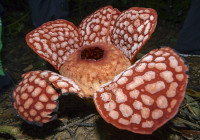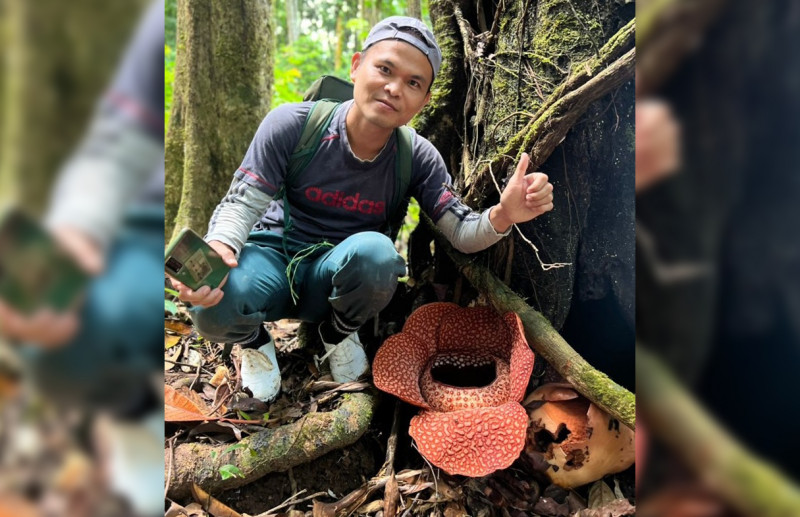
SANDAKAN – A rafflesia found in Silabukan in full bloom has excited professional botanists, seeing that the rare flower has never been found in the area as the plant is naturally found on the state’s west coast.
In a press statement today, the Sabah Forestry Department said a 14-man team made the discovery while conducting a forest inventory in the Silabukan Forest Reserve, around 50km east of Lahad Datu.
They found the rafflesia keithiii (r. keithii), measuring a spectacular 47cm in diameter, and an unopened rafflesia bud next to the matured flora, as well as another bud around 20m away.
Endemic to Borneo, r. keithii is the largest of three species of rafflesias found in Sabah.
The giant flower is a parasitic species that depends on host plants from the genus tetrastigma. The group identified the particular host plant as tetrastigma diepenhorstii.
This new discovery is considered rare and exciting because the species has never been recorded this far east of Sabah, according to Joan Pereira, a senior botanist at the Forest Research Centre in Sandakan.
Previously, the easternmost record of rafflesia in Sabah was a lone flower in the Danum Valley Conservation Area.
Botanical records show that r. keithii are found primarily on the west coast of Sabah (i.e. along the Crocker Range, Tambunan, Kota Marudu, and the Ranau area, including Kinabalu Park) at altitudes ranging from 250-940 m.
The jubilant Forestry Department field team was carrying out a forest inventory in the Silabukan Forest Reserve as part of a collaboration with WWF Malaysia to establish a land cover monitoring system for the larger Tabin landscape, covering about 450,000ha.
Apart from providing information on floristic composition and soils, Datuk Frederick Kugan, the chief conservator of forests, said the Forestry Department expects to produce a high-resolution carbon stock map for the Tabin landscape as an output of the inventory.
Kugan congratulated the field team for the interesting find, saying that it highlights the importance of the Silabukan Forest Reserveas a Class I Protection Forest. – The Vibes, July 14, 2022.