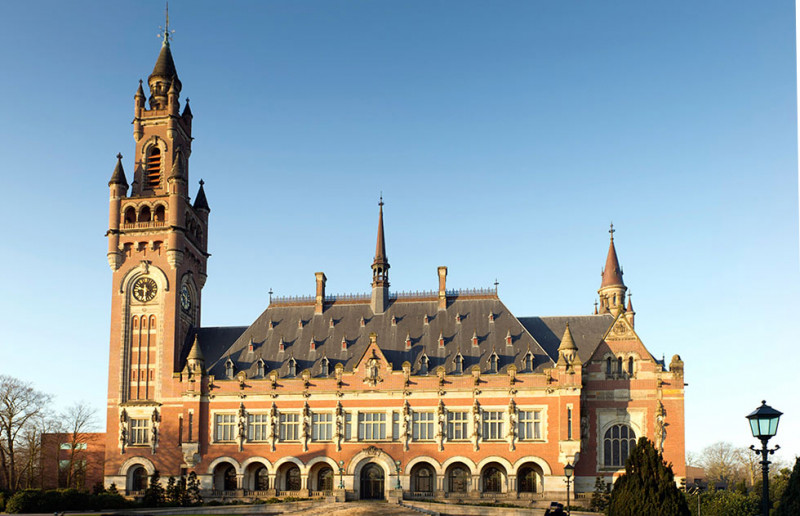
ON DECEMBER 29, 2023, South Africa instituted proceedings against Israel before the International Court of Justice (ICJ) on the ground that Israel has allegedly violated its obligations under the Convention on the Prevention and Punishment of the Crime of Genocide (the “Genocide Convention”) in relation to Palestinians in the Gaza Strip.
In instituting its action against Israel before the ICJ, South Africa seeks to found the Court’s jurisdiction on Article 36, paragraph 1, of the Statute of the Court and on Article IX of the Genocide Convention, to which both South Africa and Israel are parties.
It is facinating to note here that apparently Article IX of the Genocide Convention confers the ICJ a jurisdiction to hear "Disputes between the Contracting Parties ( Israel and South Africa ) relating to the interpretation, application or fulfilment of the present ( Genocide ) Convention, including those relating to the responsibility of a State for genocide or for any of the other acts enumerated in article III.."
On the last occasion, the ICJ ruled that Gambia could bring a genocide claim against Myanmar (Both are the contracting parties under the Genocide Convention).
In its landmark ruling in that case, the ICJ had also invoked erga omnes obligation and erga omnes partes right under the Genocide Convention to protect the Rohingyas against genocide.
In asking the ICJ to entertain its request for the indication of provisional measures (akin to injunctory relief) in order to “protect against further, severe and irreparable harm to the rights of the Palestinian people under the Genocide Convention” and “to ensure Israel’s compliance with its obligations under the Genocide Convention not to engage in genocide, and to prevent and to punish genocide”, South Africa has invoked Article 41 of the Statute of the Court and Articles 73, 74 and 75 of the Rules of Court.
By virtue of Article 74 of the Rules of Court, “[a] request for the indication of provisional measures shall have priority over all other cases”.
Though the hearing in the ICJ is likely to take years to finally resolve, South Africa has, nevertheless, called for the world court to convene in the next few days to issue “provisional measures” which are essentially calling for a ceasefire.
It goes without saying that requesting provisional measures is absolutely necessary in this case . As rightly stated by South Africa in its 84-page pleading in court, such provisional measures are duly sought in order "to protect against further, severe and irreparable harm to the rights of the Palestinian people under the Genocide Convention, which continue to be violated with impunity.”
Judging from the past precedents, the ICJ may, in all likelihood, grant South Africa such provisional measures.
Previously, the ICJ ruled by 13 votes to two for a provisional order that the Russian Federation shall immediately suspend military operations that it commenced on February 24, 2022 in the territory of Ukraine.
If we pore over South Africa’s 84-page pleading, we may say that the crux of its claims against Israel hinges on the latter's actions which it claims are genocidal in character because they are intended to bring about the destruction of a substantial part” of the Palestinians in Gaza.
Therefore, South Africa has duly asked from the court for a declaratory relief declaring that Israel “has breached and continues to breach its obligations under the Genocide Convention,” and to order Israel to cease hostilities in Gaza that could amount to breaches of the convention, to offer reparations, and to provide for reconstruction of what it destroyed in Gaza.
It also avers that genocidal acts include killing Palestinians, causing serious mental and bodily harm, and deliberately inflicting conditions meant to “bring about their physical destruction as a group.”
Unlike other international crimes , in a crime of genocide, the act must be committed with “specific intent (dolus specialis) to destroy, in whole or in part, a national, ethnical, racial or religious group, as such”.
In addition to that, South Africa has also pleaded in its pleading a slew of statements made by Israeli officials expressing genocidal intent on the part of Israel.
We may be fully aware that on 9/10/2023, the Israeli defense minister, Yoav Gallant was reported to have said "Gaza will become a place where no human being can exist... We are fighting human animals, and we are acting accordingly”.
A reservist major general, Giora Eiland, wrote in Yedioth Ahronoth, the Israeli newspaper: “ The State of Israel has no choice but to turn Gaza into a place that is temporarily or permanently impossible to live in”, a “creating a severe humanitarian crisis in Gaza is a necessary means to achieve the goal”. He also added that “Gaza will become a place where no human being can exist."
So far Israel’s government has rejected the genocidal claim made by South Africa and in turn claimed that South Africa’s case lacks a legal foundation and constitutes a “despicable and contemptuous exploitation” of the court.
Israel has also called South Africa’s case a “blood libel” and urged the ICJ to reject it.
Though Israel has a bad record of not respecting international tribunals, it, however, decides to defend itself this time around.
Historically, the term “ genocide” was coined by Raphael Lemkin in 1944 when he published his book titled 'Axis Rule in Occupied Europe'. Interestingly, he was a Jewish lawyer.
The claim made by South Africa in the ICJ entails legal disputes between member states of the UN under the Genocide Convention.
Hence only the ICJ is given a full mandate to hear such disputes. South Africa's suit does not involve criminal proceedings under the Rome Statute even though a crime of genocide is one of the four major international crimes enumerated under the Rome Statute.
Hence the criminal jurisdiction of the International Criminal Court ( ICC ) is not invoked in this case.
Under International Criminal Law, any criminal proceeding that needs to be brought against Israel, for instance, can only be brought against any individual who, in the opinion of the Office of the Prosecution in ICC, has allegedly committed a crime of genocide. – The Vibes, January 5, 2024
Mohamed Hanipa Maidin is a former MP for Sepang. He has a master's degree in international law.