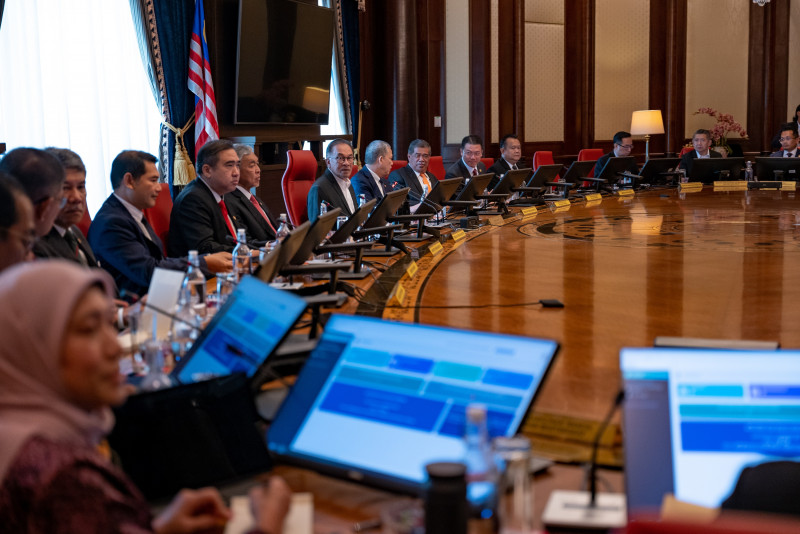
THE latest Cabinet reshuffle under the Madani Government is being widely viewed as more than a routine redistribution of ministerial portfolios, reflecting Prime Minister Datuk Seri Anwar Ibrahim’s strategic effort to balance expertise, experience, administrative demands and Malaysia’s complex political realities.
Associate Professor Dr Ku Hasnita Ku Samsu of Universiti Putra Malaysia’s Faculty of Human Ecology told Bernama the new appointments, promotions and portfolio changes signal a deliberate attempt to strengthen government effectiveness while preserving political legitimacy within a multi-party, multi-ethnic system.
“The Cabinet reshuffle reflects an attempt to balance merit and politics, reform and experience, as well as continuity and change.
“Its effectiveness will ultimately be measured not merely by the Cabinet’s composition, but by how far the line-up of ministers can translate political mandates into effective policies that are felt by the people,” she said.
From a merit-based standpoint, Ku Hasnita noted that several appointments point to a stronger emphasis on professionalism and subject-matter expertise.
“Among them are Akmal Nasrullah Mohd Nasir, who has an economics background, Dr Zulkifli Hasan with expertise in syariah, and Datuk Seri Arthur Joseph Kurup, who brings international experience, including serving at the World Trade Organisation.
“This approach aligns with civil society’s calls for a Cabinet formed based on capability and knowledge,” she said.
At the same time, political considerations remain integral to the reshuffle. Ku Hasnita highlighted the appointment of Adam Adli Abdul Halim as Deputy Minister of Higher Education as carrying symbolic weight, particularly in addressing sentiments linked to student activism.
“She said this reflects a pragmatic approach aimed at sustaining political stability in a plural society.
The reshuffle also reinforces the government’s agenda for generational renewal, with younger leaders being elevated to ministerial roles, including Dr Mohammed Taufiq Johari, 29, and Akmal Nasrullah, 39.
“The appointment is seen as an effort to bring the government closer to young voters, particularly the Undi18 group, which now makes up almost 30 per cent of the electorate. While the inclusion of younger leaders offers fresh perspectives and a stronger understanding of digital technology, observers note that limited administrative experience may pose challenges in managing crises or navigating complex policy negotiations,” she said.
On the question of professionalism, Ku Hasnita observed a clear inclination towards technocratic governance, with many of the new ministers possessing strong academic credentials alongside private-sector or international experience, potentially introducing market-based approaches and global best practices into public administration.
In terms of representation, she noted that Hannah Yeoh remains the most prominent female figure in the Cabinet, while the appointment of Marhamah Rosli as Deputy Minister in the Prime Minister’s Department for Religious Affairs further strengthens women’s participation in the administration.
She added that the appointment of specific figures to oversee Sabah and Sarawak affairs is widely interpreted as a response to long-standing demands under the Malaysia Agreement 1963 and the rising influence of the Borneo Bloc in federal politics.
Ku Hasnita also said promoting deputy ministers to full ministerial roles helps maintain policy continuity, while portfolio reshuffles are intended to inject new perspectives and prevent policy stagnation.
“However, such changes also require an adjustment period, which may affect the momentum of policy implementation in the short term,” she said.
On 16 December, Anwar announced the Cabinet reshuffle involving 28 ministers and deputy ministers, along with portfolio changes and new appointments, as part of efforts to enhance administrative efficiency and improve policy delivery.
The Prime Minister also named six new deputy ministers and confirmed several portfolio adjustments, including the elevation of Deputy Minister of Higher Education Datuk Mustafa Sakmud to Minister in the Prime Minister’s Department in charge of Sabah and Sarawak affairs.
This marks the second Cabinet reshuffle under Anwar’s Unity Government, following the first adjustment made in December 2023. - December 18, 2025