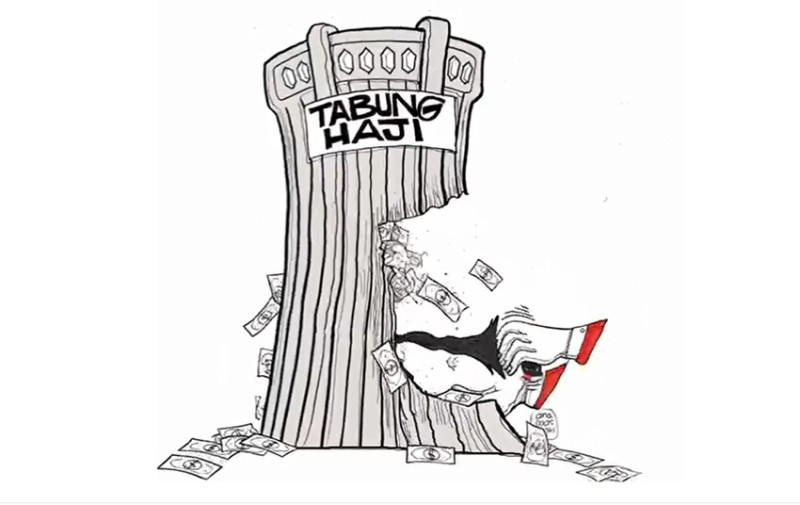

THE Tabung Haji scandal has produced plenty of questions about who did what, who knew what and who should be held responsible.
Those questions need answers.
But there is another question that may matter even more: what has actually changed to make sure this never happens again?
The Royal Commission of Inquiry found serious weaknesses in Tabung Haji’s governance and political interference in its management and profit distribution. The government has said 75% of the RCI’s 25 recommendations have already been implemented, with the remaining measures being worked on.
That is encouraging.
But implementation should not be the end of the conversation. It should be the beginning of a much harder one.
Because Tabung Haji is not just another government-linked institution.
For millions of Malaysians, it is where they save for haj.
And for many ordinary Malay families, particularly those who do not have much money to spare, those savings are built slowly.
RM50 here. RM100 there. Sometimes less.
It may take years before there is enough to feel that the dream of going to the Holy Land is getting closer.
That money carries a different weight.

So when we talk about Tabung Haji losing money, making bad investments or suffering from poor governance, we should remember who is ultimately behind those figures.
It is not just a balance sheet. It is someone’s savings. Someone’s hope.
Someone who may have spent years believing that the institution created to help them perform haj was looking after their money.
That is why the issue of trust cannot be treated as a public relations problem.
It is an institutional responsibility.
And Malaysians should not be told to simply trust that everything is fine because the people running Tabung Haji today are different.
People change. Governments change. Boards change. Chief executives change.
The rules and safeguards are what should remain. That is where the real reform has to happen.
If the past showed us anything, it is that an institution can have highly qualified people on paper and still make terrible decisions.
So the answer cannot simply be to find better people.
It has to be to build a system that makes it harder for anyone to make a bad decision without being challenged.
Major investments need proper independent scrutiny. Conflicts of interest should be declared, recorded and dealt with.
Procurement must be transparent enough for someone to ask why a particular company was chosen and whether the institution got value for money.
And those sitting around the boardroom table must be able to say “no” when something does not look right.
That sounds basic. It should be. The same applies to politics.
The RCI’s findings on political involvement should not be brushed aside as something that belonged to another era.
Tabung Haji manages money belonging to ordinary people. It should therefore be run professionally, not according to the interests of whichever political group happens to be in power.
That does not mean politicians have no right to scrutinise Tabung Haji. They absolutely do.
But there is a difference between oversight and influence. One asks questions.
The other can determine answers. That line needs to be kept clear.
There is also a bigger problem with the way Malaysians sometimes talk about Tabung Haji.
Because the institution has a religious purpose, there can be a tendency to treat criticism of it as if it is somehow criticism of the institution’s mission.
It isn’t. A depositor asking where his money went is not attacking Tabung Haji.
A depositor asking why an investment failed is not being disloyal.
A depositor asking who approved a decision is not undermining the institution.
It is exactly what a responsible depositor should do. And the institution should welcome those questions.
Because transparency does not weaken trust. It is how trust is earned.
The people who need that trust most are not the people sitting in boardrooms.
They are the depositors. The teacher putting aside RM100 every month.
The small trader who saves whenever business is good. The pensioner who has spent years putting money away.
The family that has been saving for their parents. These are the people who cannot afford for their savings to become collateral damage in a governance failure.
And this is where the question of whether Malaysians are being properly informed becomes important.
People can be misled without anyone actually lying to them.
If information is buried in corporate language, complicated structures and decisions that ordinary depositors cannot reasonably understand, then the public is being left with only one option: trust.
That is not enough anymore. The poor depositor should never be the last person to know what happened to his money.
There should also be no fear inside the institution about speaking up.
An employee who spots something wrong should have a safe way to report it.
Whistleblower protection should be real, not something mentioned in a policy document and forgotten.
Sometimes the person who saves an institution from its next scandal is the person sitting at a desk who notices something that does not add up.
Give that person a reason to speak. And give management a reason to listen.
The RCI report is now public. The government says most of its recommendations have already been implemented, while enforcement agencies are also examining the findings.
This is the point where everyone will move on to the next political argument.
They should not. The report should become a reference point every time a major decision is made at Tabung Haji.
Every board appointment. Every major investment. Every large procurement exercise.
Every decision involving depositors’ money.
The question should always be: would this decision survive the scrutiny we now know was necessary? If the answer is yes, good.
If not, stop and ask why. That is how an institution learns. Not by saying it has moved on.
But by refusing to forget why it had to change in the first place.
Tabung Haji can recover financially. It can rebuild its reserves. It can improve its returns.
But financial recovery alone is not enough.
The real recovery is when depositors can look at the institution and know that their money is protected not because they happen to have good people running it today, but because the system itself leaves much less room for abuse, political interference or reckless decision-making.
That should be the legacy of the scandal.
Not another report. Not another apology.
Not another change of faces. A stronger institution.
One where the next person who tries to repeat the mistakes of the past finds that the safeguards are already there — and the doors are no longer open. – August 19, 2026
See video here https://www.facebook.com/reel/1575482160617850