By Hasnah Rahman
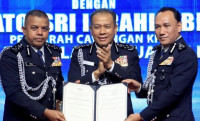
There are police officers who are remembered for the positions they held. Others are remembered for the principles they stood for. Tan Sri Ayob Khan Mydin Pitchay appears to belong to the latter. When the former Deputy Inspector-General of Police retired in July 2026, he left behind more than a distinguished career spanning almost 35 years.
He also left behind a reputation for being a no-nonsense officer — firm, disciplined and, by many accounts, unwilling to compromise when it came to enforcing the law. In a profession where public trust is often tested, such a reputation is no small achievement. The tributes that followed his retirement, including expressions of appreciation from journalists and members of the public, reflected the respect he had earned beyond the corridors of Bukit Aman.
But perhaps the more interesting question is not what Ayob Khan achieved during his years in uniform. It is what Malaysia might still gain from a man whose experience, leadership and understanding of the country's security challenges remain relevant.
From Pendang To Bukit Aman
Ayob Khan's journey from humble beginnings in Kedah to the second-highest position in the Royal Malaysia Police is a story of determination, discipline and professional advancement. Over nearly three and a half decades, he served in some of the country's most demanding areas of law enforcement. His career included leading the Counter-Terrorism Division of the Special Branch, serving as Johor police chief, heading the Narcotics Criminal Investigation Department and later the Criminal Investigation Department.
In June 2023, he was appointed Deputy Inspector-General of Police. Few officers have had such extensive exposure to the different dimensions of policing, from intelligence gathering and counter-terrorism to organised crime and narcotics enforcement. During his years in counter-terrorism, Malaysia faced the growing threat of extremist networks, including those linked to the Islamic State. Much of the work involved preventing threats before they materialised — an aspect of policing that rarely receives the same public attention as crimes already committed. It is a difficult profession in which success is sometimes measured by what never happens.
When Crime Meets Influence
Ayob Khan also became associated with investigations into organised crime networks, including the widely publicised case involving businessman Nicky Liow. The case raised broader questions about the reach of criminal syndicates, the influence of wealth and the challenges confronting enforcement agencies when investigations involve individuals with extensive connections. It also highlighted a fundamental issue facing any criminal justice system: the need to demonstrate that investigations are conducted without fear or favour, while ensuring that allegations are tested through due legal process. No individual should be presumed guilty simply because of public allegations.
Equally, no individual should be beyond investigation because of wealth, status or influence. For an enforcement officer, navigating that balance requires more than toughness. It demands sound judgement, investigative discipline and an unwavering commitment to the rule of law.
These are qualities that become particularly important when investigations attract political attention or intense public scrutiny.
Integrity Must Begin At The Top
In August 2026, Ayob Khan spoke publicly about the importance of political will in combating corruption. His central message was that integrity must begin with leadership, and that institutions cannot be transformed if wrongdoing is tolerated or concealed. It is a straightforward principle, yet one that remains difficult to translate into practice.
Malaysia has no shortage of anti-corruption campaigns, integrity pledges or governance frameworks. What the country continues to need is consistent implementation. Public confidence is not built through slogans. It is built when people see the law applied fairly, investigations conducted professionally and those entrusted with authority held accountable.
The challenge is not simply to have strong institutions on paper. It is to ensure that those institutions are led by individuals with the competence, independence and moral courage to fulfil their responsibilities.
The Leadership Malaysia Needs
This brings us to a larger question. Should the retirement of an experienced public servant automatically mean the end of his contribution to national leadership? At 60, Ayob Khan may have completed his career in the police force, but his experience in intelligence, investigations, security and organisational leadership remains valuable. Malaysia faces increasingly complex threats, from transnational criminal networks and cyber-enabled fraud to corruption and sophisticated financial crime.
These challenges require leaders who understand how criminal networks operate, how institutions can be compromised and why enforcement agencies must be protected from improper interference. One institution where such experience could be relevant is the Malaysian AntiCorruption Commission (MACC). This is not to suggest that Ayob Khan has sought, been offered or is being considered for its top position. Rather, his career invites a broader discussion about the qualities Malaysia should seek when appointing leaders to institutions entrusted with safeguarding the public interest.
A future MACC chief, for example, should possess not only investigative experience but also the ability to command public confidence, protect institutional independence and uphold due process. The same principles apply to other important national institutions. Of course, no individual's reputation, however favourable, should substitute for transparent selection, appropriate scrutiny and effective institutional checks and balances. Strong leadership matters. But strong institutions must never depend entirely on one individual.
A Career Ends, A Contribution Need Not
Since retiring, Ayob Khan has continued to be associated with efforts to promote integrity, including his appointment to chair the Football Association of Malaysia's Integrity Committee. It is an example of how experience gained in public service can remain useful beyond the institution in which it was acquired. There are other possible avenues through which Malaysia could benefit from his expertise, whether in institutional reform, national security, governance or advisory roles.
The question should not be whether another position can be found for a retired senior officer. It should be whether his knowledge and leadership can help address a genuine national need. And that consideration should apply to all capable former public servants, not merely those who have enjoyed prominent careers.
Beyond Rank And Recognition
Perhaps the greatest measure of a public servant's legacy is not the rank attained, the medals received or even the positions held. It is whether the principles associated with that person continue to command respect after the authority of office has ended. For Ayob Khan, the uniform has come off. The responsibilities of a Deputy Inspector-General of Police have passed to someone else.
But the experience accumulated over nearly 35 years has not disappeared. Nor has Malaysia's need for leadership that combines firmness with fairness, courage with accountability and authority with integrity. At a time when public confidence in institutions remains an important national concern, Malaysia should be looking carefully at the talent, experience and institutional knowledge already available to it.
Not every retired officer needs another appointment. Nor should any individual be considered indispensable. But neither should retirement become a convenient reason to overlook someone who may still have much to contribute.
The real question is not whether Tan Sri Ayob Khan needs another position. It is whether Malaysia can still benefit from the experience and principles he brings to public service. And that is a question worth asking. - November 23, 2026