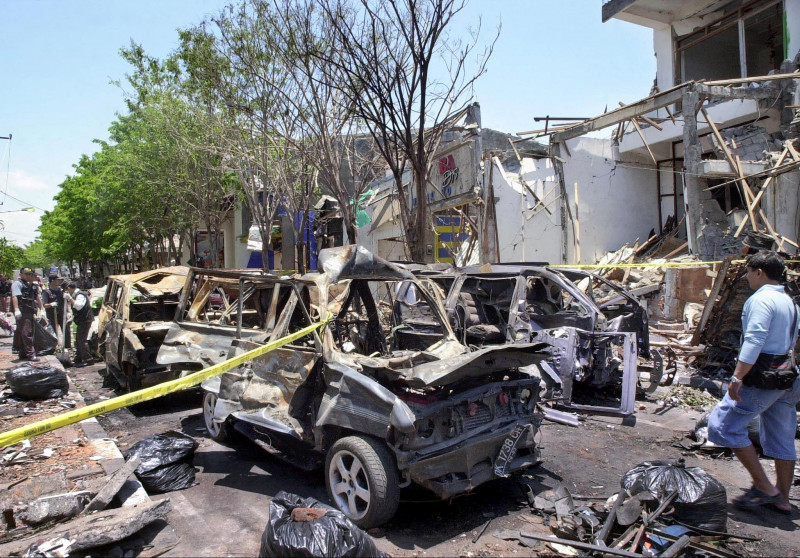
THE United States has brought military charges against Indonesian Hambali and two Malaysians indicted over the Bali and Jakarta hotel bombings.
This has been 18 years in the making to prove the trio’s involvement under the US military justice system, which would be debatable if it were under civilian laws and prosecution.
The laws apply to military and combatants, and the trio have been placed under the military justice system, which has stricter extradition laws. US Homeland Security Department and intelligence services will not compromise on allowing individuals deemed a high-level security threat to be extradited to any country and subjecting them to a civilian justice system.
Hambali was al-Qaeda’s Southeast Asian representative, as he was a trusted loyalist and worked closely with Osama bin Laden. He had many engagements with Osama, and many operational plans of attack in Southeast Asia were shared.
Hambali, who also lived in Malaysia, had travelled within the region to ensure funding for Islamist groups.
Another reason was to make it known to these groups that he headed al-Qaeda’s operations in Southeast Asia, besides leading Jemaah Islamiyah (JI).
NCTN-IACSP resource person Nasir Abbas, the former head of JI Mantiqi 3 in Indonesia, Hambali, and Abu Bakar Baasyir hold Malaysian permanent resident status.
Hambali was the mastermind of both the Bali and Jakarta attacks, and was instrumental in the Christmas Eve bombings in 2000, making it a point to target Christians in Indonesia.
Malaysians Mohamad Nazir Lep and Mohammad Farik Amin were co-conspirators in the Bali and Jakarta bombings, as they were involved in the planning and ensuring the movement of funds to JI’s Unit Khos, a specialised military unit under the leadership of Zulkarnaen, who was captured in Lampung, Indonesia, last year. Hambali had provided the plans to both Nazir and Farik.
They were also involved in providing intelligence and supporting the cause. Funding was provided to Noordin Top, another Malaysian who, in JI’s early days, was living in Johor, where the group operated, and conducted training for Malaysians.
He made sure the payouts covered the logistical and operational needs of the attacks, which he oversaw, including the makings of the bombs.
Unit Khos
This specialised military wing of JI in Southeast Asia, with its operational unit based in Indonesia, carried out the Bali and Jakarta bombings, as well as many other attacks. Unit Khos was initiated by Zulkarnaen, and there exist four other similar units with different commanders, including Nasir himself.
However, some members of Unit Khos under Zulkarnaen decided to join Hambali’s operations and be under his leadership, hence disobeying Zulkarnaen.
Zulkarnaen’s involvement in the attacks is not clear. Though he did attend the first meeting to plan the Bali bombings, he did not appear for further meetings.
“It was Unit Khos members who carried out the deadly attacks in 2002 and 2003,” said Nasir, who is also a resource person to Densus 88 of Indonesia’s Counterterrorism Unit.
Mukhlas aka Ali Ghufran, a commander of a unit under him, and members of Unit Khos under Zulkarnaen were responsible for coordinating and detonating the bombs.
Extradition not an option
It is not an option for the US government to extradite Malaysians or Indonesians to face charges in their home countries.
The terrorist trio are regarded by the Homeland Security Department as a “Tier 1” threat.
Malaysia has also not adopted a clear national action plan for countering violent extremism leading to terrorism.
With regard to Malaysia, Yazid Sufaat and Dr Abdullah, a hardcore JI leader, were sentenced over terrorism, with their jailing extended to eight and seven years, respectively, from the initial four. This is because they still held true to their radical and violent extremist Islamist ideologies.
These are only two out of a few who have not been deradicalised. As such, US authorities are not in favour of the Malaysians being extradited, as they feel these individuals will not be able to be deradicalised if sent back home.
It is also known that during Yazid’s imprisonment, he tried to radicalise prison officers. He was transferred to another location, and the guards were also assessed and transferred out.
Yazid was the key leader in organising the 9/11 meetings held in Malaysia, and worked alongside Hambali.
The meeting was held at a hotel in Petaling Jaya. The initial plan was to hijack two aircraft from Thailand en route to the World Trade Centre in the US.
Owing to the lack of trust in deradicalisation programmes and the measures taken, the US is not ready to reconsider the Malaysians for extradition. Indonesia, on the other hand, does not want to take the risk, as these are high-profile Islamist ideologues who demand high levels of deradicalisation.
The Indonesians have also made it clear that they will not take back any citizen who has joined a terrorist organisation.
Rehabilitation and deradicalisation
According to Nasir, one of the reasons these hardcore Islamists are not easily deradicalised is that Malaysia does not have clerics or ustaz who are able to challenge their arguments and counter their belief system, and may not be fully knowledgeable on international Islamist terrorist narratives.
He said Yazid and others still follow their spiritual leader, Abu Bakar, who continues to believe that strict, radical syariah law must be adopted.
Nasir feels that Malaysian authorities do not have a sound deradicalisation programme.
He also supports the decision taken by US authorities to charge and indict the trio in the US, because he sees Hambali, Nazir and Farik as being considered martyrs and heroes who survived the “infidel wars”, leaving a high-level detention centre with no concrete criminal charge in the US.
He claims that Malaysia and Indonesia are not ready to deradicalise Islamist fighters held at the Guantanamo detention camp. Indonesia is being realistic in not bringing Hambali back, acknowledging its limited capabilities.
However, he said, Malaysia has good anti-terrorism measures and security laws to limit the movements of former terrorists.
Conclusion
The adoption of the US military justice system for the trio is welcomed because, among other things, it will prevent further interventions, including civilian legal challenges and from governments that the US does not feel comfortable with.
The US military court is the right institution to deal with the perpetrators, as they are imprisoned in a military prison in wartime.
As they are considered combatants and have military training, they should be tried under the military justice system.
The Indonesian deradicalisation programme is now being shared and introduced to the European Union through the Nordic Counter Terrorism Network, a specialist think-tank on Islamist terrorism based in Helsinki, Finland.
In Indonesia, NCTN-IACSP’s deradicalisation programmes are in use. They have a high scientific application to provide real data that is reliable in the assessment of terrorist conditioning and high-level terrorist operatives.
These programmes are delivered to foreign security agencies, and collaborate with Indonesian authorities. And, an NCTN fellow has been appointed chairman of the Indonesian Ulama Council. – The Vibes, January 30, 2021
Malaysian-born Andrin Raj is director of the Nordic Counter Terrorism Network (NCTN) based in Helsinki, Finland; Southeast Asia regional director for the International Association for Counterterrorism and Security Professionals (IACSP) Centre for Security Studies; expert at the European Expert Network on Terrorism; and, associate fellow at the Centre for Security and Violent Extremism, University of Indonesia