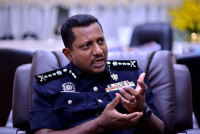
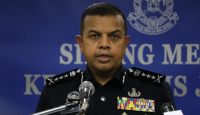
THE seizure of 650kg of Captagon from a container at Port Klang in Selangor by the Narcotics Crime Investigation Department earlier this month indicates the evolving threat of the nexus between crime and terrorism.
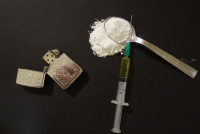
Captagon, dubbed the “jihad drug”, is an amphetamine used to enhance the capabilities of strength, endurance and bravery of the human body through a hallucination, psychological state of mind.
According to news reports, the Royal Malaysia Police and Saudi Arabia’s General Directorate of Narcotics Control, in a joint intelligence operation, confiscated the container, which departed from the Middle East. However, they did not state from which part of the Middle East the container was flagged off.
Saudi ports are known to be conduits for drug shipments leaving the kingdom and other Gulf states in the region.
Drugs used by Islamist terror groups are nothing new.
During the Afghan war, the Taliban and mujahideen forces used drugs to enhance their fighting capabilities and keep themselves awake, as well as fund their operations in later years.
During the turn of the century, the criminal dealings and use of smuggled narcotics, and threat of terrorism, grew, with terror groups using such activities to fund operations in the Middle East and globally.

Al-Qaeda is one of the earliest international terrorist organisations to realise that the use of drugs is vital in operational combat, and smuggling them proves lucrative to fund global operations. Later on, other Islamist terror groups followed in its footsteps.
Security agencies are aware of drug smuggling operations by terrorist organisations, and the threat these transnational crimes pose – such as the case of the Liberation Tigers of Tamil Eelam, who smuggled drugs to fund its operations in Sri Lanka.
Drug smuggling is considered a profitable and “secured” business as it not only involves criminals, but also the public, including government officials and politicians.
The container seized in Port Klang was reportedly headed for West Asian countries, which include those in the African and Asia Minor regions.
Malaysia has long been a conduit for drug smuggling as it sits in between two major continents and Southeast Asia’s lanes of communications. Seafaring container ships from the East to the West, or vice versa, will have to make their way through the Straits of Malacca, where they will likely transit.
In Europe, jihadist groups, such as al-Qaeda and the Islamic State (IS), have continued to advocate the use of drugs to potential recruits, who are “soul searching” in Islam and are either alienated, depressed or discriminated against in the continent.
These potential recruits are usually advised to seek medical treatment for mental health issues. And during prescribed medication, they are moulded, indoctrinated and radicalised to prepare them for jihad (a struggle or fight against the enemies of Islam) and lone wolf attacks.
Lone wolves who carry out attacks in Europe are almost always associated with having some kind of mental illness by authorities, until further investigations reveal the true nature of the crime.

The “jihad drug” is considered a “fighting” drug, according to sources provided to the Nordic Counter Terrorism Network, and has been used by IS, as well as Boko Haram and al-Shabaab in Africa, and Abu Sayyaf in the Philippines.
Drugs prescribed by medical practitioners for mental illnesses are able to modify the emotional and mental well-being of a patient. They can be purchased from any drug store.
It is uncertain whether security agencies are monitoring social media platforms, which contribute to the recruitment and radicalisation of potential terrorists. Social groupings are also hotspots for recruitment, and where drugs play a role. Extremist groups use Arabic or non-European languages online, making it hard to officially ascertain the connection between the platforms and radicalisation.
The “jihad drug”, if it is indeed a nexus between crime and terrorism, tells of an enduring international threat. It can be sold and profited off by terror groups, who see conflict zones in Africa, West Asia and Southeast Asia as “cash cows”.
Busts, raids and seizures may temporarily disrupt terrorism, but these profit-making activities have been evolving and growing globally.
The smuggling of Captagon is rampant in the Middle East’s conflict region, where it is used as a “fighting tool” for Islamist militia when in combat as it boosts bravery, courage and the will to fight in engagement with security forces.

The use of drugs in terrorist attacks have also evolved, and is still evolving.
For example, whenever Boko Haram attacks security forces, it usually wins most of the fights. This is not only because of its increase in numbers, but also due to the “fighting drug” pushing members to fight to their deaths.
What is the solution to these threat evolutions brought about by the “jihad drug”?
Profit-making crimes will not be easy to curtail as politicians, law enforcement, border controls and security agencies are tempted by cash and corruption, thus making this an unending business, with criminal groups prepared to give payouts to anyone.
To prevent such crimes, governments need to combat corrupt practices among civil servants and criminal organisations, and prosecute everyone involved, regardless of their position.
A strong political will is needed to curtail this threat. If left unaddressed, the nexus between crime and terrorism will only grow. – The Vibes, April 21, 2021
Andrin Raj is Nordic Counter Terrorism Network director, and Security and Violent Extremism Research Centre, University of Indonesia, adviser and associate fellow