THE Permatang Pauh MP deserves a commendation for coming out strongly against the Penang South Reclamation Project (PSR).
What is more, Nurul Izzah Anwar’s stance on this issue has validated years of tireless struggles that were mounted by Penang Forum and other civil society organisations against the Penang government’s unthinking decision to embark on a massive reclamation project to finance the Penang Transport Masterplan (PTMP).
It is worth mentioning here that before this controversial and monstrous project had become public knowledge, the Centre for Policy Research and International Studies of Universiti Sains Malaysia was commissioned in 2015 by former Balik Pulau MP and deputy health minister Datuk Seri Helmi Yahya to undertake a comprehensive social impact assessment on the repercussions of this inhumane project on not only the people in the immediate vicinity of the project but also on the wider population of Penang, northern Perak, and southern Kedah.
Our findings were presented to the then Environment Minister Datuk Seri Wan Junaidi Tuanku Jaafar who agreed with our findings, and who then decided not to approve the environmental impact assessment submitted by the state.
Although it started out as a plan to solve the increasing traffic woes in the state, PSR has taken on a life of its own, morphing into a vicious creature that is hell bent on destroying not only the environment but also the very social fabric that had coloured the south of Penang for generations.
For those of us who are familiar with the state, we know that Penang has been a manufacturing and tourism hub in Malaysia since the 1970s, when the then Penang government led by Tun Lim Chong Eu charted the industrialisation of the state.
The industrialisation plan led to Penang receiving a lot of foreign direct investments and being dubbed the Silicon Island of the East. Once a thriving free port, the state was transformed into an industrial hub producing semiconductors and electrical and electronic products.
While most parties would agree that the industrialisation had some negative externalities in the form of environmental damage and traffic congestion, the proposed PTMP remedy to this problem will not only destroy the biodiversity in the state but will put more cars on the street as well.
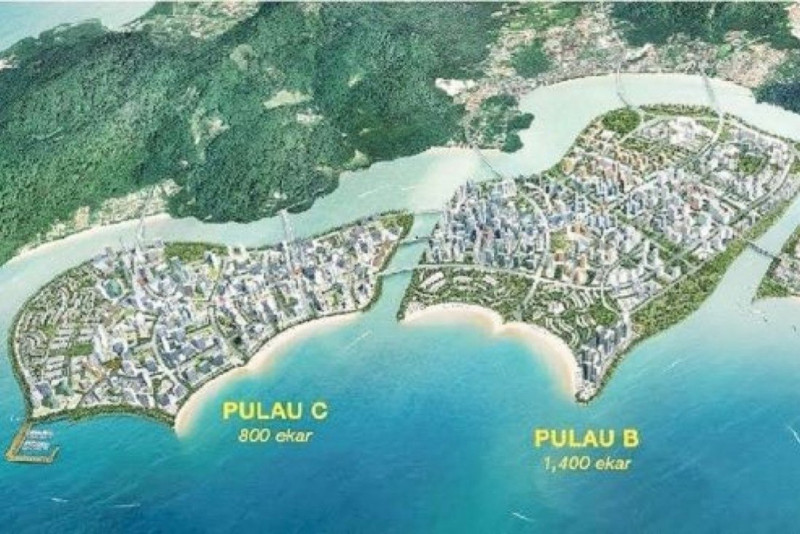
This is the primary reason why the PTMP drew huge opposition from civil society organisations – and to fund this mammoth project requires the reclamation of an area measuring 4,500 acres off the coast of Permatang Damar Laut.
Put in another way, this massive reclamation will not only lead to a shrinking fishing zone and destruction of fishing grounds but also to an increase in sea pollution and sedimentation.
Besides leading to a declining fish and prawn population, which make up the bulk of the fishermen’s catch, the breeding areas of cockles and mussels will also be badly affected, leading to their extinction.
It is refreshing to note that there is still a progressive and young politician like Nurul Izzah coming out strongly against this inhumane and mindless project. Her observation that the state does not need the project augurs well with the sentiment among environmentalists and the fishermen.

The state government’s claim that the PSR would in and of itself bring about a huge multiplier effect is anything but realistic.
With the current health crisis and the concomitant economic meltdown, a financial plan to sell land to fund the PTMP will surely hit a snag.
Even if the state argues that PSR will provide an engine for the state to leapfrog into Industrial Revolution 4.0 (IR 4.0), reclamation in and of itself will not propel the state there.
Leapfrogging into IR 4.0 is beyond land matters; it requires a paradigm shift and a steady supply of human capital that is ready to embrace it.
Surely, PSR has been hijacked by the developers when the Penang government entered into an agreement in 2015 with SRS Consortium Sdn Bhd as the project delivery partner (PDP) for the entire PTMP, except for the three highways and tunnel project being undertaken by CZC.
SRS Consortium comprises Gamuda Bhd (60% stake), Loh Phoy Yen Holdings Sdn Bhd (20%) and Ideal Property Development Sdn Bhd (20%). To part finance the PTMP, the PDP will be awarded the reclamation rights of 1,500 acres (607ha) of land.
Initially, the land to be reclaimed would be on the Middlebank – a grassy, muddy sandbank in the middle of the Penang channel.
However, after a public outcry against the reclamation of an ecologically sensitive area that is home to a variety of marine life, the state backtracked on its plan.
Any thinking person would come to the full realisation that the reclamation works and building more highways will not propel Penang into the next stage of growth. If anything, this project will fill the deep pockets of the developers, destroy the environment, and kill the fishing industry.
Once again, I would like to congratulate YB Nurul Izzah Anwar for taking a stance that is in line with the welfare of the people and the sustainability of the environment. – The Vibes, June 2, 2021
Associate Professor Azeem Fazwan Ahmad Farouk is the director for the Centre for Policy Research and International Studies of Universiti Sains Malaysia (USM)