
WHEN deciding where to invest, it is only natural that we want to put our money into companies we believe will increase in value. You may also only want to invest in companies that reflect your personal values. However, to investigate individual companies and then decide whether to invest or not and how much to invest is time-consuming, potentially error-prone, needs continual monitoring, and could cost money as you pay the price for trading those individual shares.
There are stock market indexes that carry out this analysis for you, and you invest in the index, rather than in individual shares, knowing the type of companies that the investment manager has chosen and that they fit with your own values. The FTSE4Good Bursa Malaysia (F4GBM) index is one such example. It was launched in December 2014, comprising companies drawn from the FTSE Bursa Malaysia Emas Index (which includes 98% of companies listed on the main Malaysia stock exchange), but which have been chosen for their environmental, social and governance (ESG) track record.
When the F4GBM index was launched, it contained 24 companies, with its constituent companies being monitored and regularly refreshed. In June 2020, the number of companies in the index was 73. In December 2020, it was updated, with two companies removed (Bumi Armada and Sunway Construction) and four added (AirAsia Group, Eco World Development Group, Hibiscus Petroleum, and KLCC Prop & REITS – Stapled Sec), leading to the 75 companies that make up the index today.
The criteria by which companies are assessed are transparent, at least to the companies being assessed. Governance of the index is overseen by an independent and international body, the FTSE ESG Russell Advisory Committee.
The question we now have is: how does the index perform? It is one thing to ensure that we are investing in the types of companies that reflect our values, but we still want to make money and ideally, want our investments to perform better than if we invested our money elsewhere.
The index’s fact sheet, from 26 February 2021, provides a comparison between the F4GBM and the Emas index showing how they have performed over the last five years (see Table 1).
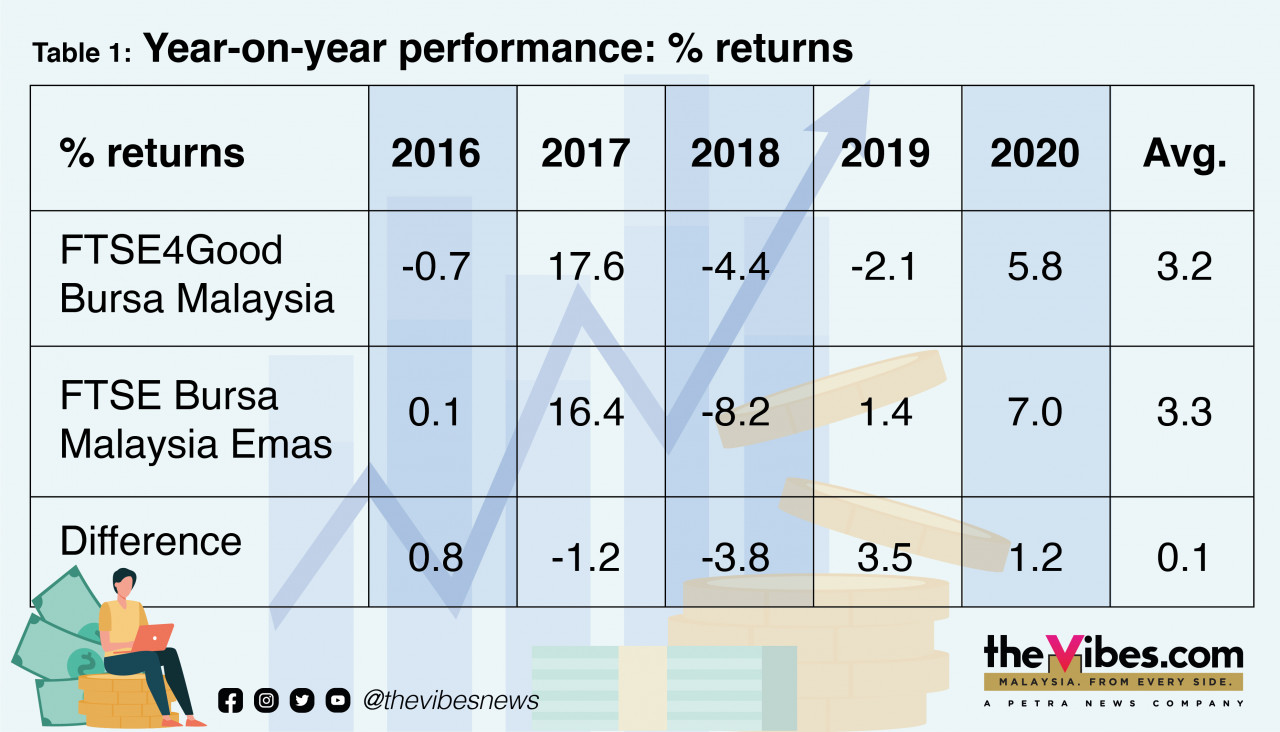
The table shows over five years that the indexes have performed almost identically (a return of 3.2% compared with 3.3%). However, the average hides some large differences in the individual years. If you had invested in Emas or F4GBM in 2018,you would have lost money but almost 4% more if you had invested in the F4GBM index. In 2020 though, we would have made 7.0% by investing in F4GBM, 1.2% more than if we had invested in Emas.
Overall though, the two indexes performed almost identically on average. You were just lucky (or not) if the index you invested in performed better than the other one in any given year.
What if we compare against other stock markets, including some from other countries? To do this, we will look at the closing prices each day, rather than the calculated returns shown in Table 1. We do this as it is difficult to easily compare due to foreign exchange differences, any dividends received, and trading charges/taxes that are levied. The closing prices alone are a good indicator of how that market has performed and, importantly, we can compare across different markets in a fair way.
Table 2 shows the markets we used. We have looked at a couple of Western markets (United Kingdom and United States) as well as some of the main local markets. We also tried to look at all the Asean markets (those with an A after their name), but this proved difficult, as some appear not to be listed on the platforms we were accessing, so the majority of the 10 Asean countries are not included in the analysis.
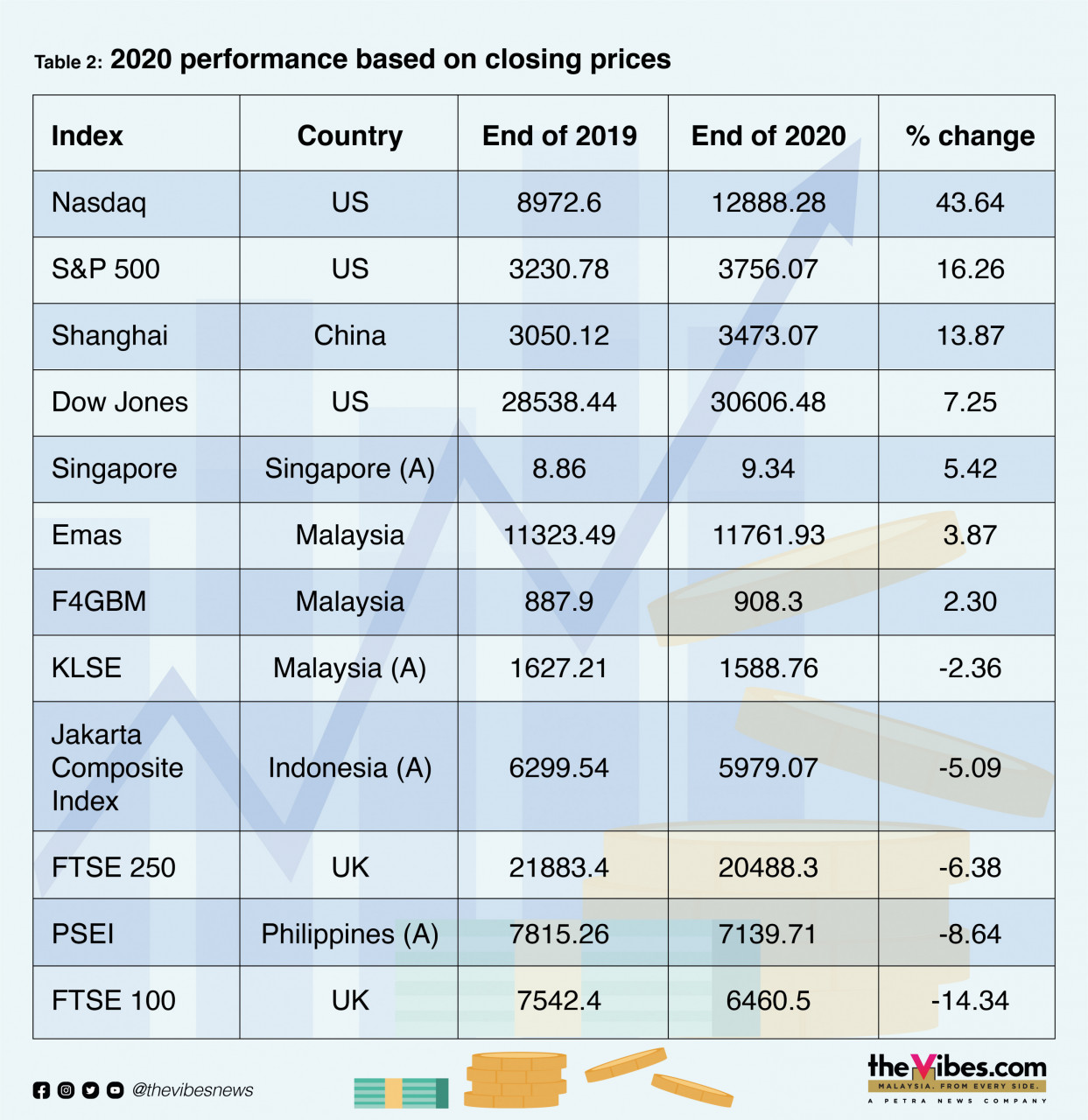
The table is sorted by percentage changes from the start of 2020 to its end. Aside from the obvious observation that we all wished that we had invested in Nasdaq, or even the S&P 500, what else can we say?
The Malaysia indexes are well down the table, and what is disappointing from the point of view of this analysis is that F4GBM did not perform as well as Emas, which is where F4GBM’s stocks are drawn from. On a brighter note, F4GBM outperformed the main Malaysia stock exchange. It is also pleasing to note that investing in F4GBM would have been profitable, at least based on just the closing prices.
What is the take-home message from this? If you were simply looking to make a profit, you would have invested in the US (and avoided the UK). If you wanted to invest in Malaysia while sticking to your personal beliefs about the type of companies you wanted to invest in, then the FTSE4GoodBursaMalaysia index would not be a bad choice. It performed almost identically to Emas (Table 1) and outperformed the main Malaysia index when compared on closing prices in 2020 (Table 2).
Perhaps the most pressing question is: do you believe in the companies that make up the F4GBM, as we are putting our faith in the judgment of others? Not only that, but we are also trusting the index managers to distribute the funds across the various companies in the best way.
We are also buying into the criteria by which the companies are chosen. In this case, environmental, social, and governance. Even if you fully agree with the vision of the index, there are many like it around the world, so why choose this one? What about the balance between the three factors which underpin this index? Would you prefer to see more weight given to environmental and social, rather than governance?
There will never be an ideal index for you, unless you do all the analysis yourself and invest your time and resources in developing your own. Most people do not have the time or the expertise to do that, so we might just have to leave it to those that do and accept that we have to compromise.
So now your choice is what index you prefer, rather than what individual companies you should invest in. – The Vibes, June 5, 2021
Professor Graham Kendall is the chief executive of the Good Capitalism Forum