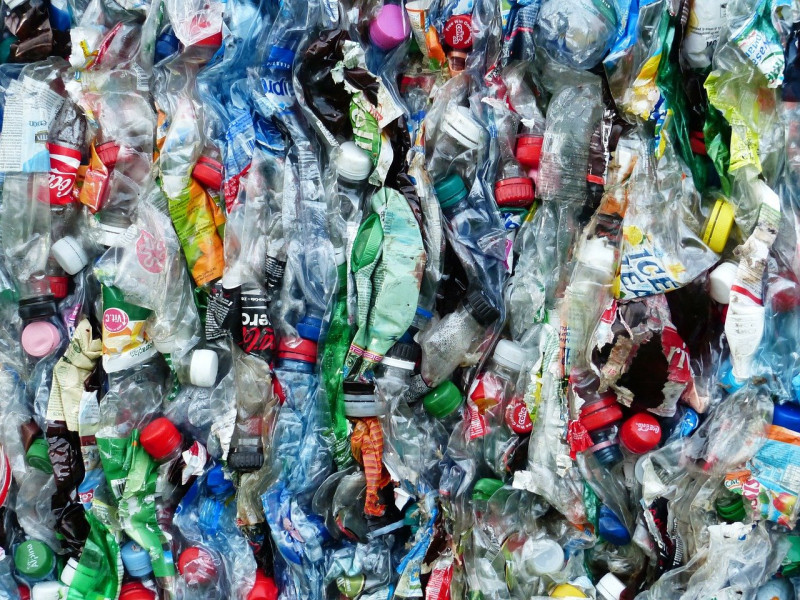
THE first fully synthetic plastic, known as Bakelite, was invented in 1907. Over more than 100 years, the plasticity of this product, being easily moulded, extruded or pressed into objects of various shapes, plus a wide range of other properties, such as being lightweight, durable, flexible and inexpensive to produce, have led to its widespread use.
Plastics are an invention that has changed human lifestyle, bringing us convenience and safety at optimum cost. There are reasons behind plastics being the material of choice for various sectors, whether packaging, automotive, medical, or electrical and electronics (E&E). Lightweight, effective barrier properties, and a small carbon footprint are some of the advantages of plastics compared with alternative materials.
Throughout the Covid-19 pandemic, plastics further proved their value in safeguarding frontliners and the rakyat, with personal protective equipment, such as masks, face shields, jumpsuits, isolation gowns and more, made primarily from plastics.
We cannot imagine what the world would be without electricity, but many fail to realise that without plastics, there would be no power supply, as the insulation around electrical wires is made of plastics.
The pandemic has forced us to work and attend school from home, which has resulted in a spike in the need for a myriad of E&E products, all of which have plastic parts and components. Plastic packaging has been at the forefront of keeping food safe from contamination during the pandemic.
In short, the world would be very different without plastics as a “friend”.
Despite the many reasons why plastics are so important to our safety and modern lifestyle, they have also been regarded as a “foe” of the environment with the increasing attention given to environmental issues, such as marine litter arising from plastic waste pollution. As plastics are widely used in our daily lives, the mismanagement of plastic waste due to the irresponsible human behaviour of littering and ineffective waste collection have caused leakages of plastic waste into the environment.
Plastics, being lightweight, are easily blown/washed from one place to another due to wind or rainwater, and are highly visible, especially in rivers and the ocean. This gives the public an inaccurate perception that all waste in the environment consists of only plastics.
With this negative public sentiment on plastics and public pressure on local governments to react and respond to the issue of plastic pollution, certain countries, including Malaysia, have implemented policies such as banning certain plastic products.
The Malaysian Plastics Manufacturers’ Association (MPMA), representing the local plastics industry, acknowledges that plastic pollution is, indeed, a threat to the environment and needs to be addressed effectively. As a responsible trade association that drives the plastics industry forward while placing special focus on sustainability and the environment, MPMA would like to provide its insights into this matter.
While plastics have proved their importance functionally and economically over the years, how do they perform environmentally? Life Cycle Assessment (LCA) is the scientific methodology used in measuring, assessing and determining the environmental impact of a material or product from raw material extraction through material processing, manufacturing, distribution, usage and disposal.
Numerous studies have shown that conventional plastic packaging, such as bags, has the smallest carbon footprint compared with packaging made from alternatives like paper, biodegradable materials, cotton and others.
For example, a report published by Denmark’s Environment and Food Ministry in February 2018 compared the LCA of different types of grocery bags, and concluded that conventional plastic bags provide the overall lowest environmental impact compared with other types, as shown in the table below.
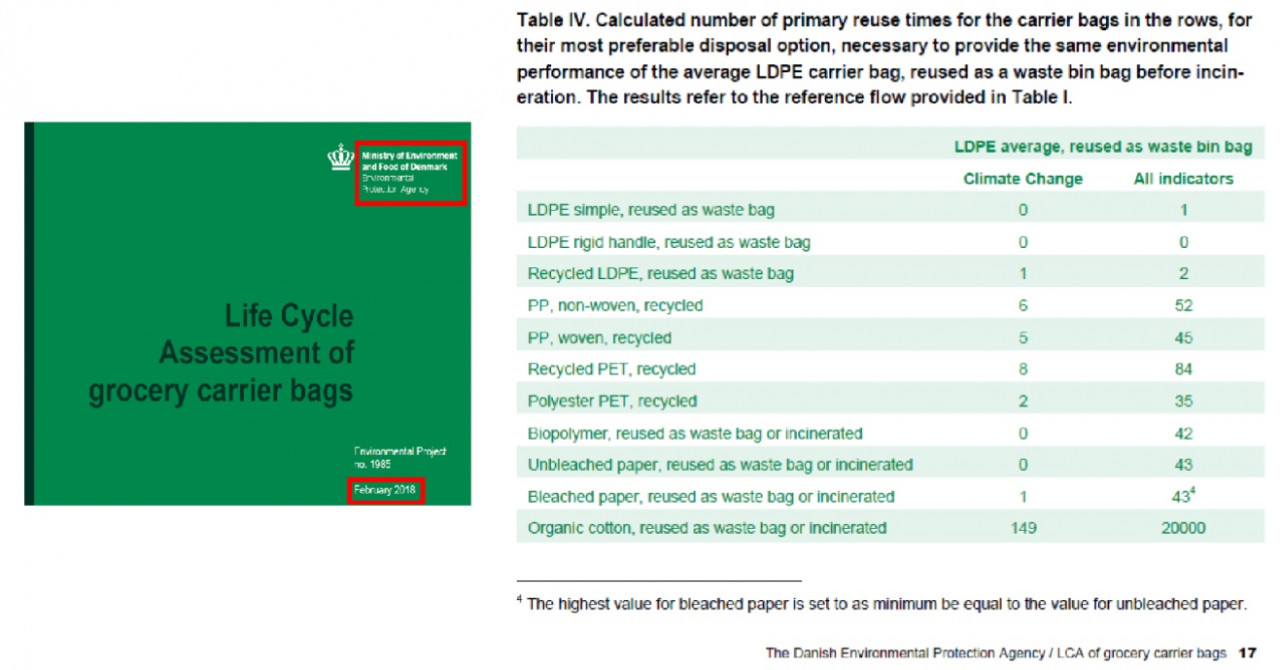
Indeed, on the basis of the above, the banning and replacement of plastics with alternative materials that have a bigger carbon footprint will lead to irreversible climate change.
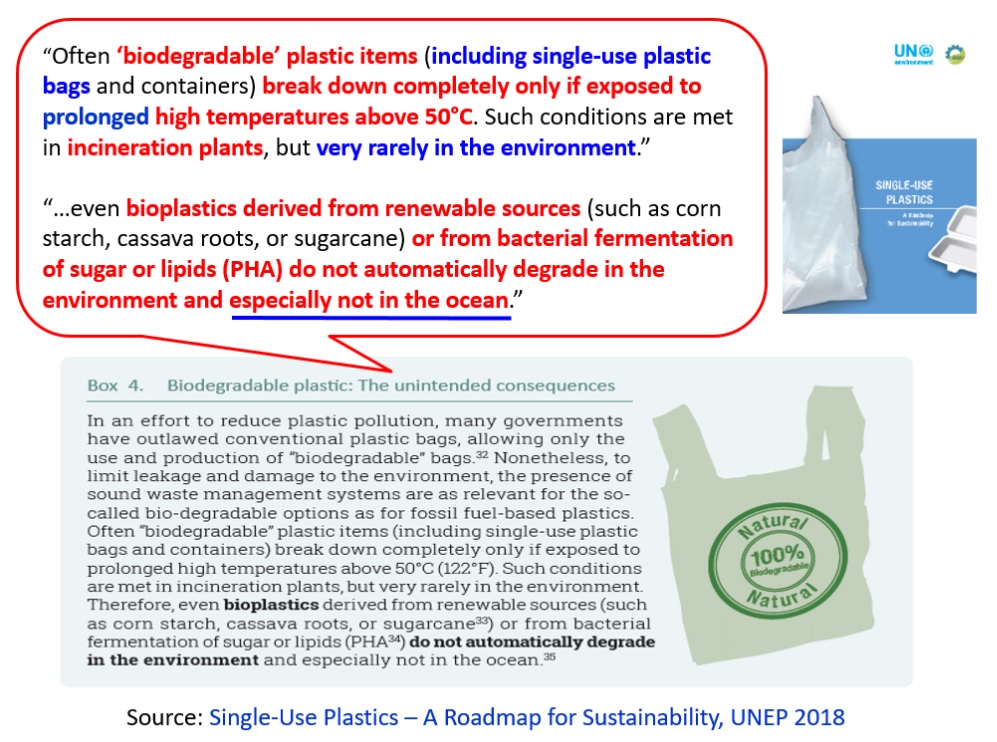
Yet another perception is that biodegradable plastics are the magic bullet to replace conventional plastics. However, the reality is that the United Nations Environment Programme (UNEP), being the premier global body on the environment, in its report Single-Use Plastics – A Roadmap for Sustainability highlighted that “in an effort to reduce plastics pollution, many governments have outlawed conventional plastic bags, allowing only the use and production of biodegradable bags”. Often, “biodegradable” plastic items (including single-use plastics bags and containers) break down completely only when exposed to prolonged high temperatures above 50°C. Such conditions are met in incineration plants, but very rarely in the environment.
Therefore, even bioplastics derived from renewable sources, such as cornstarch, cassava root or sugarcane, or from the bacterial fermentation of sugar or lipids (PHA), do not automatically degrade in the environment, and especially not in the ocean. The original extract from the report can be seen in the diagram below.
We wish to stress that MPMA is not against biodegradable plastics. However, while the material has certain niche applications, it generally lacks the functional properties required in most applications, and crucially, as stated by UNEP, it does not degrade under normal environmental conditions or in the ocean.
Even if plastics score well scientifically in terms of carbon footprint, indicating their lesser impact on global warming (which is a critical environmental issue), the visibility of plastics pollution has damaged the image of plastics globally. To address this issue, the solutions proposed and implemented have to address the root cause of plastics pollution: littering.
Littering is a behavioural problem and does not discriminate against the type of products or materials. Thus, the banning of plastics will not effectively solve pollution from mismanaged waste. Take countries like Japan, for example.
Japan has a substantially higher level of plastics usage, and yet, it does not face any issue with plastics being an environmental problem, simply because plastic waste is managed responsibly and effectively by not littering and through proper segregation, recycling and sound waste management practices. We should learn from the Japanese and inculcate this positive attitude of being responsible for our own waste.
The Malaysian plastics industry has been advocating the responsible management of plastic waste through the practices of not littering, waste separation at the source (SAS), and the 3Rs (reduce, reuse, recycle) for many years, echoing the same efforts by the government. Numerous communication, education and public awareness programmes have been organised by MPMA to educate students and the public on the importance of not littering, and separating plastics from other waste for recycling to give plastics a second life.
Malaysia has a mature and vibrant plastics recycling industry, and this could tremendously reduce the amount of waste sent to landfills.

All these are fundamental for the plastics industry to achieve a circular economy, which MPMA strongly believes is the way forward as it balances the economic interests of the industry while addressing the issue of plastics pollution. A circular economy enables the sustainable use of plastics, in which at the end of their usage, plastics can be collected effectively to be channelled back into the production process through recycling, thus closing the loop and preventing the leakage of plastic waste into the environment.
The thrust of a circular economy is the recycling sector. Despite the negative perception towards plastics recycling due to heavy coverage in the media on the blatant actions of illegal operators, the local plastics recycling sector is heavily regulated and closely monitored by numerous government agencies, such as the Environment Department (DoE) and National Solid Waste Management Department (NSWMD), to ensure compliance with environmental regulations in the country. MPMA fully supports the government’s move to take strong and fast action against these illegal operators.
MPMA has a strong commitment towards ensuring a developed plastics recycling sector with the launch of the An Advanced Plastics Recycling Industry for Malaysia white paper in 2019. Published jointly with the Malaysian Plastics Recyclers’ Association (MPRA) in collaboration with Monash University Malaysia, the white paper outlines the plastics industry’s strategies to maximise resource recovery and reduce pollution so that the country can enter a genuine state of a circular economy.
To conclude, we believe we can all continue to enjoy the benefits that plastics bring to us by managing plastics the right way. The most effective way to minimise the leakage of plastics into the environment is to always use a bin and separate plastics for recycling. The industry is working hard to bring about positive change; from brand owners looking to improve the design of plastics packaging for recycling and upstream resin producers investing in chemical recycling technology to recyclers working closely with the government to further develop the local plastics recycling sector.
Whether plastics are a “friend” or “foe”, it is all up to us. Let’s not litter, and always use a bin. Let’s learn to separate our waste to make recycling a culture in Malaysia. – The Vibes, June 27, 2021
C.C. Cheah is vice-president of the Malaysian Plastics Manufacturers’ Association and chairman of its recycling sub-committee



.jpeg)