
THE latest nationwide lockdown came into effect on June1, initially for two weeks. It was later extended for another two weeks, running from June 15 to June 28, and was then extended again, this time indefinitely, until three conditions were met. Once met, the country will move to Phase 2 of the National Recovery Plan (NRP).
The Vibes reported previously that Phase 1 involves a full lockdown, which is currently in force, and that the government will consider moving to Phase 2 only when daily coronavirus cases fall below 4,000.
The second condition that must be met is that the health service is able to cope, particularly with regard to beds at intensive care units (ICUs).
The final condition is that 10% of the Malaysian population has been fully vaccinated. On July 9, it was reported that this target has been met, so we can ignore this indicator for the rest of this article.
The key figure that most people seem to be focusing on is the requirement that daily cases must be below 4,000. The problem with using absolute figures is that as other figures change, for example, the number of tests carried out, the absolute figure becomes meaningless, or at least less meaningful.
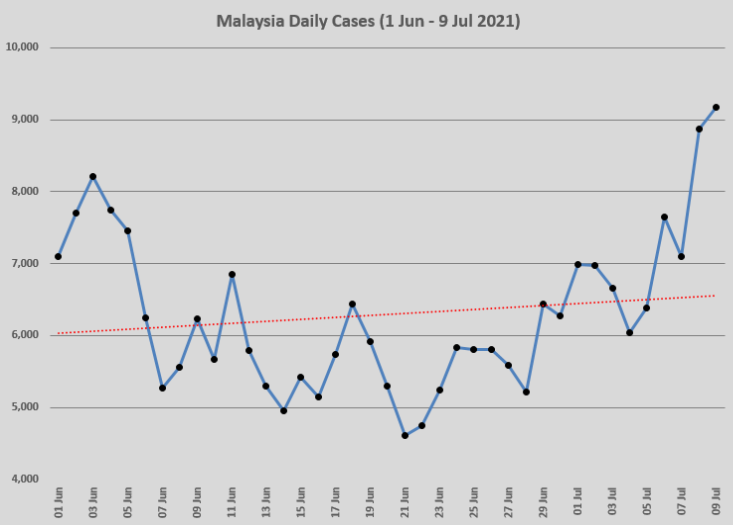
Based on data, Figure 1 shows the number of daily cases from June 1 to July 9, with the dotted line showing an overall (upward) trend. Despite a decrease in the middle of June, the numbers have risen in the past few days, reaching an all time high on July 9 of 9,180. Rather than getting closer to the 4,000 target we appear to be going in the opposite direction.
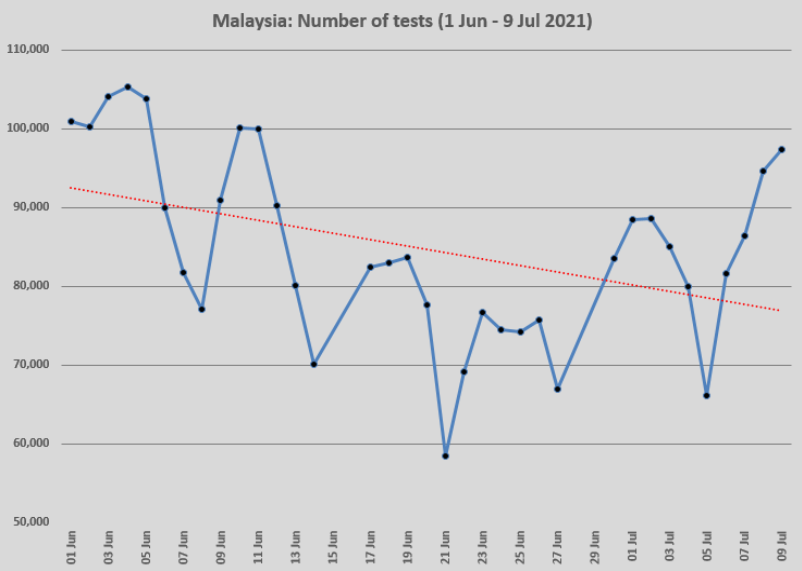
But that is only half the story, as we should also consider the number of tests that have been conducted. Figure 2 shows this, noting that four days are missing from the data (June 15, 16, 18 and 29) as this data is not available. Figure 2 shows that the number of tests has, on average, decreased since June 1 – see the dotted trend line. Although the number has increased over the last few days but is still not at the same level as at June 1 – 97,442 compared with 100,885.
What do these two figures mean in the context of trying to meet the target of 4,000 cases a day?
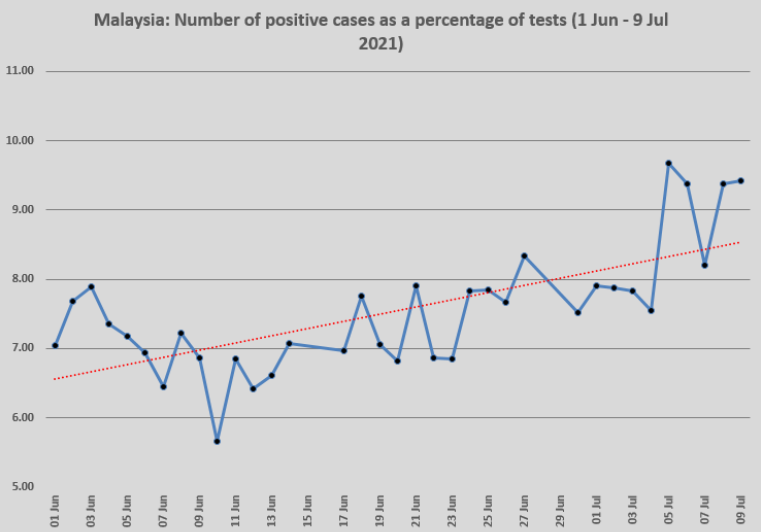
Figure 3 shows the percentage of positive cases, in relation to the number of tests, again four days are missing due to the data not being available. The figure shows that on 1 June, the percentage of those tested who were positive was 7.0%. On July 9, the percentage was 9.4%. The trend line shows that the number of positive cases, as a percentage, is increasing.
Meeting the conditions to move to Phase 2
The last time Malaysia reported the number of daily cases below 4,000 was on May 16. On that day, there were 3,780 cases, with 58,279 tests being carried out, which means that 6.5% of those tested were positive. If we assume that the government is happy to accept that when 6.5% of those tested being positive enables us to move to Phase 2, this would mean that we do not rely on the absolute number of 4,000, which is less meaningful as the number of tests carried out changes.
The following table shows this, giving three scenarios.
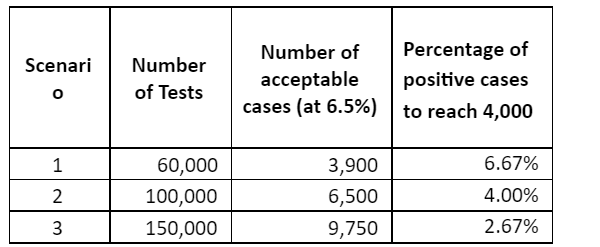
The first scenario shows the position as at May 16, with some rounding to make the figures easier to read. If we carry out 60,000 tests a day and 6.5% test positive, then we will have 3,900 cases.
If we are testing 100,000 people a day, which is the number we are hovering around at the moment, then 6.5% of positive tests would result in 6,500 cases each day. Would the government be happy with this? That is, would they use a value of 6.5% positive tests, or less, rather than an absolute value of 4,000 as a way to move to Phase 2?
If we test 150,000 people each day, which was reportedly the target on January 21, then 9,750 positive cases – 6.5% of those tested – might be acceptable in order to move to Phase 2.
Conclusion
If we use an absolute figure of 4,000, and we test 60,000 people a day and 6.67% of those are positive, then we will reach the target of 4,000 positive cases.
However, if we are testing 100,000 people a day, roughly where we are at the moment, then only 4.00% of positive cases are acceptable to achieve the target of 4,000 – see the last column in Table 3. If we ever test 150,000 people a day, then we can only accept 2.67% of those tested being positive to reach the target of 4,000.
To put this into context, since January 1 – 190 days, but only 180 of which have recorded data – 50 days have recorded a positive percentage rate below 4.00%. On only 12 of those days has Malaysia recorded a positive rate below 2.67%.
Given that we are almost six weeks into the latest national lockdown it is difficult to see how we are going to move from the approximately 9% positive rate currently, to something between 4% and 2.5% to enable us to get to only 4,000 cases per day.
Even if we set the target at 6,500 cases per day, it is still difficult to see when this might be achieved.
The final goal of being able to move to Phase 2 is for the health system to be able to cope. Whether this is a sound basis for having an absolute number of 4,000 daily cases, I don’t know.
However, to get to 4,000 looks difficult at the moment. Even if we use a percentage-based scenario, testing 100,000 and accepting that the positive rate can be at 6.5%, it still looks extremely challenging.
Trying to balance the spread of the virus and the many other factors the government must consider, such as the economic impact of the pandemic, is difficult. I hope that a data driven approach helps them through this difficult time. – The Vibes, July 10, 2021
Professor Graham Kendall is the Chief Executive of the Good Capitalism Forum and has lived and worked in Malaysia for the past ten years. He hopes that Malaysia will be his home for many years to come