GREAT controversy has been stirred regarding the recent parliamentary sitting. I hope this explanation will help to clarify the misconceptions and heated statements which falsely suggest there is a constitutional crisis.
The parliamentary session
This parliamentary sitting was a special sitting. It was called by virtue of Standing Order 11(3).
Standing Order 11 states as follows:
“11. (1) The first sitting of the House in each session shall be held in such place on such day and at such hour as the Yang di-Pertuan Agong may, by proclamation, appoint.
(2) Subject to the provisions of paragraph (1), the leader or deputy of the House shall determine at least 28 days before the commencement of each session, the dates on which the House shall meet in the session: Provided that the Leader or Deputy Leader of the House may vary from time to time the dates so fixed.
(3) If, during an adjournment of the House, it is represented to the Yang di-Pertua speaker by the prime minister that the public interest requires that the House should meet at an earlier date than that to which the House was adjourned, the Yang di-Pertua shall give notice thereof forthwith and the House shall meet at the time stated in such notice. The business set down for that day shall be appointed by the prime minister and notice thereof shall be circulated not later than the time of meeting.”
The business of the special sitting is to be determined by the prime minister.”
This was a special sitting called upon an adjournment of the last sitting of the House. It was a sitting that was called by the prime minister making representations to the speaker of the House. The purpose of this special sitting was to discuss matters of public interest. In this case, it was to discuss the Covid-19 pandemic and the government’s response to it.
The business of the special sitting is to be determined by the prime minister. This is unlike an ordinary sitting of Parliament.
The statement by the law minister
The law minister is alleged to have said something about the revocation of the emergency ordinances that apparently were done without the consent of the king. Set out below is the black letter of the Hansard for that day:
“Datuk Takiyuddin Hassan (Kota Baru): Saya ada tiga perkara sahaja. Respons kepada yang saya hormati YB ketua pembangkang untuk memandu perjalanan mesyuarat ini. Baik, isu mengenai titah Yang di-Pertuan Agong. Saya ingin menunjukkan di sini secara bertulis bahawa pemberitahu daripada YAB perdana menteri kepada tuan Yang di-Pertua yang berbunyi. Izinkan saya baca. “Dengan hormatnya, saya ingin memaklumkan bahawa Seri Paduka Baginda Yang di-Pertuan Agong telah memperkenankan untuk kerajaan memanggil mesyuarat khas penggal ketiga, parlimen ke-14 bagi Dewan Rakyat yang bersidang pada 26 Julai sehingga 2 Ogos 2021”. Dokumen speak louder than words. Ini adalah....
Datuk Seri Shahidan bin Kassim (Arau): Faham tidak?
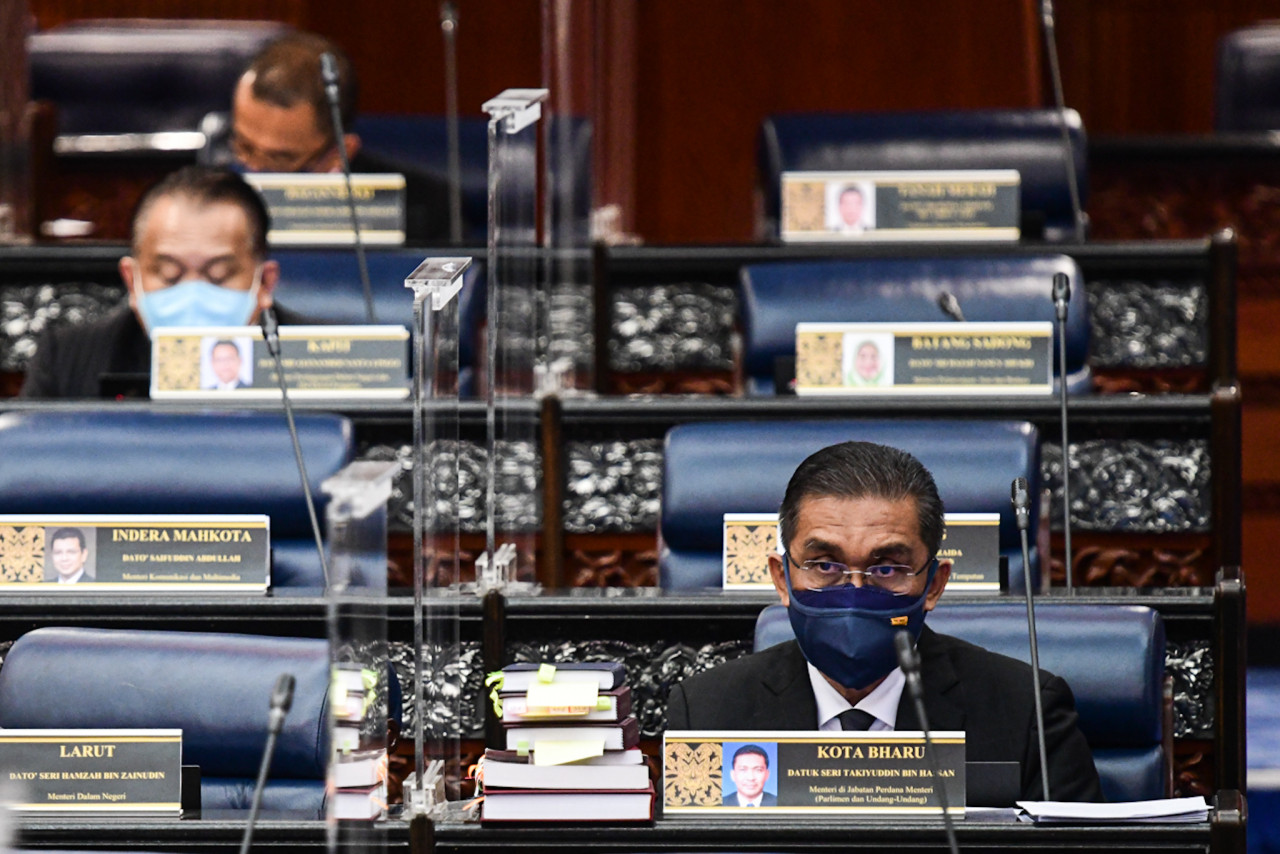
Datuk Takiyuddin Hassan (Kota Baru): Yang kedua, tuan Yang di-Pertua, saya ingin mengesahkan pada hari ini di dalam Dewan ini – saya tertakluk kepada kalau saya bercakap tidak benar, bahawa kerajaan persekutuan memutuskan tidak akan menasihatkan Yang di-Pertuan Agong untuk mengisytiharkan proklamasi darurat baharu apabila tamat 1 Ogos 2021. (Tepuk)
Yang ketiga, yang terakhir. Please listen to me. Kerajaan telah buat keputusan berdasarkan kepada Perkara 150(3) untuk membatalkan semua ordinan darurat yang telah dibuat semasa proklamasi darurat ini. Oleh sebab telah di revoke, maka isu ungkai ataupun annulment sudah tidak lagi relevan....(Dewan riuh). Terima kasih.”
The allegation that has been levelled against the law minister and the government is that it has revoked the emergency ordinances without the consent of the Agong.
As one can see this is not the case. The minister did not mislead parliament. He stated facts. The government had decided not to advise the Agong to declare a fresh emergency after August 1 and the government had decided to revoke the emergency ordinances made during the emergency proclamation.
The process of emergencies
Emergencies are regulated under Article 150 of the federal constitution. Article 150 is reproduced below:
(1) If the Yang di-Pertuan Agong is satisfied that a grave emergency exists whereby the security, or the economic life, or public order in the Federation or any part thereof is threatened, he may issue a proclamation of emergency making therein a declaration to that effect.
(2) A proclamation of emergency under Clause (1) may be issued before the actual occurrence of the event which threatens the security, or the economic life, or public order in the Federation or any part thereof if the Yang di-Pertuan Agong is satisfied that there is imminent danger of the occurrence of such event.
(2A) The power conferred on the Yang di-Pertuan Agong by this Article shall include the power to issue different proclamations on different grounds or in different circumstances, whether or not there is a proclamation or proclamations already issued by the Yang di-Pertuan Agong under Clause (1) and such proclamation or proclamations are in operation.
(2B) If at any time while a proclamation of emergency is in operation, except when both Houses of Parliament are sitting concurrently, the Yang di-Pertuan Agong is satisfied that certain circumstances exist which render it necessary for him to take immediate action, he may promulgate such ordinances as circumstances appear to him to require.
(2C) An ordinance promulgated under Clause (2B) shall have the same force and effect as an Act of Parliament, and shall continue in full force and effect as if it is an Act of Parliament until it is revoked or annulled under Clause (3) or until it lapses under Clause (7); and the power of the Yang di-Pertuan Agong to promulgate ordinances under Clause (2B) may be exercised in relation to any matter with respect to which Parliament has power to make laws, regardless of the legislative or other procedures required to be followed, or the proportion of the total votes required to be had, in either House of Parliament.
(3) A Proclamation of Emergency and any ordinance promulgated under Clause (2B) shall be laid before both Houses of Parliament and, if not sooner revoked, shall cease to have effect if resolutions are passed by both Houses annulling such proclamation or ordinance, but without prejudice to anything previously done by virtue thereof or to the power of the Yang di-Pertuan Agong to issue a new proclamation under Clause (1) or promulgate any ordinance under Clause (2B).
(4) While a proclamation of emergency is in force the executive authority of the Federation shall, notwithstanding anything in this constitution, extend to any matter within the legislative authority of a state and to the giving of directions to the government of a state or to any officer or authority thereof.
(5) Subject to Clause (6A), while a proclamation of emergency is in force, Parliament may, notwithstanding anything in this constitution make laws with respect to any matter, if it appears to Parliament that the law is required by reason of the emergency; and Article 79 shall not apply to a bill for such a law or an amendment to such a bill, nor shall any provision of this constitution or of any written law which requires any consent or concurrence to the passing of a law or any consultation with respect thereto, or which restricts the coming into force of a law after it is passed or the presentation of a bill to the Yang di-Pertuan Agong for his assent.
(6) Subject to Clause (6A), no provision of any ordinance promulgated under this Article, and no provision of any Act of Parliament which is passed while a proclamation of emergency is in force and which declares that the law appears to Parliament to be required by reason of the emergency, shall be invalid on the ground of inconsistency with any provision of this constitution.
(7) At the expiration of a period of six months beginning with the date on which a proclamation of emergency ceases to be in force, any ordinance promulgated in pursuance of the proclamation and, to the extent that it could not have been validly made but for this Article, any law made while the proclamation was in force, shall cease to have effect, except as to things done or omitted to be done before the expiration of that period.
From Article 150(1) and (2B) it is clear that the Agong does two things. His Majesty issues a ‘proclamation’ of emergency and His Majesty ‘promulgates’ ordinances under the emergency. There is no provision for the Agong to revoke, annul or cancel the proclamation or the promulgated ordinances.
It is also clear that by virtue of Article 40 of the federal constitution, the Agong is constitutionally bound to accept the advice of the government and act in accordance with such advice. The only instances of personal discretion for the exercise of any power provided to the Agong is when the words “in his discretion” are used. This principle was codified by amendment of the federal constitution. The principle has been affirmed by the Federal Court and has been repeated and adopted multiple times.
In Teh Cheng Poh v. Public Prosecutor [1979] 1 MLJ 50, the Privy Council, when describing the emergency powers of the Agong said: “Although this, like other powers under the constitution, is conferred nominally upon the Yang di-Pertuan Agong by virtue of his office as the supreme head of the Federation and is expressed to be exercisable if he is satisfied of a particular matter, his functions are those of a constitutional monarch and except on certain matters that do not concern the instant appeal, he does not exercise any of his functions under the constitution on his own initiative but is required by Article 40(1) to act in accordance with the advice of the cabinet. So when one finds in the constitution itself or in a federal law powers conferred upon the Yang di-Pertuan Agong that are expressed to be exercisable if he is of the opinion or is satisfied that a particular state of affair exists or that particular action is necessary, the reference to his opinion or satisfaction is in reality a reference to the collective opinion or satisfaction of the members of the cabinet, or the opinion or satisfaction of a particular minister to whom the cabinet have delegated their authority to give advice upon the matter in question.”
The Agong, with the deepest of respect, does not have the discretion to refuse the advice of the government. Chang Min Tat J made this clear in N. Madhavan Nair v Government of Malaysia [1975] 2 MLJ 286: “As I have earlier shown, executive power is in the hands of the Yang di-Pertuan Agong and his cabinet. Though the Yang di-Pertuan Agong is with customary and loyal courtesy asked to be pleased to promulgate the ordinance, it is clear that he as the constitutional monarch does not refuse. He has no discretion in the matter but surely the events of those days were clearly sufficient and only too apparent to show the necessity for the ordinance without any agreement.”
As recently as 2001, a five-man bench of the Federal Court restated the position in Abdul Ghani bin Ali v. Public Prosecutor [2001] 3 MLJ 561:
“In his book, Governments & Crisis Powers, which is a legal study on the use of emergency powers, Cyrus V. Das said at page 237 that although a debate had previously ranged on the subject, there can be no doubt now that the Privy Council opinion on the Teh Cheng Poh case settles the point firmly that the Yang di-Pertuan Agong does not have a personal discretion under Article 150(1), but has at all times to act on Cabinet advice… It is my considered view, based on the constitutional provisions and the authorities cited, that the Yang di-Pertuan Agong, in acting under Clause (1) of Article 150 of the constitution in the position of a constitutional monarch, must act on the advice of the cabinet as provided in Article 40 of the constitution.”
The law on this subject has remained unchanged since the late 1970s. There is no doubt that the Agong is bound to act on the advice of the government to either proclaim an emergency or to promulgate any ordinance and finally to revoke them. There is no discretion in the matter.
When we examine Article 150(3) with the statements of the law minister, it is clear that there has been no misleading of parliament or any constitutional violation.
Article 150(3) envisages two ways in which an emergency ordinance can be brought to an end. It can be laid before the House and the House can pass a resolution to annul it or it can be ‘sooner revoked’. In other words, the emergency ordinances which the law minister referred to as being revoked by the government would fall within the provision of Article 150(3).
In addition to the methods outlined above, the proclamation of emergency in this case had a sunset provision. It was due to naturally expire on August 1. By virtue of Article 150(7), any ordinances promulgated under the proclamation of emergency would likewise lapse and cease to have effect 6 months after the proclamation ceased to have effect.
Consequently, there has been no misleading of Parliament or constitutional violation because the government:
a) Called for the special sitting of Parliament under Standing Order 11.
b) The business of the meeting was to brief the House on the Covid-19 Recovery Plan.
c) There was no business set by which any motions or bills could be debated or voted upon. Standing Order 14 was not in effect. There was no ordinary business of the House to be transacted.
d) The law minister did in fact inform the House about the ‘decision of the government’ not to seek a further proclamation of emergency.
e) The law minister also informed the House that “the government has made the decision pursuant to Article 150(3) to revoke all the emergency ordinances”.
f) The government did lay before the House the emergency ordinances.
g) There was no need to debate or move a motion on the continued existence of the emergency ordinances given the fact that the government had made the decision to ‘sooner revoke’ them under Article 150(3).
The statement by the palace
The Palace issued two statements. Shorn of the formal language and niceties, the substance of the statements were:
a) That the Agong had not consented to the revocation of the emergency ordinances because the Agong wanted the emergency ordinances to be debated in Parliament.
b) That the revocation of the emergency ordinances were to circumvent (“membelakangi”) the constitutional function of the Agong.
c) That the revocation was backdated to July 21, 2021 notwithstanding that the application for consent of the Agong was only received on July 23, 2021.
d) That the power to revoke the emergency ordinances was a power that vests in the Agong and not exclusively in the Cabinet.
e) That the Agong has directed that the revocation of the emergency ordinances be laid before and debated by Parliament before the Agong signs the revocation.
The Agong has not been properly advised of his constitutional role. This can be seen as follows:
a) The Agong’s power is to proclaim the emergency and promulgate the ordinances under Article 150(1) and 150(2B).
b) That decision to proclaim and promulgate is not a personal decision of the Agong or a personal power to be exercised. It is to be carried out on advice of the cabinet and must be followed.
c) There is similarly no power of revocation. Even if there is a formal requirement for the written assent of the Agong, the Agong is bound to accede and carry out the advice of the government.
d) There is certainly no power to direct that the revocation of the emergency ordinances be tabled and debated before the House before the Agong can consent to it.
e) The Agong does not have the power to direct what is to be laid before and voted on in Parliament. That is exclusively a government power.
f) The emergency ordinances are not bills of Parliament that they have to be debated and voted on before they are signed.
The Agong is being advised to exceed his authority under the constitution. In this respect the law minister had simply stated the facts. The cabinet had decided to revoke the emergency ordinances. There was therefore no need to debate it in Parliament. While the Agong may have suggested to the government that it be so debated, the government was under no constitutional duty to do that. – The Vibes, August 4, 2021
Rosli Dahlan is a prominent lawyer who has been involved in several high-profile cases of public interest