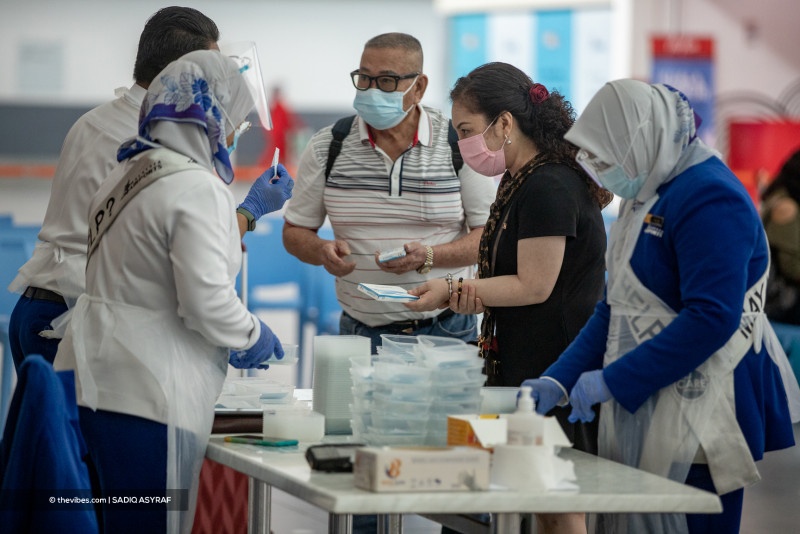
BUSINESSES, golf courses and schools are opened, and from Monday “rentas negeri” is allowed, which marks the day we have finally returned to “normal”. Well, not quite normal; we are merely transitioning to the endemic phase of the pandemic, a coveted status for countries able to vaccinate a very large proportion of its population. We have just hit 90% adult coverage rate, a remarkable achievement by our government, which put us in this privileged category. But it does not mean the worst is over (see what happened in Singapore, Israel, Iceland, all highly vaccinated countries experiencing resurging Covid-19 due to the Delta variant). It just means from now on, we are going to let it be. All Malaysians will become infected eventually (already a huge proportion were, see below), there is nothing we can do to stop that, and we just have to learn to live with it safely, like we do with other endemic infectious diseases in Malaysia, notably dengue and the flu. How do we do that safely? But first an accounting of our recent past.
The darkest period in Malaysian history
As disaster goes, our country has just experienced the darkest episode of its history.
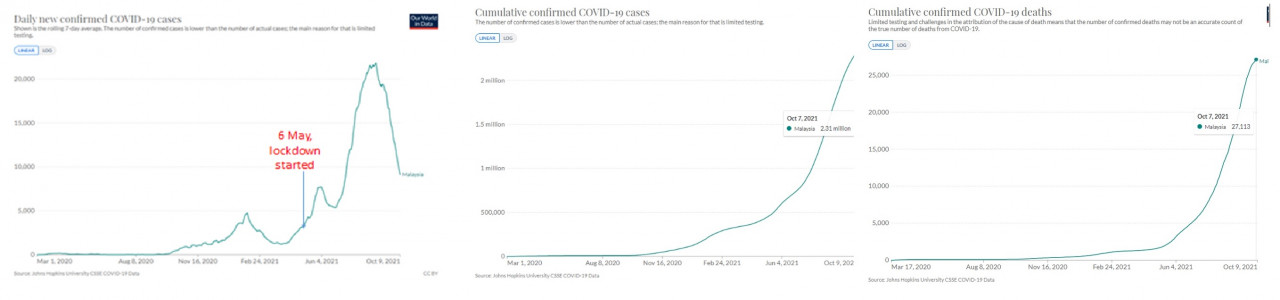
The current wave of Covid-19 started in mid-April 2021 (left figure below); lockdown was soon imposed on May 6, the wave peaked on August 26 with 24,599 new cases that day.
By October 7, 2.31 million of our fellow Malaysians have been infected (centre figure below) and 27,113 have died of Covid-19 (right figure below).
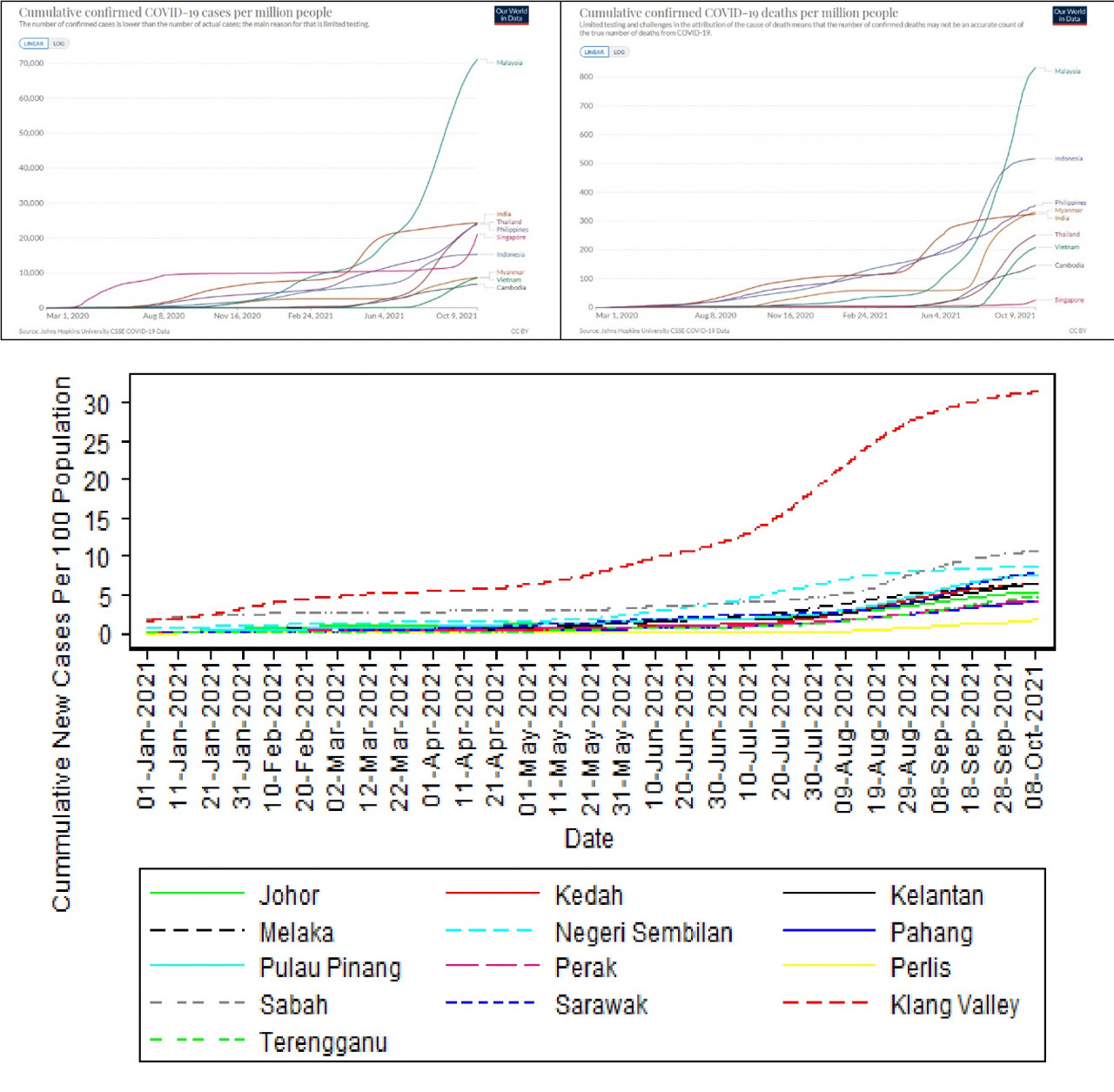
Over the course of six months from April to October, Malaysia has emerged as one of the most heavily affected country in the world. On both case (left figure below) and death rates (right figure below), we beat all our neighbours by a long stretch. Measured in percentage of people infected, the Klang Valley has exceeded 30% by October (bottom figure). This is just counting those who tested positive. Including people who were infected but not tested, my guess is more than 80% of people have been infected in Klang Valley. The rest of the country will no doubt catch up. Do note the huge surge in infection has occurred in the past six months while most of us were locked up in our homes.
Covid-19 has hit us hard, which is painful for a country that has not had famine, war, civil strife or major natural catastrophe in the past 50 years. Will our recent tragic experience recur, despite all of us all being vaccinated? The answer is both yes and no.
Yes because: (1) Vaccine-induced immunity will wane over time. We do know antibodies (specifically neutralising antibodies that block virus entry into our cells) wane over time, but the other two components of our immune response (so called memory B and T cell responses) may hold up longer; (2) new virus variants will emerge and some may escape our vaccine-induced immunity. The current vaccine is holding up well against the Delta variant; yes, it no longer prevents vaccinated people from becoming infected and transmitting the virus, but it still protects us from severe disease.
So, we will continue to experience outbreaks of Covid-19 here and there, but not on the same catastrophic nationwide scale as the one we just had the past six months. And, a booster vaccine dose, which I am certain our government will introduce, if only for select groups, will likely help. That’s endemic Covid-19; every year, several thousand people will die of it, just like dengue here.
How to live with Covid-19 safely?
Regardless of the outcome, which remains uncertain, there is plenty we can do to live with Covid-19 safely, and I don’t mean more lockdowns, whether self-imposed or otherwise.
1. Vaccination
Firstly, get yourself and everybody around you vaccinated. Now that we are in the endemic phase, you are going to meet the airborne virus sooner or later; there is no avoiding that. Vaccination has become even more important because: (1) It will protect you from severe disease. You want to meet the virus from a position of strength, that means, only after you are fully vaccinated; (2) having everyone vaccinated actually helps protect against the emergence of variants. Variants emerge because there are large pockets of unvaccinated people in a population in whom the virus transmits more freely, stays in the host longer, causes more severe disease and, for all these reasons, is more likely to mutate to become a new variant. And (3), here is the strange part, now that you are vaccinated, while your immunity may be waning, you are still protected against severe disease, it is probably a good time to catch the virus, which will further boost your immunity. The problem, however, is you don’t know whether you are personally protected (vaccines are not 100% effective). The best readily available measure that correlates with immune protection is neutralising antibody (Nab) level. If your Nab level is low, you may want to consider getting yourself a booster dose now rather than wait for the government’s decision on this. Do note that a government makes decision for the entire population; the risk-benefit calculus is not necessarily the same as one you would apply in your own personal decision. Remember, it is OK (and even desirable) to meet the virus but only do so when you are still strong.
2. Three Ws and three Cs
When an infectious person talks, coughs, sneezes, he discharges virus particles that are carried in the air in two forms – droplets and aerosols (<5 um in size). Droplets are heavy and drop to the ground quickly (and contaminate surfaces). This is why we wear masks, keep our distance (1m-2m apart), and practise hand and surface sanitisation. But aerosols, being very light, can be carried in air currents for a long time over a long distance and, in a poorly ventilated indoor space, they do re-circulate to be inhaled by all present. Masking, distancing and hand-washing do not protect you from virus-laden aerosol. Nasal sprays and proper ventilation of crowded indoor spaces do (more on this below).
3. Screening tests
A congregate setting is where a large number of people must unavoidably meet or interact in-person for a prolonged duration (several hours) and often repeatedly. Examples are workplaces, schools, dormitories and nursing homes. Such settings are well known for Covid-19 transmission; many Covid-19 outbreaks in Malaysia have arisen from workplaces. Owners or managers of such places should consider screening tests for all persons at entry. Our Parliament, which opened recently, tested our MPs and senators at entry, many schools are doing this voluntarily, I heard even some high-end restaurants require this of their customers for indoor dining.
RTK antigen tests are most commonly deployed for this purpose. Its low cost and ease of use makes it suitable for this despite its lowish sensitivity, which could be mitigated by more frequent testing to enable detection of an infectious person as his viral load increases over time. Ideally, this should be twice weekly; the International Trade and Industry Ministry requirement to test once every two weeks is more symbolic than science-based. More sensitive, but more costly, screening tests are also becoming available.
4. Indoor space & ventilation
Indoor living is unavoidable because not all activities can be conducted outdoors (learning in classrooms, some sports, offices, factory floors etc) or we are driven indoors by a desire for comfort in our rainy tropical clime. Safe use of indoor spaces where many other people are present requires monitoring the CO2 of indoor air (humans take in oxygen and exhale CO2, which, in a poorly ventilated room, will quickly accumulate). A safe level is less than 800 ppm or lower. If possible, keep windows open with a window fan, especially when CO2 >800 ppm. Air purifiers (with HEPA filter) will also help improve indoor air quality. For very high-risk indoor spaces, its safe use requires monitoring indoor air for the Covid-19 virus and have users be tested negative at entry.
In summary, to stay safe while we learn to live with Covid-19, do get jabbed and do continue to observe the 3Ws+3Cs. Going about your daily life, whether at work or play, will get you indoors with other people, so do pay attention to air ventilation and it will be nice, too, if others around you are all tested negative at entry. It is OK to be exposed but not in heavy doses. Avoiding Covid-19 at all costs is not necessarily the best protection, nor is it compatible with a normal life. – The Vibes, October 13, 2021
Dr Lim Teck Onn is a consultant in clinical research and medical statistician