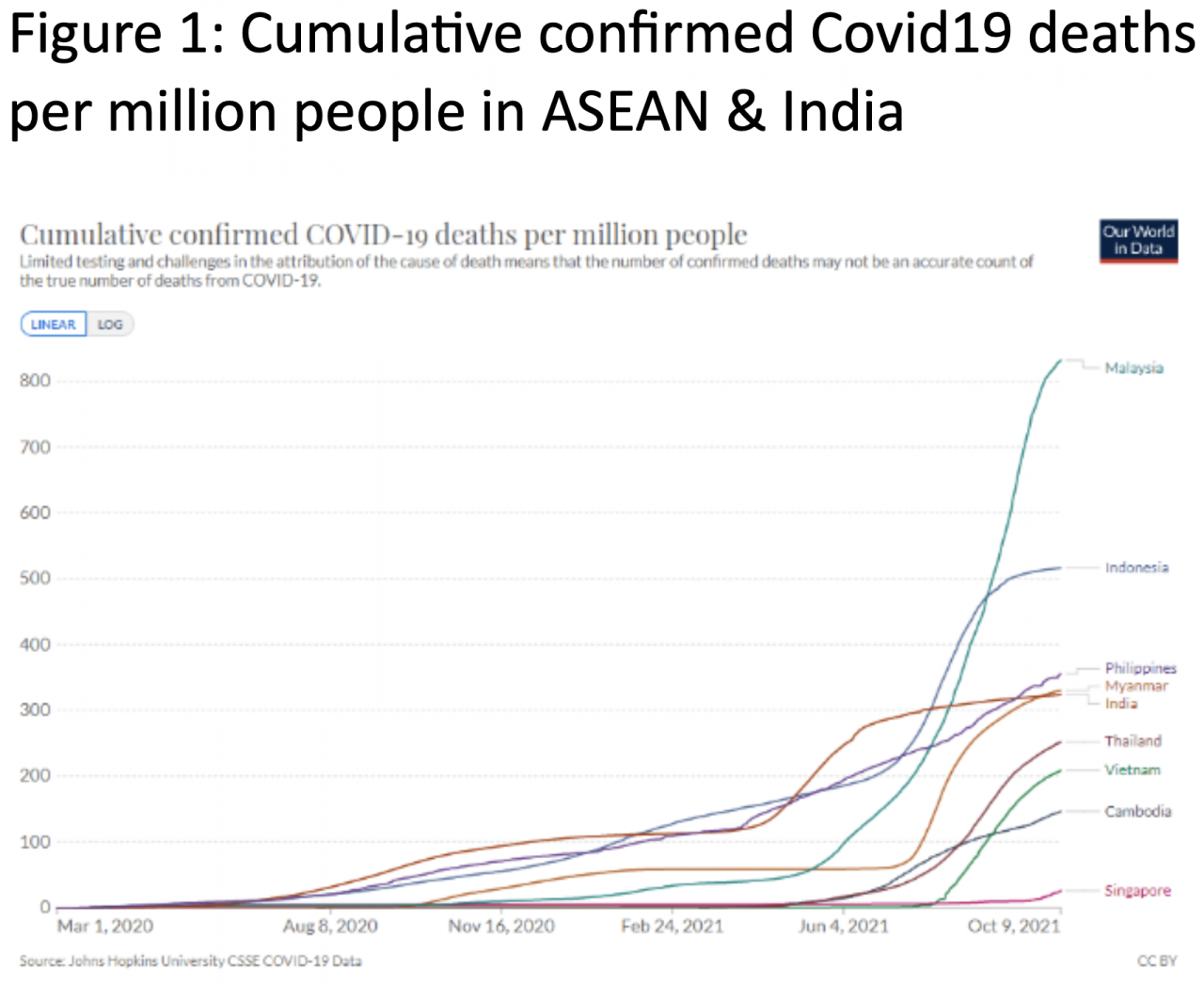
MALAYSIA has emerged from the recent wave of Covid-19 infection between June and October 2021 with the highest death toll in Asia (Figure 1). The government to its credit has ramped up vaccination rapidly, reaching almost 100% adult coverage by October, and the government is now stepping up booster vaccination too. This will help the country to transition to the endemic phase. Our disease control strategy has shifted accordingly to minimising deaths and the risk of overwhelming the health system.
Life as we know it has finally returned to “normal”; businesses and in-dining restaurants have reopened, workers have returned to work and kids are back at schools.
But what does endemic Covid-19 mean?
And what is in store for you in an endemic? For one, it certainly does not mean the virus has vanished. Endemic Covid-19 simply means the virus will continue to circulate widely, and we are going to let it be. All of us will become infected eventually, there is nothing we can do to stop that.
The figure below depicts the possible trajectories of any epidemic, which eventually will end in one of three possible ways.
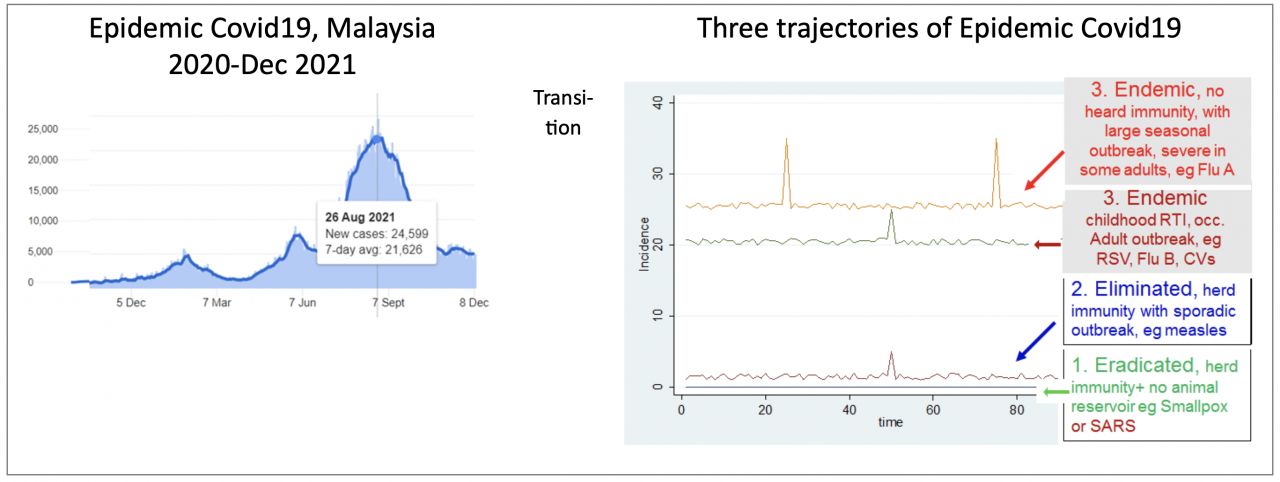
The best outcome is if the virus will be completely eradicated. This will not happen to SARS-Cov2, the virus which causes the Covid-19 disease. This has only happened to smallpox, and hopefully to polio virus one day, neither of which has any animal host.
The next best case is for the virus to be eliminated as a result of herd immunity brought about by natural infection and widespread vaccination. When almost everyone has become “immune”, the virus will have nowhere else to go (though pockets of outbreak will occur whenever vaccine coverage has dropped, such as driven by anti-vaccine sentiment). This was what we had hoped to achieve with vaccination. Alas by now we know herd immunity is no longer achievable, the vaccine-induced immunity will not last (it wanes over time) and new variants have emerged which could infect vaccinated people and spread to others (immune escape).
The only realistic trajectory is for the virus to become endemic. It will continue to circulate widely in human populations, and will largely infect newborns who of course are not immune. A more resistant variant will sometime spread to adults (who are protected from prior exposure or vaccination). In the worst case, the virus evolved so rapidly like the Influenza A virus, to escape immunity elicited by past infection and vaccination. This will periodically drive global seasonal epidemics, often affecting adults, some of whom will develop severe disease and succumb to it. Periodic booster dose, perhaps tailored to the new variant, will be required then to protect us against severe disease. This is the worst possible outcome of endemic Covid-19; every year, several thousand people will die of it, just like dengue here.
How to live with Covid19 safely?
Regardless of the trajectory the virus will take, which only time will tell, there is plenty we can do to live with Covid-19 safely. Here are FIVE things you can do to protect yourself and your family.
1. Get your booster dose. It doesn’t matter which one, and taking a different vaccine (so-called mix and match) from the one you had earlier is fine. In general, mRNA vaccine (Pfizer) is most immunogenic (it induces a higher antibody level) but it is also causes more side effects which are tolerable. As to when, should you just wait for MySejahtera to call? Yes, unless (a) you are at high risk of severe disease (elderly, obese, immunocompromised), or (b) you live in a community with very high local transmission, or (c) your neutralizing antibody level is low (more on this below), then get your booster soonest. By the way, for those who had Sinovac, get your third dose soon. A third dose of Sinovac is NOT considered as booster. The vaccine, being weakly immunogenic, just requires more doses.
2. Don’t fly blind, check your Neutralizing Antibody (Nab) level. These are antibodies which block the virus’ entry into our cells, hence its name. Nab is one of 3 components of our immune defence against the virus (the other 2 are memory B and T cells) but it is the only readily available measure which correlates with immune protection. It is wise to check this because (a) some people just don’t respond to vaccine (elderly, immunocompromised), and (b) all vaccine-induced immunity wanes over time.
3. Practise self-test and entry screening at workplaces and other congregate settings where large number of people must unavoidably meet or interact in-person for a prolonged duration (several hours) and often repeatedly. Low-cost Rapid Test Kits for detecting the virus antigen (RTK) are now widely available but how best to use the test without professional guidance may be tricky. Do beware of issues with test performance; research in Malaysia showed that the test has lowish sensitivity especially early in the course of an infection and in untrained hands, which could be mitigated by more frequent testing. The test is also prone to producing false positive results. Better but more costly screening tests are also becoming available.
4. Monitor CO2, ensure good ventilation & use nasal spray in crowded indoor space, which may not be avoidable because not all activities can be conducted outdoor (learning in classroom, some sports, offices, factory floors etc) or we are driven indoor for comfort in our rainy tropical clime. The Covid-19 virus is airborne, it spreads through the air you breathe in, and not through your hands after touching a surface contaminated by the virus (a year ago we used to believe that, hence the past emphasis on hand washing, sanitizing surfaces etc).
Safe use of indoor spaces when many other people are present requires monitoring the CO2 of indoor air (humans take in oxygen and exhale CO2, which in a poorly ventilated room will quickly accumulate). A safe level is less than 500ppm or lower. If possible, keep windows open with window fan, especially when CO2 >500ppm. Air purifier (with HEPA filter) will also help improve indoor air quality.
When an infectious person talks, coughs, sneezes, he discharges virus particles which are carried in the air in two forms, (1) droplets and (2) aerosols (<5 um in size). Droplets are heavy and drop to the ground quickly (and contaminate surfaces). This is why we wear mask, keep our distance (1-2m apart), practice hand and surface sanitisation. But aerosols, being very light, can be carried in the air current for a long time over a long distance, and in a poorly ventilated indoor space, they do recirculate to be inhaled by all present. Masking, distancing and handwashing do not protect you from virus-laden aerosol. Nasal spray and proper ventilation of crowded indoor spaces do.
5. Oral anti-viral treatment is finally here, but early treatment soon after infection (<3 days) is critical. Medical care of an infected person used to be just watchful waiting; the doctor just watch and only intervene if the person were to progress to more severe disease (which thankfully only happens to <1% of people). Those days are over. Low cost oral anti-viral drugs such as Molnupiravir and Ritonavir are now available. Antibody therapy has been around for a longer time but is rarely used in Malaysia because of its high cost.
In summary, to stay safe while we learn to live with Covid-19, do get your booster and check your antibody level. Practise self-test at home and entry screening at workplaces. Going about your daily life, whether at work or play, will get you indoor with other people, so do pay attention to air ventilation and use nasal spray. It is okay to be exposed but only when you are “strong”, that is when you know you are immune-protected. Avoiding Covid-19 at all costs is not necessarily the best protection, nor is it compatible with a normal life. – The Vibes, December 30, 2021
Dr Lim Teck Onn is a consultant in clinical research and medical statistician. If you need help to obtain and implement the above protective measures, please call Ms Yow Ai Nie 012-273 5668 or Ms. Betty Soon 010-719 9121