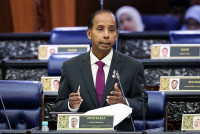
ON November 9, Hassan Abdul Karim, the honourable MP for Pasir Gudang, requested that the speaker withdraw the rule limiting the presence of only 80 lawmakers in the chamber during the Budget 2021 debate.
The speaker’s response included the following statement:
“Di manakah terdapatnya di dalam Perlembagaan Persekutuan bahawa pada setiap masa... saya perlu mendengar 222 orang MP dalam Dewan? Kuorumnya 26 orang peraturan mesyuarat. Itu kuorumnya dan kita ada 80 orang.”
The speaker, in his rebuke, said not all 222 MPs attend the sitting each day.
There may be 100 to 120, and not all are in the chamber from 10am until 5.30pm, and at times, there is no quorum.
The speaker’s statement must not be misconstrued to mean that he has the power to limit the number of MPs entering the chamber.
The main function and role of the office of the speaker is to act as the presiding officer over Parliament debates in accordance with the Standing Orders, and to interpret the Standing Orders when required.
The Standing Orders are the rules of procedure approved by MPs themselves under Article 62 (1) of the federal constitution.
Consequently, the speaker does not have an inherent power to act independently beyond the Standing Orders. The speaker, therefore, does not have the power to limit the number of MPs entering the chamber or prevent them from participating in a Parliament sitting.
The honourable Hassan Abdul Karim is correct. Neither the laws on the prevention of infectious diseases, nor the speaker, the minister in charge of parliamentary affairs or party whips, can override the constitutional rights of MPs to enter the chamber during a Parliament sitting.
The importance of MPs’ right to attend a sitting is reflected in the Motion of the House at the Parliament opening each year, directing the inspector-general of police to ensure that MPs are not obstructed from attending Parliament. For this year, the motion was tabled and passed by the House on July 13.
MPs’ right to attend Parliament is also reflected in Section 9(e) of the Houses of Parliament (Privileges and Powers) Act 1952 (Act 347), which provides that it is in contempt of Parliament to obstruct any member from coming or going. The word “House” in the context of Act 347 refers to a Parliament sitting.
The true basis of the 80-MP limit is in the second part of the speaker’s response to Hassan Abdul Karim. It was a decision made by a consensus reached between the respective party whips. This means each MP, by his or her own volition, refrained from entering the chamber. This is very different from the speaker having the power to limit the number of MPs attending a sitting.
This voluntary restraint by MPs is a responsible and practical solution to enable Parliament to function in the time of the Covid-19 pandemic.
Many Parliaments, such as the House of Commons in the UK, as well as in Ireland and Australia, have agreed to reduce the number of MPs in attendance, in response to the pandemic.
Therefore, it is important to stress that the 80-MP limit rule is based on each MP’s voluntary decision not to enter the chamber in a number exceeding this. It is a temporary measure to enable Parliament to function in the midst of the pandemic.
The speaker cannot prevent an MP from attending, participating and voting in Parliament. I call on the speaker not to post an orderly in front of the chamber door to stop MPs from entering without a pass.
If the speaker is allowed to do this, then it amounts to an erosion and subversion of the basic principle of constitutional democracy. It is important that this misconception is corrected. Otherwise, this is how democracy dies. – The Vibes, November 11, 2020
William Leong is Selayang MP