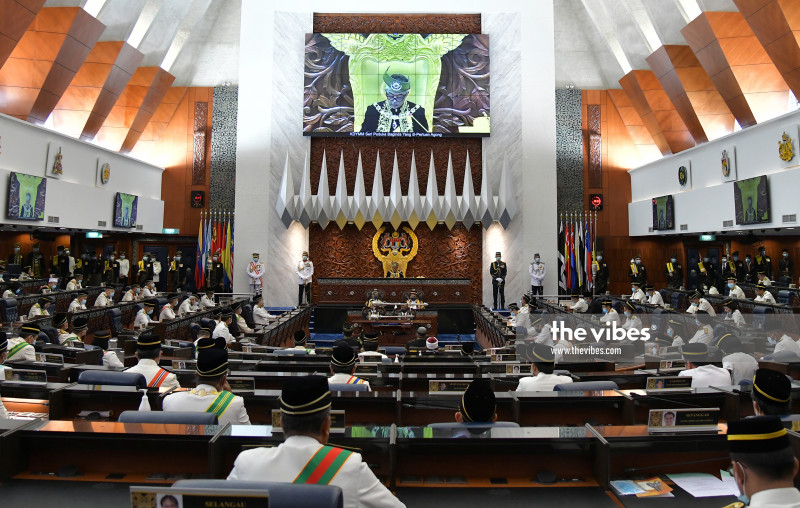
AFTER a general election, the first step in the formation of a government is for the Yang di-Pertuan Agong to appoint as the prime minister an MP who, in his judgement, is likely to command the confidence of the majority of Dewan Rakyat’s members.
The prime minister then goes on to name his cabinet to form the government.
In the past, the choice has been relatively easy. The Agong chooses as prime minister the leader of the party or coalition that has secured the largest number of seats in Parliament.
However, the results of the 15th general election show that no single party or coalition has secured the 112 seats needed to secure a simple majority. This has resulted in what is termed as a “hung Parliament”.
How then does the Agong choose a prime minister, as it is not really possible for the king to ascertain who will command the confidence of the majority of the members in the Dewan Rakyat?
There is no explicit provision in the constitution to answer this unique situation.
Our courts have provided the answer. Then the king must resort to how these issues, not explicitly provided for in the constitution, are resolved.
The solution lies in abiding by conventions – that is, unwritten practices that are generally followed in the absence of specific provisions in the constitution.
In the 2009 Zambry v Nizar litigation tussle as to who will continue to be the menteri besar and form the state government of Perak, the Court of Appeal said that conventions are an integral source of law, citing in support Article 160(1) of the constitution which reads as follows
“Law includes written law, the common law, insofar as it is in operation in the federation or any part thereof, and any custom or usage having the force of law in the federation or any part thereof.”
What convention then governs a hung Parliament situation? It is this.
The party (which includes a coalition of parties) with the highest number of seats will first be asked by the king to form the government.
It is then up to that party to get any other party to agree to join it; thus obtaining a sufficient number of seats to secure majority support in the Dewan Rakyat.
With these numbers secured, it will present them to the king to satisfy His Majesty of the majority numbers. The king will then appoint the accepted leader of the coalition as the prime minister who will then appoint his cabinet that will form the government.
In the present context, the Pakatan Harapan (PH) coalition has secured the largest number of votes (82). By convention, it should be given the first choice of eliciting support from other parties to form the government. – The Vibes, November 20, 2022
This statement is jointly issued by:
Datuk Gurdial S Nijar
Tan Sri Zainun Ali
Tan Sri Mohamad Ariff Md Yusof
Datuk Kuthubul Zaman Bukhari
Datuk Ambiga Sreenevasan
Datuk Yeo Yang Poh
Christopher Leong
Ragunath Kesavan
Ivy Josiah
Persatuan Patriot Kebangsaan (Patriot)