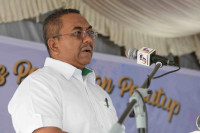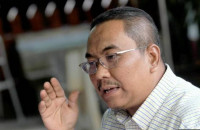
WE refer to the announcement by Kedah Menteri Besar Muhammad Sanusi Md Nor last week that the state intends to mine rare earth elements (REE), which may be worth RM62 billion.
REEs are extracted from ores and minerals as they are not often found concentrated in mineable deposits. REEs are almost always found in conjunction with significant radioactivity as these ores and minerals naturally contain uranium and thorium.
Seventeen REEs exist, namely scandium, yttrium, lanthanum, cerium, praseodymium, neodymium, promethium, samarium, europium, gadolinium, terbium, dysprosium, holmium, erbium, thulium, ytterbium and lutetium. Can the MB let us know which type of non-radioactive rare earth is found in Kedah?
Rare earth mining and processing is a more environmentally hazardous process than other mining activities, since radioactive waste is formed. They have serious environmental impacts if not properly managed. Low-level radioactive tailings from the presence of uranium and thorium in REE ores are a potential hazard, and improper handling of these substances can result in enormous environmental and health damage. Both uranium and thorium remain radioactive for hundreds of years and exposure to them has been linked to increased risks of lung, pancreatic and other cancers.
REE mining has caused the contamination of soil and water: Radioactive waste can leach out into aquatic environments and be absorbed by aquatic vegetation, which can then bio-accumulate and potentially enter the human food chain if livestock or humans choose to eat the vegetation.
Exposure to radioactive waste can lead to cancer, respiratory issues, dental loss and even death. The group most at risk are children as radioactive waste can impact their neurological development, affecting their IQ and potentially causing memory loss.
Nowhere is the industry’s ecological and human fallout starker than in China, which accounts for more than 80% of the world’s REE output. In Jiangzxi province, rare earth mining has led to extensive water and soil pollution, while concrete-leaching ponds and plastic-lined waste water pools dot the hills.
As clean-up of these polluted sites begins, China’s Industry and Information Technology Ministry estimated the clean-up bill could amount to 38 billion yuan (RM23 billion). According to Chinese authorities, it will take 50 to 100 years before the environment can fully recover and the cost borne by the locals has been high.
In Jiangxi province, two methods are used to extract rare earths – the first method involves removing layers of topsoil and transporting them to a leaching pond, where acids and chemicals are used to separate the various REEs from clay, soil and rock.
The second process involves drilling holes (which the Kedah MB vaguely alluded to) into hills inserting PVC pipes and rubber hoses, and then flushing out the earth using a mix of water and chemicals. This mix will then be pumped or transported to the leaching pond for further separation of REEs.
Chinese officials said mining has dumped excessive amounts of ammonia and nitrogen compounds into the region’s groundwater. Other pollutants like cadmium and lead are released during the mining process and long term exposure to these metals pose health risks as well.
Rare earth mining has led to radioactive material clinging to the elements in some areas according to a researcher who studied the environmental and health impacts. The end result, the researcher said, may be central nervous system cancers, like bone and skin cancers, and cardiovascular and respiratory disorders.
Nearer to home, at the rare earth refinery in Bukit Merah, Perak, the Consumers’ Association of Penang (CAP) had documented birth defects and leukemia cases within five years in the community. Doctors said thorium contamination from the plant had led to an increase in cancer. A company, Asian Rare Earth, had also sold calcium phosphate, a by-product of rare earth processing as fertiliser, which, according to a former Bukit Merah resident, killed the cows that ate the grass grown with the fertiliser.
A factory operated by Mitsubishi Chemical closed in 1992 amid strong opposition from local residents, environmentalists and Japanese politicians. The company was involved in a US$100 million (RM407 million) clean-up, which entailed the removal of more than 80,000 steel barrels of radioactive wastes to a hilltop repository. The United States Environment Protection Agency lists Bukit Merah one of Asia’s largest radioactive waste clean-up sites.
It looks like history is about to repeat itself with the Lynas Advanced Materials Plant (LAMP) rare earth refinery, which is set to become the world’s largest processing facility of rare earths. Lynas’s operations, a complex project involving radiation hazards, was fast-tracked for approval without a permanent disposal facility in place. Since it started in 2012, it has accumulated wastes, namely the Water Leached Purification (WLP) residue, which is radioactive, totalling 451,564 metric tonnes and the Neutralisation Underflow (NUF) waste, which has been classified as scheduled waste, amounting to 1.2 million metric tonnes as at February 2018. Currently, the massive mounds of wastes are openly accumulating within Lynas’s factory site. The NUF storage capacity had reached its limit in June 2018, and the need for a secure landfill is no where in sight. To date, the public has no knowledge of the planned Permanent Disposal Facility.
In 2018, the Executive Committee Report (ECR) on Lynas had noted that the main cause of sediment pollution in Sg Balok was from LAMP operations. Citing the Radiological Impact Assessment Report (2016), it stateed that “there is a statistically significant increase in U 238 radioactivity from the stream sediments at the location of LAMP effluent dumps as compared to the downstream location”.
This means that radioactive materials, such as Uranium-238, are able to settle in water and accumulate in sediments at the bottom of the river. Bottom feeders are able to collect these radioactive materials from river water and sediment. The ECR also found “non-compliance with some heavy metals (nickel lead, chromium and mercury) in ground water particularly alarming”.
In light of the above health and environmental hazards and problems associated with rare earth mining, namely radioactive wastes, heavy metals contamination, waste disposal and storage, and lifetimes, the MB must realise that these issues and problems will have to be borne by the state and its people. It will bring about irreversible damage to the environment, destruction of forests, devastation of watershed, scarred desert-like landscapes, poisoned soils and waters, as well as a public health crisis. The financial, social and ecological costs will be astronomical. The Malaysian experience and its toxic legacy is a sobering reminder and Kedah should learn from it.
Does the Kedah Department of Environment have the capacity to monitor and evaluate REEs mining and processing, supervise the decommissioning and approval of suitable land for the permanent disposal facility and disposal of toxic wastes among others?
Given the dangers highlighted above, CAP urges the State and Federal governments to declare a moratorium on any mining, production and refining of REEs, their wastes disposal and storage. – The Vibes, December 8, 2020
Mohideen Abdul Kader is Consumers’ Association of Penang president